There are so many real estate shows on television. I thought it might be fun to literally take a bird’s eye view of house hunting. With that in mind, let’s explore the options for bird houses.
Bird House Requirements:
Elevated to protect from predators. Roof overhang and sturdy construction as shelter against the weather. Multiple perching locations. Entry hole big enough for the resident, while keeping out larger birds. Located near food and water.
Bird House Building Materials: Wood (Most common)
Grapevines
Ceramics
Wine Corks
Architecture & Design: Alpine Chalet
Boho
Castle
Two-Story Colonial
Log Cabin
Log Cabin Adjacent to a Food Store
Unconventional Single-Family Home
Tropical Villa
Multi-Tenant Housing: Row Houses
Apartment Building
Log Cabin
Urban Housing Development
High Rise Condominiums
Most Important Factors in Real Estate – Location! Location! Location!: Botanical Garden
Apple Orchard
Wooded Lot
Waterfront (Duck House)
Hazardous Sites: Flood Zone
Window Ledge in Wild Cat Area (a.k.a. Feline Box Lunch)
Community Services: Signpost Birdhouses
Whoever created this points-of-interest signpost had a great sense of humor, including Papa Noel (a.k.a. Santa Claus) and Castle Dracula! lol
Bat Houses
Bats excel at eating insects. Attract a few bats to your property and enjoy a much less “buggy” summer. If you have fruit trees, bats are great pollinators too.
I hope you are inspired to build or purchase a birdhouse. Many species are in decline, and this is an easy way to preserve nature, while expressing your unique creative style.
As a kid, I remember reading a book about a courting frog, which is still popular today. And who could forget the story of the Frog Prince? To this day, my mom kisses every frog figurine, ornament, or pendant, just in case it turns into a prince. Nothing so far, but she remains hopeful. This week we will be painting a frog in search of a mate. We will start with a couple of photos for inspiration:
Inspiration
This frog has great patterns, nice mixture of greens and browns, and cool eyes.
Inspiration
The spotted pattern on this frog would be easy to duplicate.
How to Paint a Resin Frog:
Original Gray Resin Frog – Front
Talk about having a case of the blahs! This cute little frog has some nice details, such as the collar, tie and the intricately carved rose. We have been using it as a doorstop for years, and we never gave it a second thought. That changes today.
Original Gray Resin Frog – Profiles
The sculptor did an amazing job defining the frog’s body from head to toe, including adorable, webbed feet. The rose has layer after layer of petals with curled edges like a living bloom.
Original Gray Resin Frog – Back
The textured straw hat has been accurately rendered and will need to be carefully painted to maintain its integrity. Be sure to apply a thin coat of paint, or those details may be lost.
Supplies
Supplies:
Resin Frog (11” high x 10” wide x 8” deep)
Acrylic Paints – white, red, yellow, blue, green, metallic gold, black, & tan
Small detail paintbrush and thicker brush for base coats
Clear Spray Paint – gloss or matte finish
Note: If you choose to blend several paints to create a special color, be sure to make enough to complete the project because it is difficult to duplicate. To keep wet paint fresh on a palette or dish for later use, cover the surface with plastic wrap.
Painted Straw Hat – Front
Paint the straw hat yellow, one rough coat to preserve texture. My mom painted the hat. And yes, she kissed the frog too! (lol)
Painted Straw Hat – Back
As you can see the straw texture is still visible.
Painted Frog – Front
Paint the frog’s entire body green.
Painted Frog – Profiles
You will need to use a fine brush in areas close to the hat to prevent green paint from marring the yellow.
Painted Frog – Back
Be sure to paint green all the way around, even in the tight curves and at the edges of the collar, tie and rose.
Painted Collar & Tie
On the first attempt, the collar was painted white. I decided the contrast between the green and white was too harsh and should be softened.
Repainted Collar & Rose
The collar was repainted tan, which has a much softer effect. Paint the tie blue and the red rose. The pupils are painted black and will be completed in the next step.
Completed Painting
Finish the eyes by outlining them with metallic gold. I experimented with a patterned iris, but he looked scary instead of cute, so I repainted the black. Add white highlights to give this little guy twinkles in his eyes. Look over the frog and touch up any areas as needed.
Frog Ready for his Close-Up
This is the close-up of our leading man. All he needs now is to find the love of his life.
Clear Coat Protection
To protect the acrylic, I recommend sealing the paint with two coats of clear spray paint. Notice how much richer the colors become after being sealed.
Frog Before & After
This froggy’s makeover is complete! He went from bland gray to fashionably colorful in a few easy steps.
Frog Royalty
If one day in your travels, you encounter a frog like this one, it might just be worth risking a kiss to find a true frog prince or princess. Good luck painting your next project, and I hope you find that special someone!
Arranging flowers is like painting a masterpiece. Instead of paints on canvas, you place fresh-cut or silk flowers and leaves in a vase, bottle, or bowl. Before you begin, you have some decisions to make. What colors will you choose? How will you create visual interest? Do you prefer balanced or abstract designs? What will be your focal point(s)? Do you have a container in mind? Would you like to include a few accents, such as berries, or butterflies? Feel overwhelmed? Below are several pointers on flower arranging to help you get started.
Complementary Colors:
Orange & Blue
Complementary colors provide maximum contrast. They say opposites attract. Maybe that is why this orange butterfly found a blue flower irresistible.
Yellow & Purple
Yellow shines brilliantly alongside its complement, purple. This combination is associated with spring as well as Easter.
Red & Green
Red immediately grabs your attention. Set against green it really pops. Although red and green are hallmarks of Christmas, they are perfect any time of year, especially with other accent colors, as shown in the above photo.
Exotic Focal Points:
Bird of Paradise
While you are selecting flowers for a new arrangement, consider your focal point(s). A few exotic flowers bring bold colors, shapes, and textures to your design.
Dahlias
Dahlias offer amazing variety. Check out the gorgeous pink and white dahlia in this photo. Many people believe the ombre-effect was manmade, but Mother Nature thought of it first.
Hibiscus
Although hibiscus is a readily available flower, the rich, blended colors and delicate details appear to be hand-painted by Mother Nature.
Monochromatic:
Pinks
Monochromatic designs do not have to be boring. Choose a variety of flowers in shades of your chosen color and arrange them in a visually pleasing way.
Purples
Dramatic contrasts in color as well as shape are the keys to this arrangement.
Multicolor:
Tulips
Jewel-tone tulips stand on their own as an easy and attractive centerpiece.
Assorted Flowers
Pastel colors and small-scale blooms blend harmoniously in this lovely springtime bouquet.
Floral Design Balance:
Symmetry
This arrangement has elements of symmetry and asymmetry. The heart shape and three roses are symmetrically balanced, while the assorted perimeter flowers are asymmetrical and yet still fit within the overall heart shape.
Asymmetry
This asymmetrical centerpiece is an abstract art lover’s dream.
Floral Accessories:
Cute Critters
You might want to include a few well-chosen characters to adorn your floral creations, including birds, butterflies, ladybugs, geckos, and fairies.
Bouquet Holder
Give a floral bouquet an upgrade with a special themed holder, such as this heart for Valentine’s Day, which can be paired with a vase, and reused for years to come.
Ribbons & Twigs
The bright yellow daffodils contrast well with purple ribbon, woven with other blooms upon a twig base. In autumn, pinecones, and berries are attractive additions.
Floral Display Containers:
And the Envelope-Please…
Flowers look beautiful no matter how you choose to display them. For the cute arrangement above, you need to “think inside the box!” An envelope-shaped box is a sweet surprise and wonderful conversation starter.
Martini Glass
A new use for an old friend – this martini glass, with an extra-long stem, is a great idea for providing floral beauty, while still enabling guests to see each other across the table.
Old Fashioned Ceramic Jar
For country chic, choose the simplicity of a ceramic jar filled with a few fresh cut blooms.
Water Bowl
Who needs a vase when you have a water bowl? A floating mandala design sets a relaxing tone. If you are having a party, each table could have a unique floating centerpiece to show off your creativity.
Floral Design Influences:
Religious
This Balinese flower offering exhibits many of the design principles discussed in this post including symmetry, focal point, all six complementary colors, multicolor flowers, and a unique flat design display. A large outdoor table, in a shaded area, offers a great opportunity for a flat floral centerpiece.
Cultural (Before & After)
Tropical flowers grow in abundance in Hawaii and are an integral part of their cultural history and traditions. This beautiful arrangement has a nice selection of exotic flowers, but two elements throw off this design: 1) The red roses do not belong in a tropical arrangement. 2) The metallic silver vase is too contemporary. To fix it, add more red ginger and anthuriums, and use a Hawaiian drum to conceal the vase, unifying this Polynesian theme.
Architectural
A large interior space requires an equally strong floral display, and this one meets that challenge. These organ pipes have strong vertical lines, multiple levels, sculptural scrolls, and decorative arches, which are echoed in the grooved, scalloped urn, tiered flowers, curled leaves, and bell-shaped flowers. High contrast of complementary colors can be found in the purple flowers with bold yellow centers, and the blue flowers against the tall orange-red stalks. Exotic lilies serve as focal points, drawing the eye in toward the rich lush greens and purples and pulling your attention upward, much like the heavenly organ music floating upon the air.
Sculptural
Seashells and lotus blossoms automatically make you think of water. Beginning at the top, invisible water flows diagonally, from leaf to leaf, making its way back and forth across the arrangement until it reaches the bottom, only to begin the journey anew. Textures in the seashell are repeated in the leaves. Whether you spend the day at a pampering spa or have a luxurious soak in the bathtub at home, this soft color palette and gentle flowing movement soothes away your cares bringing peaceful relaxation to body and mind.
Take your time finding inspiration, developing ideas, and planning your design. Choosing flowers and creating a unique floral display will shine with your artistic flair. Enjoy the process and best of luck!
On a scale of 1-10, who is the cutest – an Alpaca or an Ewok?
My apologies to all the Star Wars fans, but this week our craft project is all about Alpacas.
This baby alpaca looks so soft and cuddly like a stuffed animal.
Adults have long shaggy fur, which is used to make yarn for blankets, sweaters and other garments.
Some have monochromatic fur, such as the one pictured above.
Alpaca fur tends to be thick and plush in a variety of shades and a few fashion-forward combinations. Whatever your preferences, you can’t go wrong applying those creative choices to this fun project.
How to Paint a Wooden Alpaca:
Raw Wood Alpaca
Thick wood has been cut out in the shape of an alpaca. Both sides and all the edges will need to be painted. Due to the raw nature of the wood, it may require a little sanding, especially along the edges.
Supplies
Supplies: Wooden Alpaca (6-1/4” high x 4-1/2” wide x 1-1/2” thick) Acrylic Paints – gray, white, black Bottles Fabric Paint – brown, white, black Paintbrushes Sandpaper Black Sharpie Marker or pencil
Paint Base Color
Using acrylic gray paint and a brush, paint both sides of the body and all the edges.
Paint Accent Colors & Draw Eye Detail
Apply white acrylic paint with a brush on the head, neck, lower legs and tail. With a pencil or marker, draw the eyes.
Define Facial Details
Using a combination of acrylic and fabric paints, add the eyes, nose and mouth.
Textured Fur Detail
Creating thick, three-dimensional fur is easy with fabric paint. You must start at the BOTTOM and work your way up using short downward strokes. Keep the placement and stroke size random, layering new fur over the previous sections as you work your way to the top. Allow the paint to dry overnight because it shrinks as it dries. Repeat this process until you achieve the desired appearance.
Paint White Textured Fur
This photo shows the completed white fur on the legs and tail. Repeat this process on the other side.
Note: To achieve a very thick fur coat, you may need several bottles of fabric paint.
Paint Brown Textured Fur
Apply brown fabric paint on the torso, and upper legs, using the same textured process described above.
Paint Additional Layers of Textured Fur
Repeat the painted fur process as many times as needed to create a thick fur coat.
Paint White Textured Fur
Once again using the white fabric paint, start creating the fur at the bottom of the neck and work upward.
Paint Additional Layers of White Textured Fur
Repeat the process to achieve desired thickness. Remember to thoroughly cover the edges too. You may also want to add more fur on the tail as well for a bushy effect. Allow time for the paint to dry between coats so that you can see which areas need more work.
Finished Alpaca
Congratulations! You are now the proud parent of an adorable alpaca!
Finished Details
As you can see in this photo, the fur continues up over the top of the head, including bangs on forehead.
Alpaca – Before & After
We started with a plain wood figure, and with little effort and patience during drying times, this cute alpaca is ready to adorn your home or be given as a gift. Either way, smiles are sure to follow.
I must admit it was a sudden craving for chocolate that inspired this post. Fortunately, I have a secret stash of peanut butter cups. Before you continue reading, I suggest you have some chocolate on hand. Go ahead and get it. I’ll wait right here… Okay, we’re ready to explore the delicious world of chocolate:
Rolled Chocolate Wafer Cookies with Chocolate Fudge Filling
Chocolate & Caramel Lava Cakes
Chocolate & Strawberry Ice Cream Cake
Chocolate Caramel Bars
Chocolate Caramel Pecan Cake
Chocolate Cheesecake
Chocolate Cream Pie
Chocolate Cupcake with Modeling Chocolate Flowers
Chocolate Eclairs
Gourmet Brownies
Chocolate Milkshake
Chocolate Mousse
Oreo Cheesecake
Chocolate Peanut Butter Cake with Berry Glaze
Chocolate Pistachio Cake
Chocolate Roulade (Roll Cake)
Chocolate Strawberry Shortcake
Chocolate & Vanilla Cannolis
Red Velvet Cake (Rich, moist chocolate cake dyed red with food coloring)
Black Forest Cake
Death by Chocolate
Still craving chocolate? Please check out my website for several posts on candy and desserts with lots of yummy photos. What is your favorite sweet treat? Please let me know in the comments.
Wild cats may live on continents far away, but they still influence our daily lives. We are intrigued by their beauty, strength and courage, qualities to which we aspire. Let’s continue admiring these amazing creatures.
Lions:
Ancient Babylonian Lion Mural
Lion Architectural Relief Sculpture
The Cowardly Lion (“The Wizard of Oz” – Movies & Musicals)
Lion Fantasy Digital Art (This is the only safe way to get a selfie. lol)
Lion Statue
“The Lion King” (Movies & Musical)
Glass Lion Digital Art
Ancient Egyptian Sphinxes
King Richard the Lionheart
Mountain Lions (also known as Cougars & Pumas):
Florida Panther (Despite its name, this wild cat is an very rare mountain lion)
Puma (sporting goods)
Mountain Lion Mixed Media
Mountain Lion Illustration
Mountain Lion Pennsylvania State University Mascot
Mountain Lion Digital Art
Tigers:
Tiger Digital Art
Ancient Tiger Hunting Mural
Tiger Illustration
Tiger Oil Painting
Tigger the Tiger (“Winnie the Pooh” – Books & Movie)
Eye of the Tiger (Music, Books, Jewelry & Movies)
Tigerseye Jewelry
White Tiger Digital Art
Wild Cats (Multiple Species):
Leopard, Tiger, & Cheetah Comforter
Lions & Tigers Cupcakes
Jaguar & Leopard Pillows
Wild Cat Cake
Tiger & Lion Digital Art
As I drive off into the sunset with my two friends comfortably resting in the back of my pickup truck, I realize we have come to the end of our Wild Cat series. Their inspirations have lasted for centuries and hopefully will continue in the future through conservation. In case you missed seeing part 1, please click here. Please let me know your favorites in the comments.
Wild Cats have inspired creativity from ancient times to present day. Their influences are reflected in everything from art and architecture, to fashion, sports and entertainment. In this 2-part series, we will explore the world of wild cats and their creative inspirations.
Black Panthers: (A black panther is a leopard or a jaguar)
Black Jaguar Digital Art
Black Leopard Illustration
Black Leopard Bagheera (“The Jungle Book” – Book & Movies)
Black Panther Paper Craft
Cheetahs:
Cheetah Digital Art
Cheetah Illustration
Cheetah Paper Craft
Cheetah Tapestry
Jaguars:
Jaguar Automobile Hood Ornament
Jaguar Digital Art
Jaguar Urban Mural
Jaguar Faux Fur
Leopards:
Leopard Digital Art
Cartier Leopard Bracelet
Leopard Urban Mural
Leopard Needlepoint
Leopard Faux Fur
Leopard Print Fabric
Leopard Print Bread
Snow Leopard Digital Art
This concludes Part 1 in the Wild Cat series. Please stay tuned for Part 2, which includes Lions, Mountain Lions and Tigers. Please let me know your favorites in the comments.
Ever wonder how many spots a cheetah has? I wish I could tell you, but I lost count during this week’s project. a painted wooden cheetah.
Inspirations: Resting in the Shade
Look at that gorgeous coat! It’s beautiful but also serves as camouflage. The black tear-like markings help these stealthy predators by cutting the sun’s glare.
Mother & Cubs
Their long muscular legs and bodies make cheetahs the fastest land animals. They often stand on trees and rocks for better views of their hunting grounds.
Keeping a Lookout
It’s important to stay alert. You never know when the next meal might come along.
Supplies: Raw Wood Cheetah
Closeup – Raw Wood Cheetah’s Feet
Do you notice the problem with his front feet? If you are familiar with music from the 1970’s, you’ll know the rock group Kiss. Their costumes always included platform boots and apparently this cheetah is a fan! lol This odd design choice will be corrected in a later step.
Acrylic Paints
How to Paint a Wooden Cheetah: Paint Base Coats on Cheetah & Stand – Front View
Be sure to paint all surfaces, including the edges.
Paint Base Coats on Cheetah & Stand – Back View
Draw Details on the Body and Face
Defining the legs on the front and back is a bit of a challenge. You’ll notice there is extra wood at the edges, which should have been trimmed off. Instead, we will paint it brown in a later step so that it is less noticeable. Add the facial details too.
Paint the Details – Front View
The tail, belly, inner side of each leg, and areas on chest and face are white with black spots. The rest of the coat is tan or golden with black spots. The facial details bring this figure to life.
Closeup – Legs
As noted previously, the excess wood on the legs is painted brown to blend into the background.
Paint the Details – Back View
Paint the Spotted Coat – Front View
The tip of the tail is solid black with a few stripes above it. Spots cover the remainder of the body.
Paint the Spotted Coat – Back View
Completed Cheetah – Front View
Glue stones to the base, beneath the front feet, to correct the issue noted in the sixth photo and to create the illusion the cheetah is scoping out his surroundings.
Completed Cheetah – Back View
I hope you enjoyed this post and are inspired to begin your next creative project.
Several countries around the world celebrate the pre-Lenten festival of Carnival/Mardi Gras. In fact, many people travel internationally every year to participate in the festivities. One thing all these festivals have in common is a very colorful assortment of costumes and masks. Forget about the office or that seemingly endless “To-Do” list. Toss aside any worries or concerns and enjoy living in the moment. As the musical artist, Prince, said, “Tonight I’m gonna party like it’s nineteen ninety-nine!”
Carnival Rio de Janeiro, Brazil
The crowd goes wild during this high energy, tropical themed extravaganza led by sexy samba dancers, stepping to the beat, arrayed in flamboyantly colored feathers, beads and sequins.
Mardi Gras New Orleans, U.S.A.
Collecting the signature purple, green and gold beads becomes an almost obsessive mission for revelers at Mardi Gras as they enjoy the parades, sample spicy Cajun food, indulge in a cocktail or two, and dance until dawn.
Carnival Germany
Wooden masks scare away the ghosts and darkness of winter, while bright colors welcome the coming of spring. And of course it wouldn’t be a German celebration without plenty of beer.
Carnival Venice, Italy
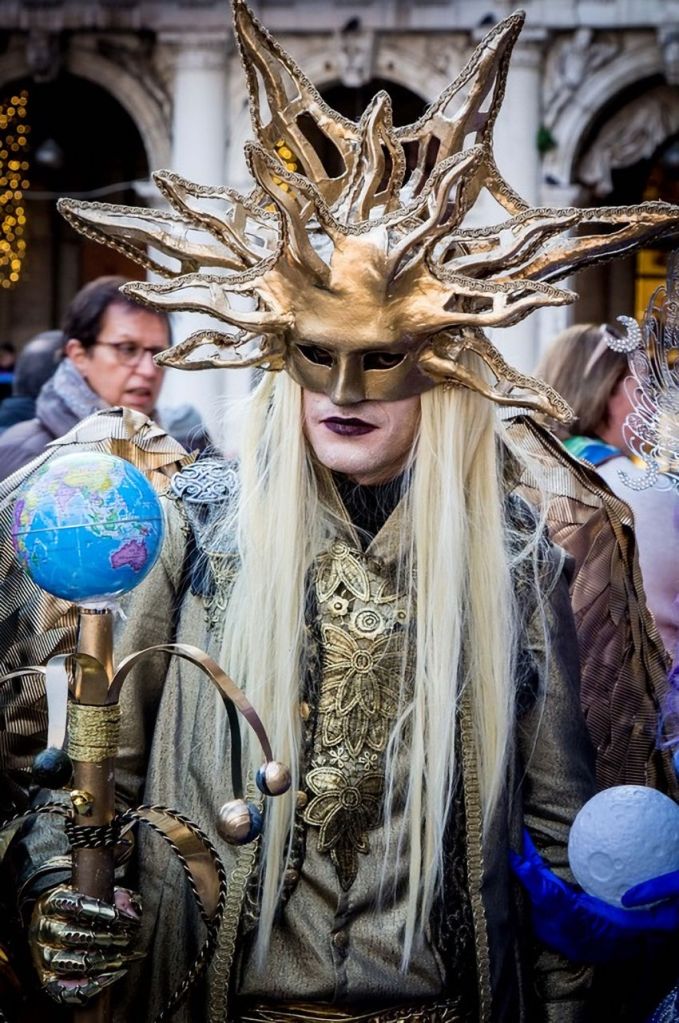
The Carnival in Venice is one of the oldest celebrations, featuring elaborate costumes made from lavish fabrics, porcelain masks, and gold leaf accents. This beautiful purple and gold costume has an air of royalty about it. It’s incredibly detailed and is a feast for the eyes.
A great mask is the key to these celebrations. As with Halloween, masks invite the wearers to step out of their comfort zones. When the parties are over, masks become beautiful wall art, decorated with feathers, rhinestones, braided trim, and hand applied designs.
The bold feathers and black trim on this half mask focus the viewer’s attention upon the eyes of the wearer, drawing you in to discover more.
The sheer volume of taupe feathers creates an impressive headdress, accented by the delicate gold lace and embossed details. From a distance this appears to be a half mask, but upon closer inspection, it’s actually a full-face porcelain mask, and the lips have been painted a complementary shade of gold.
Venetian masks are among the most ornate. While meant to be worn, many have become prized collector’s items in the world of art.
If you’re going to wear a mask, why not make a costume to go with it? And don’t forget to accessorize! As an extravagant touch of luxury, many Venetian masks are decorated with genuine gold leaf.
This bride & groom have gone above and beyond in honoring their wedding vows –“Til death do us part…” (lol)
Wearing a full-face mask can get a little uncomfortable. Having a coordinating half mask, as a back up, is a great idea.
This beautiful jester mask is a crafter’s dream, incorporating beading, painting, fabric, braided trim, glitter, and decoupage.
Half masks are readily available and comfortable to wear without the need for special makeup or accessories. They also happen to be very easy to decorate yourself. For step-by-step instructions, please read a previous post, “Who’s Behind the Mask?”
Carnival just might be the adult equivalent of recess on the playground – Come outside and play! Make new friends. Have the time of your life and let’s do it all again next year!
Happy Carnival, Happy Mardi Gras and Happy Crafting!