Before we begin this Easter-themed project, we’ll need a little inspiration. Let’s take a look at a few of Mother Nature’s color scheme choices in the adorable bunny photos below:

Baby bunnies are just so cute! That’s a lot of love wrapped in a soft tan and cream coat.

This stylish rabbit is modeling the very popular gray and white color combo.

Wild rabbits often have a blended fur coat of brown, tan and black to help camouflage them from predators. The one pictured above looks perfectly content to nap where he is without a care in the world.

Last but not least is this precious black and white baby. His delicate features, including his button nose, inner ears and the outline of his eyes, are a soft pink.
Now that we’ve seen a few ideas, let’s get started painting!
How to Paint a Wooden Rabbit:

Thick wood has been cut out in the shape of a rabbit and has the advantage of strong, rectangular base. Both sides and all the edges will need to be painted. Due to the raw nature of the wood, it may require a little sanding, especially along the edges.

Supplies:
Wooden Rabbit (17” high x 8” wide x 1/4” thick) (Base is 5-3/4” wide x 4”deep)
Acrylic Paints – brown, black, gray, tan, green & white
Fan paintbrush, small detail paintbrush and thicker brush for base coats
Sandpaper
Optional: Fabric paints – black, brown, white (Refer to Advanced section below)

Step 1 – Paint the rabbit with 2) coats of white acrylic paint, including both sides and all edges.

Step 2 – Start painting the fur on the back. Experiment with colors and brush techniques. I poured black, brown and gray paint onto an artist’s palette. Dip a fan brush into each color and then apply to wood surface to create a fur-like effect. Because the paints have not been mixed, each new brush stroke will have a slightly different combination of colors, just like real fur. Repeat thus process until the back is completed. The white tail will be added later.

Step 3 – On the front, draw the face (eyes, eyelids, eyelashes, muzzle with nose, mouth, whiskers), ears and feet with a pencil. Paint the inside of the ears and eyelids tan.

Step 4 – Create the fur by repeating the procedures in Step 2. Be sure to make long brush strokes along the edges of the ears to resemble thick fur. You can leave the eyes, muzzle, and feet white for now. These areas will be detailed in the next step.

Step 5 – Paint the facial details. I painted the eyes, eyelashes, nose, mouth and whiskers black.

Step 5A – This is an alternate version for the eyes and nose. A brown iris has been added to each eye, the eyelashes have been extended, and brown nostrils define the nose. For a more lively expression, don’t forget to put a dot of white in the pupil of each eye.

Step 6 – The finished rabbit has white feet with black lines to define the toes. The base was painted with two coats of green.

Step 7 – Paint a big, white fluffy tail on the back.
At this point your project is finished and ready to display. If you would like to take this design to the next level, please follow the steps below.
Advanced Rabbit in 3D
Followers of this blog know how much I love creating 3D details on wood projects using fabric paints. If you appreciate three-dimensional effects, this section is for you! Unless otherwise noted, all paints listed below are dimensional fabric paints.

Start by painting 2 thick coats of white fabric paint on the muzzle, and brown paint for the eyes.

Next paint the feet with 2 thick coats of white paint.

To complete the face, use black paint for the nose, mouth, whiskers, eyelashes, and the outline around the eyes. Add a black pupil in each eye. Paint a white dot in the center of each pupil, and use brown paint in each nostril.

Add long brown fur along the inner edges of both ears and define the two front legs using the same paint. Add the black lines to define the toes on each foot.

Using short strokes, bring the black and brown fur mixture up into the face.

Layer additional black and brown fur to define the body, and add the two back feet.

Because the rear legs are in the background, keep the paint lighter by using tiny strokes with just the brown paint in an upward direction. If you want additional fur texture, you could use acrylic paints and a brush to thicken the fur coat with highlights and lowlights.

The last step is painting the tail with 3 coats of white fabric paint.
Mission accomplished! This cute little guy is ready to be displayed in your home, bringing joy to your life for years to come.
Happy Easter and Happy Crafting!
















 It’s hard to believe we are in the month of October already. Thoughts of my favorite time of the year, Halloween, come to mind. I suppose I’m just a big kid at heart. Dressing up was so much fun. Deciding what to be for Halloween was a major accomplishment. Sometimes the costume was store bought (e.g. Snow White, Peter Pan), while other times we made our own (e.g. Gypsy, Witch).
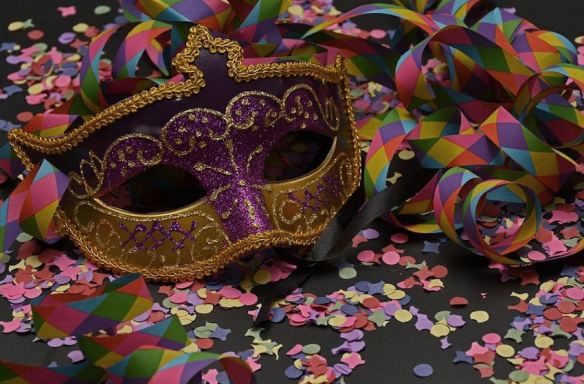 All you really need is a great mask. Craft stores sell a variety of white masks to decorate any way you please. In terms of comfort, the quarter masks are an easy solution, as opposed to latex masks, sold in Halloween stores, which can be very hot to wear.
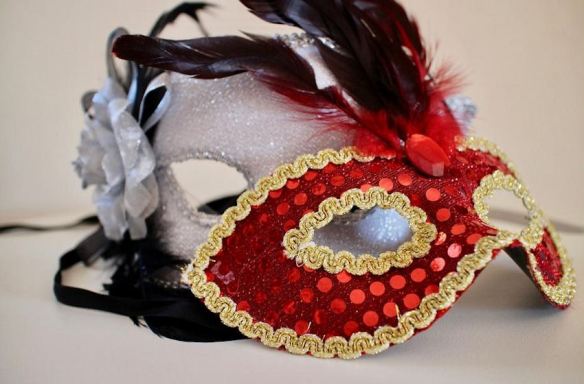 Masks can be decorated with a particular theme in mind or for holiday celebrations, such as Carnival, Mardi Gras, New Year’s Eve, and the Chinese New Year. Each finished mask is a beautiful work of wearable art.
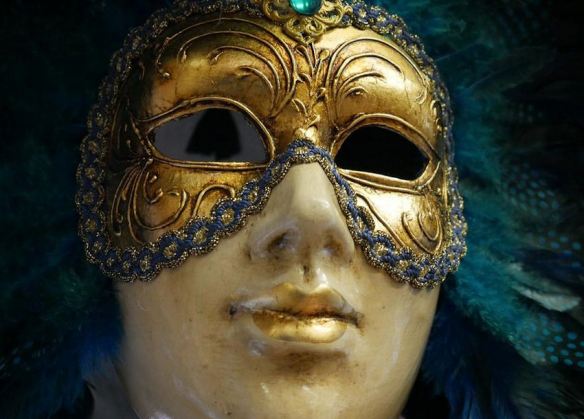 I look at this mask and think of Aqua Man, the Marvel Comic’s super hero. It is also reminiscent of the Philadelphia Mummer’s Parade. The rich details and vibrant colors are real showstoppers.
 This mask has a devilish quality about it. Practical jokes are sure to follow.
 Musical notes and gold braided trim adorn these fanciful masks.
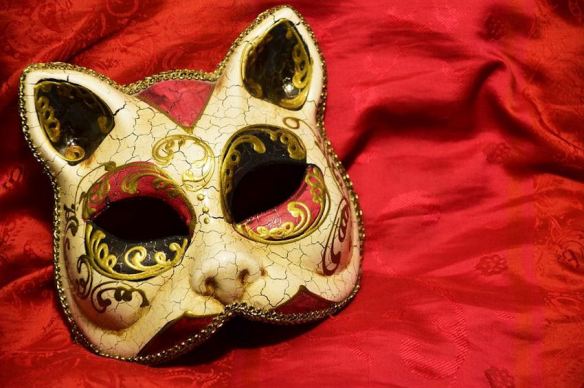 Perky ears and delicate patterns make this mask a favorite among cat lovers.
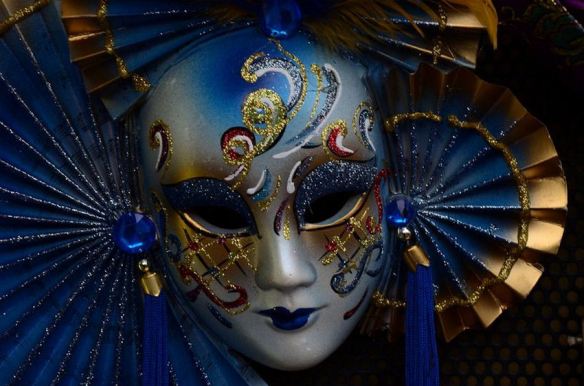 A lovely combination of two arts – mask making and fan decorating.
 This assortment of masks is ready to be worn in celebration or displayed as artwork and party decor.
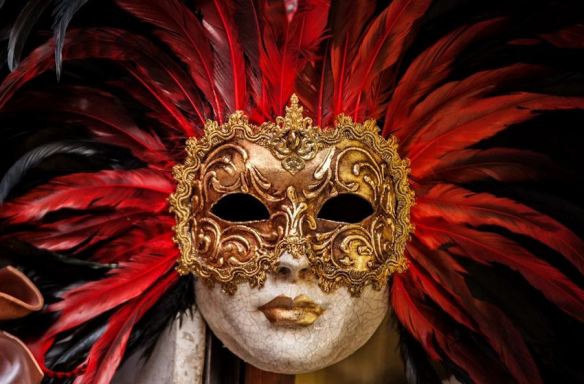
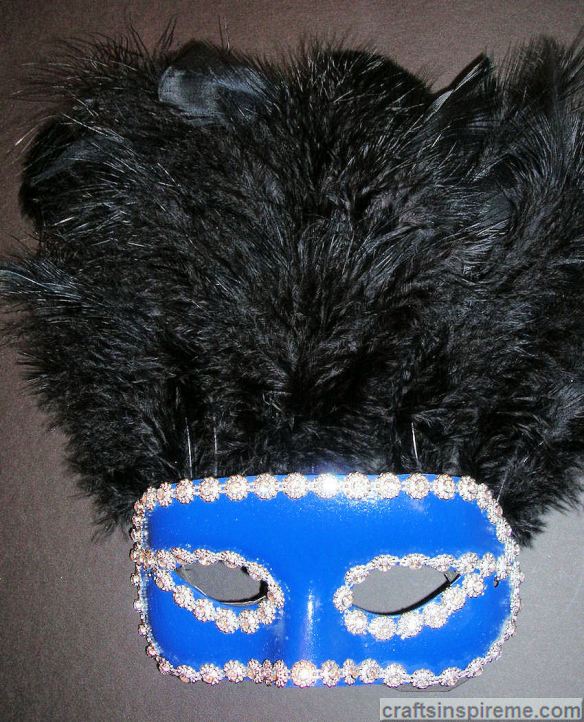
 Feathered masks tend to be the most flamboyant.
 The visual impact of this red, black and gold mask is enhanced with light catching glitter and thick gold trim. A few faux gemstones are the perfect finishing touch.
 Masks made to celebrate the Carnival of Venice are among the most elaborately decorated with lavish brocade fabrics, ribbons, crystals, intricately hand painted designs, and touches of gold or silver leaf. This centuries old technique has influenced artists world wide, and is highly valued among collectors.
 Most craft stores have several style options. Because this was a first attempt at decorating a mask, this simple white quarter mask was chosen.


























 Crafts Inspire Me