Flower Power

Multicolor Flowers

Arranging flowers is like painting a masterpiece.  Instead of paints on canvas, you place fresh-cut or silk flowers and leaves in a vase, bottle, or bowl.  Before you begin, you have some decisions to make.  What colors will choose?  How will you create visual interest?  Do you prefer balanced or abstract designs?  What will be your focal point(s)?  Do you have a container in mind?  Would you like to include a few accents, such as berries, or butterflies?  Feel overwhelmed?  Below are several pointers on flower arranging to help you get started. 

Complementary Colors:

Orange & Blue
Complements Orange & Blue

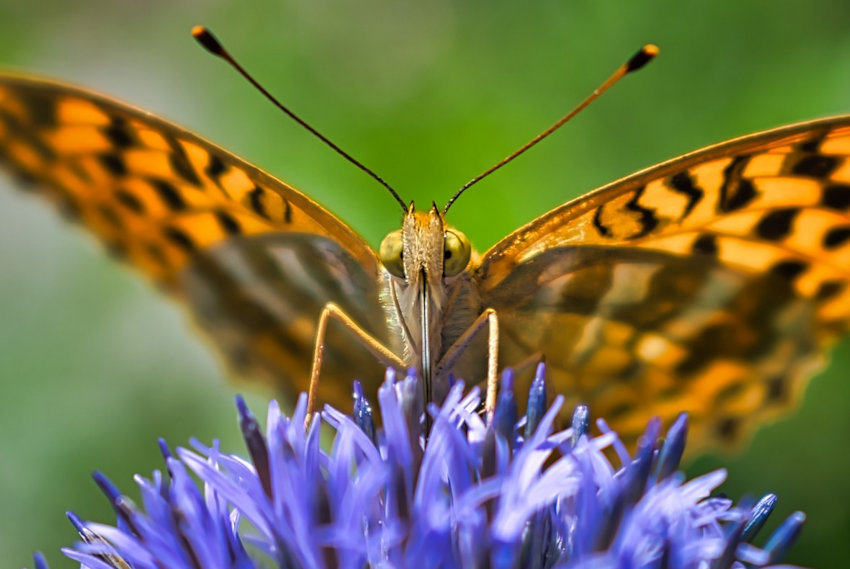
Complementary colors provide maximum contrast.  They say opposites attract.  Maybe that is why this orange butterfly found a blue flower irresistible. 

Yellow & Purple
Complements Purple & Yellow

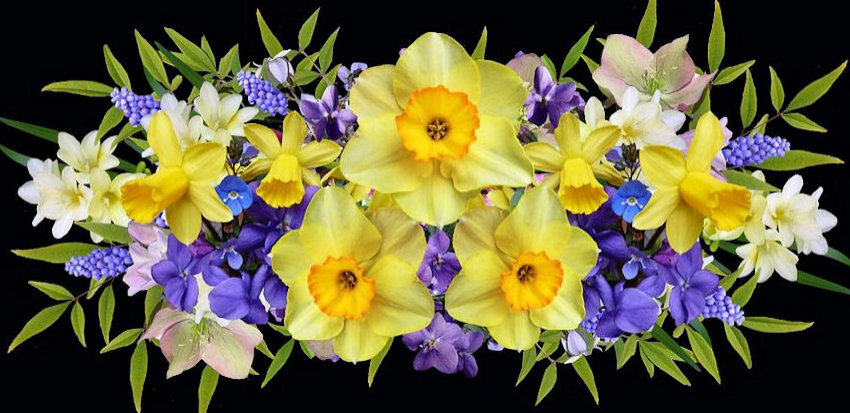
Yellow shines brilliantly alongside its complement, purple.  This combination is associated with spring as well as Easter. 

Red & Green

Complements Red & Green

Red immediately grabs your attention.  Set against green it really pops.  Although red and green are hallmarks of Christmas, they are perfect any time of year, especially with other accent colors, as shown in the above photo. 

Exotic Focal Points:

Bird of Paradise
Exotic Bird of Paradise

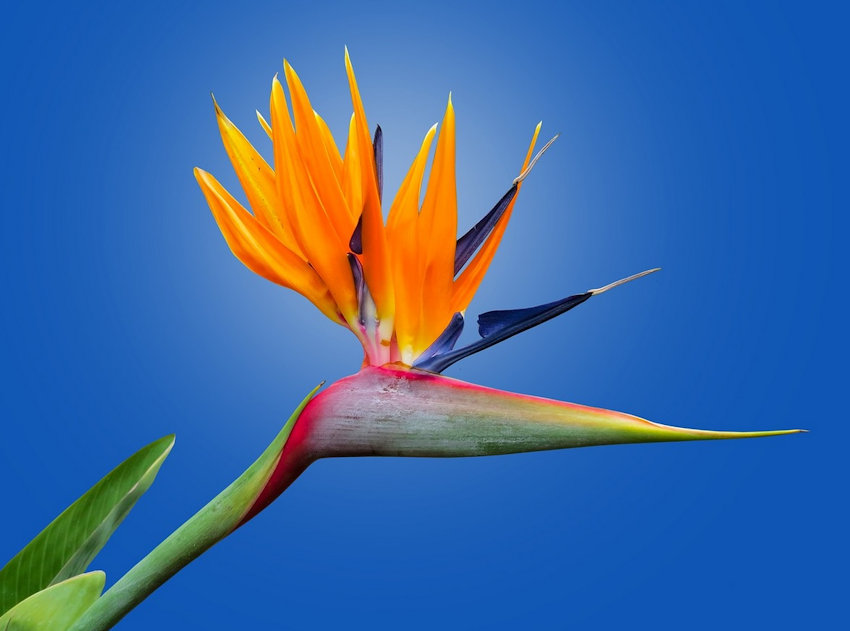
While you are selecting flowers for a new arrangement, consider your focal point(s).  A few exotic flowers bring bold colors, shapes, and textures to your design. 

Dahlias

Exotic Dahlias

Dahlias offer amazing variety.  Check out the gorgeous pink and white dahlia in this photo.  Many people believe the ombre-effect was manmade, but Mother Nature thought of it first. 

Hibiscus

Exotic Hibiscus

Although hibiscus is a readily available flower, the rich, blended colors and delicate details appear to be hand-painted by Mother Nature. 

Monochromatic:

Pinks

Monochrome Pink

Monochromatic designs do not have to be boring.  Choose a variety of flowers in shades of your chosen color and arrange them in a visually pleasing way. 

Purples
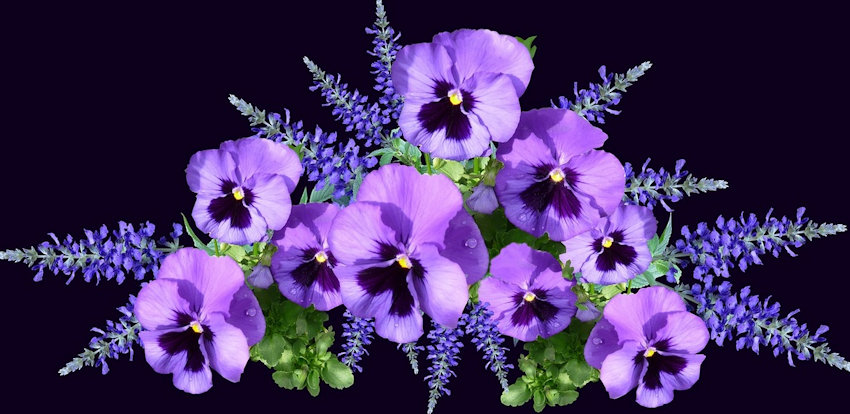
Monochrome Purple

Dramatic contrasts in color as well as shape are the keys to this arrangement. 

Multicolor:

Tulips

Mulicolor Tulips

Jewel-tone tulips stand on their own as an easy and attractive centerpiece.

Assorted Flowers
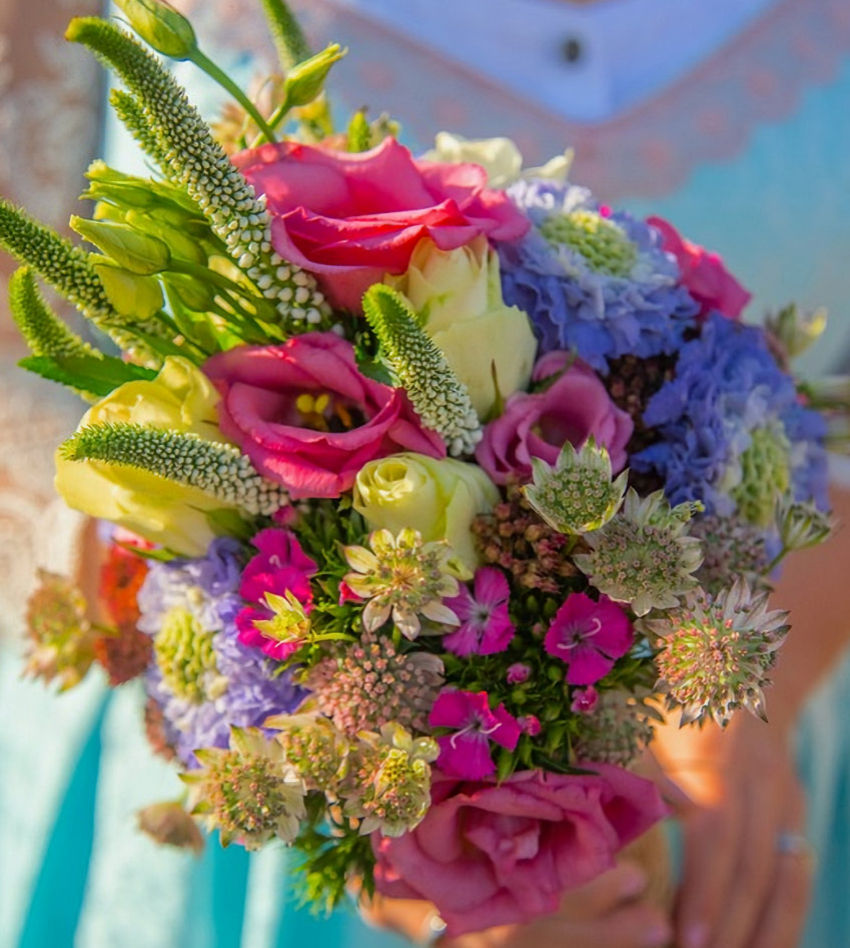
Multicolor Flowers

Pastel colors and small-scale blooms blend harmoniously in this lovely springtime bouquet. 

Floral Design Balance:

Symmetry

Symmetry Asymetry Heart

This arrangement has elements of symmetry and asymmetry.  The heart shape and three roses are symmetrically balanced, while the assorted perimeter flowers are asymmetrical and yet still fit within the overall heart shape. 

Asymmetry
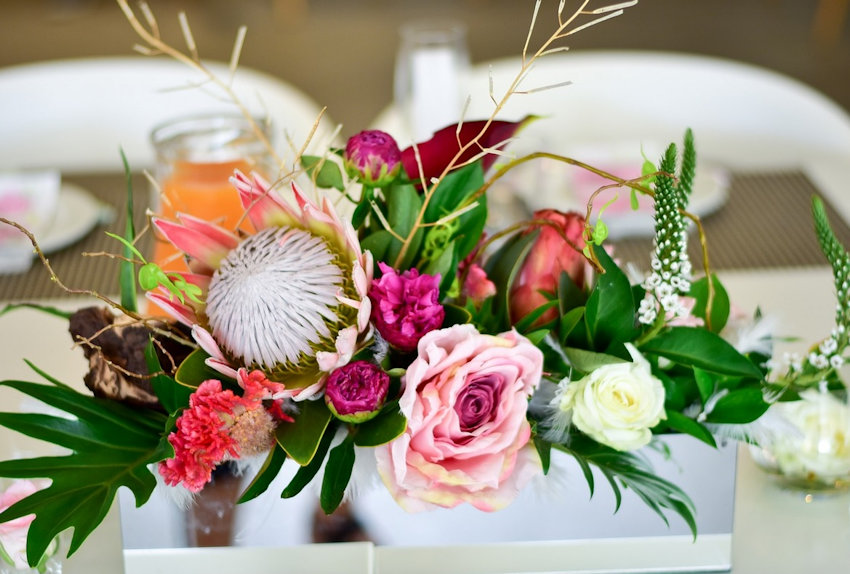
Asymmetry

This asymmetrical centerpiece is an abstract art lover’s dream. 

Floral Accessories:

Cute Critters

Accessorize Birds & Flowers

You might want to include a few well-chosen characters to adorn your floral creations, including birds, butterflies, ladybugs, geckos, and fairies. 

Bouquet Holder

Accessorize Heart Bouquet

Give a floral bouquet an upgrade with a special themed holder, such as this heart for Valentine’s Day, which can be paired with a vase, and reused for years to come. 

Ribbons & Twigs

Accessorize Ribbon Sticks

The bright yellow daffodils contrast well with purple ribbon, woven with other blooms upon a twig base.  In autumn, pinecones, and berries are attractive additions. 

Floral Display Containers:

And the Envelope-Please

Accessorize Ribbon Sticks

Flowers look beautiful no matter how you choose to display them.  For the cute arrangement above, you need to “think inside the box!”  An envelope-shaped box is a sweet surprise and wonderful conversation starter. 

Martini Glass

Container Martini Glass

A new use for an old friend – this martini glass, with an extra-long stem, is a great idea for providing floral beauty, while still enabling guests to see each other across the table. 

Old Fashioned Ceramic Jar
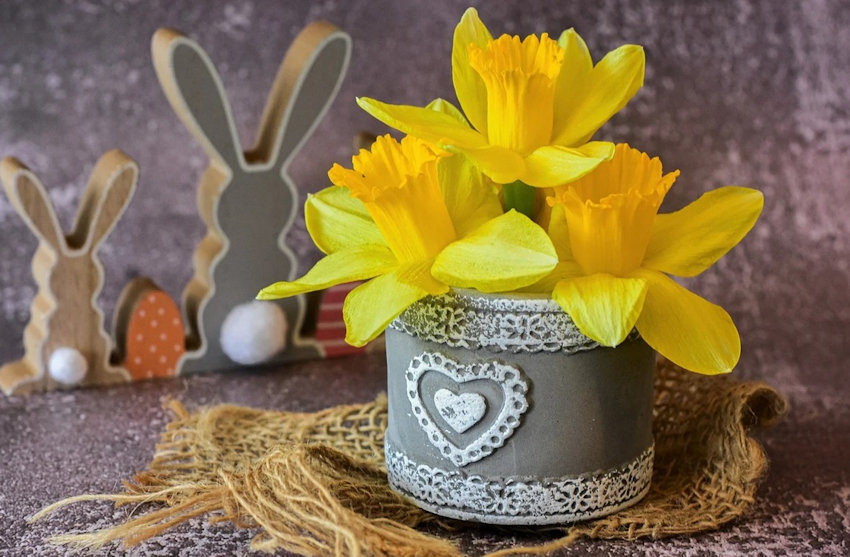
Container Simplicity

For country chic, choose the simplicity of a ceramic jar filled with a few fresh cut blooms.

Water Bowl

Container Bali Floating Flowers

Who needs a vase when you have a water bowl?  A floating mandala design sets a relaxing tone.  If you are having a party, each table could have a unique floating centerpiece to show off your creativity. 

Floral Design Influences:

Religious

Bali Design

This Balinese flower offering exhibits many of the design principles discussed in this post including symmetry, focal point, all six complementary colors, multicolor flowers, and a unique flat design display.  A large outdoor table, in a shaded area, offers a great opportunity for a flat floral centerpiece. 

Cultural (Before & After)

Tropical Rain Forest Before&After

Tropical flowers grow in abundance in Hawaii and are an integral part of their cultural history and traditions.  This beautiful arrangement has a nice selection of exotic flowers, but two elements throw off this design: 1) The red roses do not belong in a tropical arrangement.  2) The metallic silver vase is too contemporary.  To fix it, add more red ginger and anthuriums, and use a Hawaiian drum to conceal the vase, unifying this Polynesian theme. 

Architectural

Architectural Floral Design

A large interior space requires an equally strong floral display, and this one meets that challenge.  These organ pipes have strong vertical lines, multiple levels, sculptural scrolls, and decorative arches, which are echoed in the grooved, scalloped urn, tiered flowers, curled leaves, and bell-shaped flowers.  High contrast of complementary colors can be found in the purple flowers with bold yellow centers, and the blue flowers against the tall orange-red stalks.  Exotic lilies serve as focal points, drawing the eye in toward the rich lush greens and purples and pulling your attention upward, much like the heavenly organ music floating upon the air. 

Sculptural
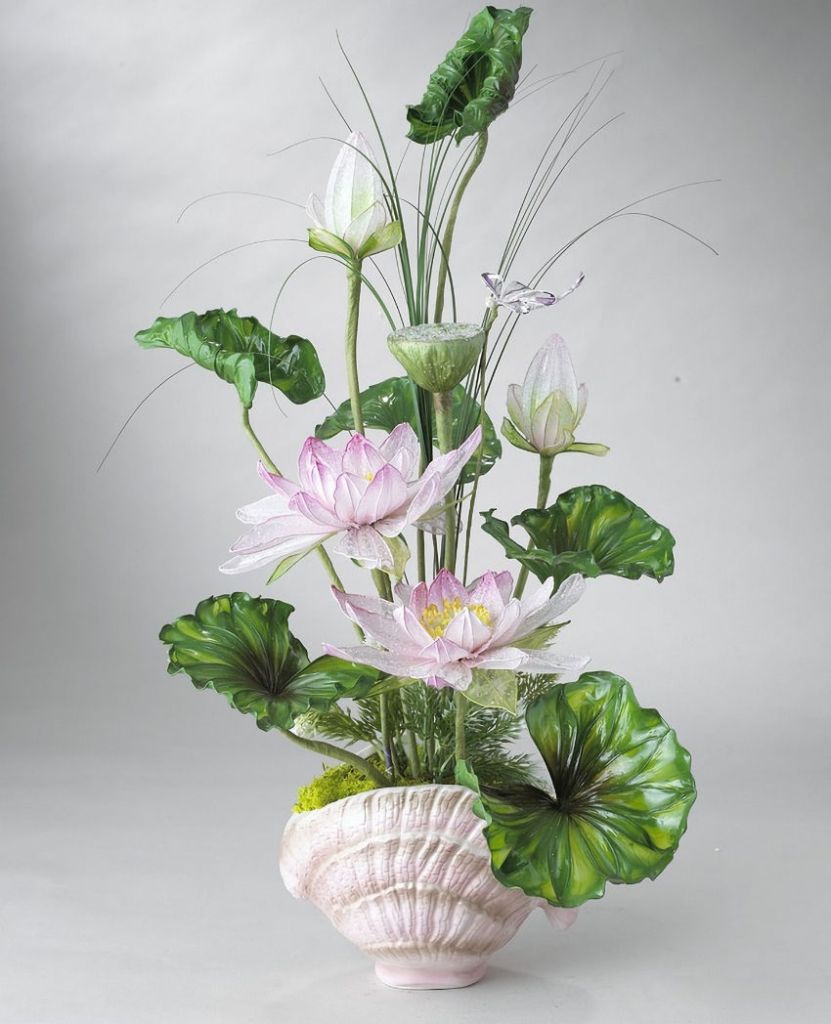
Sculptural Floral Design

Seashells and lotus blossoms automatically make you think of water.  Beginning at the top, invisible water flows diagonally, from leaf to leaf, making its way back and forth across the arrangement until it reaches the bottom, only to begin the journey anew.  Textures in the seashell are repeated in the leaves.  Whether you spend the day at a pampering spa or have a luxurious soak in the bathtub at home, this soft color palette and gentle flowing movement soothes away your cares bringing peaceful relaxation to body and mind. 

Take your time finding inspiration, developing ideas, and planning your design.  Choosing flowers and creating a unique floral display will shine with your artistic flair.  Enjoy the process and best of luck! 

Thanks for Reading & Happy Crafting!
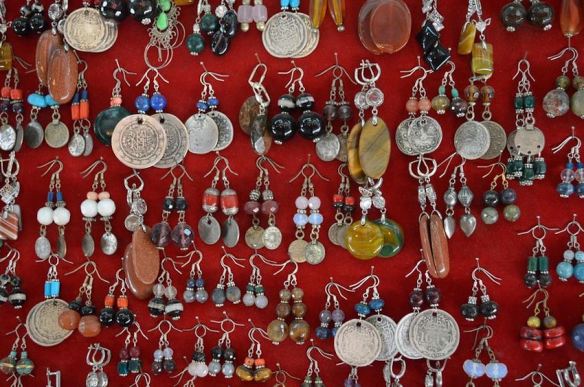
Want to Make Beaded Earrings?

Assorted Earrings
Making fine jewelry requires years of special training in gemstones, precious metals, and jewelry design. Materials and tools are very expensive, and mistakes can be very costly. The invention of beaded jewelry created beautiful designs in a much more affordable way, and put the jewelry making possibilities into everyone’s hands. If you’ve ever wondered how to make a piece of jewelry, now is your chance.

How to Make Black Onyx & Tigerseye Earrings
Tigerseye Black Onyx Earrings
These 2” long gemstone earrings are fashionable and easy to make.

Required Beads & Findings:
Earring Supplies
Supplies:
To make this pair of earrings you will need:
2) Silver plated Head Pins – 2” length,
2) 8.5mm Granulated Round Pewter Rondelles,
2) 8mm Tigerseye beads,
2) 10mm Black Onyx beads,
2) Silver plated Round 4mm Spacer beads
2) Silver plated Surgical Steel Fishhook Earwires with ball & coil

(Please note: Head pins are the foundation of these earrings. They are inexpensive and come in big packages. Be sure to have several on hand just in case. Craft stores carry jewelry making supplies, including beads, accents, and tools. If you get hooked on jewelry making and yearn for the ultimate selections, look no further than FireMountainGems.com)

Jewelry Making Tools:
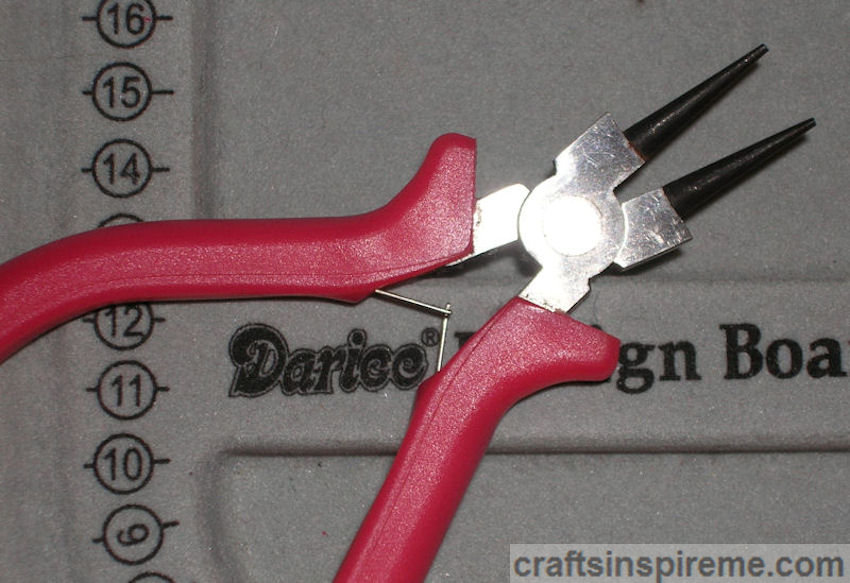
Round Nose Pliers
Round Nose Pliers – the smooth, round tips on these pliers make it easy and safe to manipulate wire, pins, and small jewelry metal pieces known as findings. Please don’t use standard pliers, which have teeth that will damage delicate precious metals.

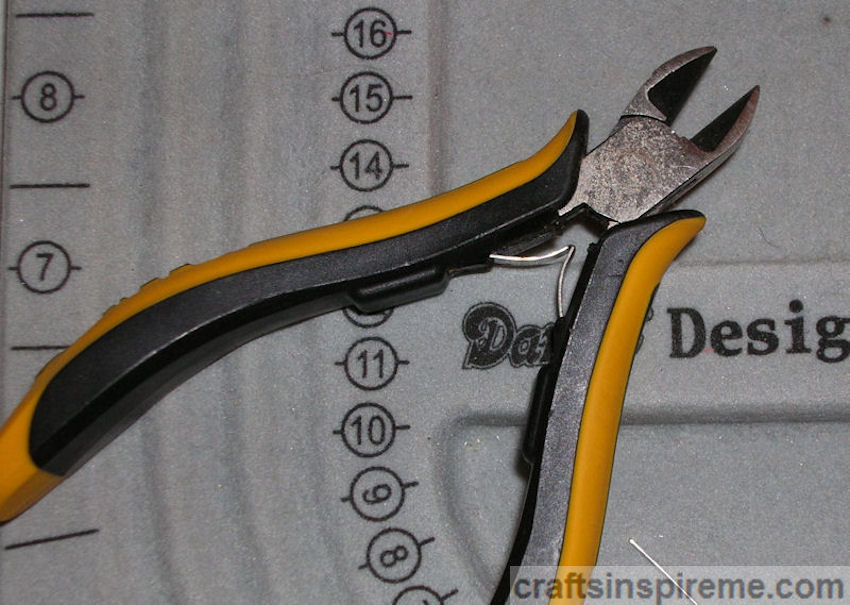
Jewelry Wire Cutters
Jewelry Wire Cutters – a sharp pair of wire cutters makes jewelry making so much easier. Do not use them for other crafts, such as floral arranging, which can damage the blades.

Earring Making Instructions:

Bead Layout
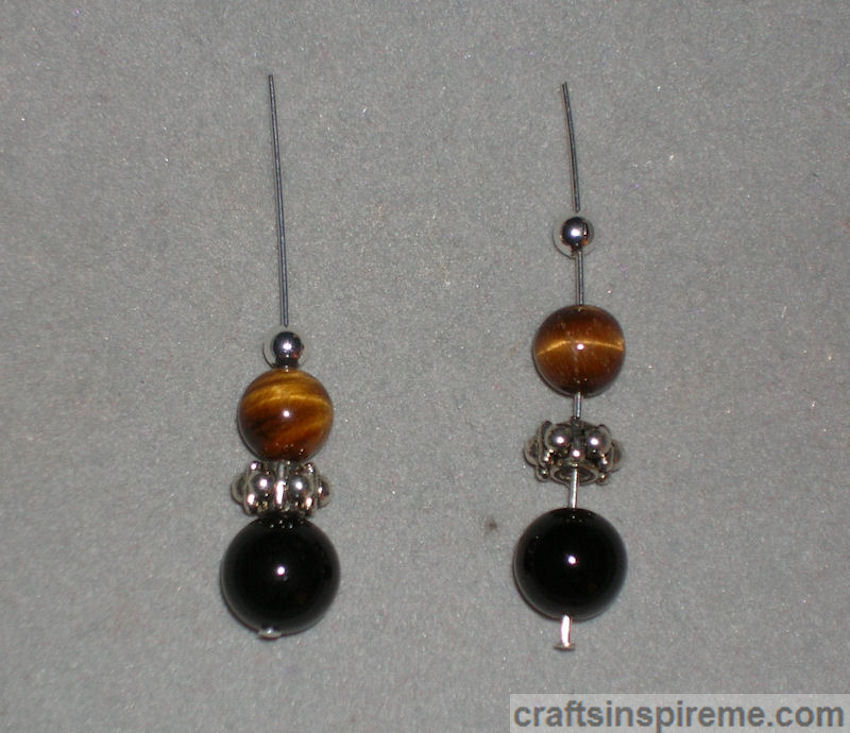
Step 1: Stack the beads in sequence on the head pin as shown. This is the dangle part of the earring.

Grip with Pliers
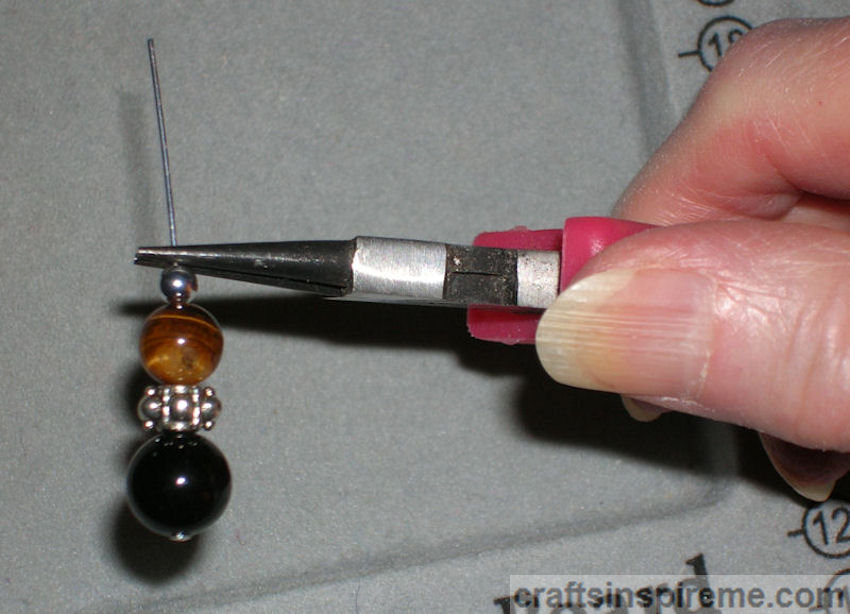
Step 2: With the round nose pliers in your right hand, grip the wire just above the top silver bead. Be sure the beads are close together with no gaps in between. Hold the pliers in this position for the next step.

Grasp Wire with Fingers
Step 3: Grasp the end of the head pin with your left thumb and index finger, and bend the wire toward you.

Bend Wire
Continue bending the pin over the tip of the pliers until it touches the Black Onyx bead.

Reshaped Wire
The reshaped pin will look like the photo above.

Trim Excess Wire
Step 4: Cut off the excess wire. Leave enough wire to form a small loop above the silver bead. This may take a few tries. Don’t worry if you cut it too short. Simply use a new head pin and repeat the steps.

Shortened Wire
This photo shows the trimmed wire, and beside it is the scrap piece to be thrown away.

Attach Earwire
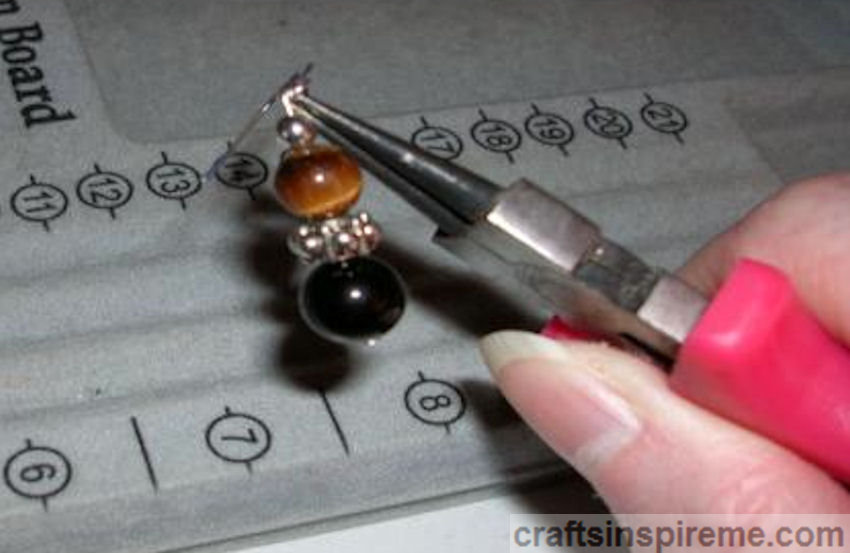
Step 5: Hook the dangle earring onto the loop on the bottom of the fishhook earwire,

Loop Closeup
and close the loop using the round nose pliers.

Finished Earrings
Congratulations! You have successfully made your first pair of earrings.

These skills can be used to create many styles, which at first may appear to be complex, but are actually fairly easy when broken down into basic steps. Let’s take a look at a few examples below.

Blue Earrings
Blue Bead & Pearl Earrings– If you look closely, you’ll notice the same elements we talked about before: head pins, stacked beads, and earwires. The choice of silver earwires and accents with faceted blue crystals and Mother of Pearl creates a cool, summery vibe. This pair of earrings utilizes a different type of earwire known as lever backs, which prevent the earring from falling off – no more lost earrings!

Fossil Earrings
Fossil Earrings – The natural spiral design and intricate details of these fossils make great focal points for these earrings. You can purchase charms and pendants such as these and simply attach earwires to the provided loops on top. How easy is that?

Triangle Earrings
Triangle Earrings – These earrings are a simple progression from the fossil earrings above. The triangles are merely charms. Head pins, which are available in many lengths, are the keys to this design. Attach the three beads on the bottom of each triangle using pliers. The yellow beads are also attached with head pins. Cut the head off a pin, and use the pliers to make a loop above and below the yellow bead and then attach to the triangle on the bottom and to the earwire on the top.

Jasper& Pearl Earrings
Jasper & Pearl Earrings – Gemstones come in an amazing array of colors and shapes. The accent beads can be mixed and matched in infinite combinations. Experiment by laying out the beads to test your options. The nice thing about earrings is that you can place the beads on a pin and hold them up to your ear to see how they look, with no commitment whatsoever. Don’t like what you see? Try another combo.

Jewelry making is a fun, creative hobby. Best of all you get to wear and share your creations with your family and friends. For more information on beaded jewelry, please read “Designing Beaded Jewelry.”

Thanks for Reading & Happy Crafting!

Alpacas versus Ewoks

Alpaca & Ewok

On a scale of 1-10, who is the cutest – an Alpaca or an Ewok? 

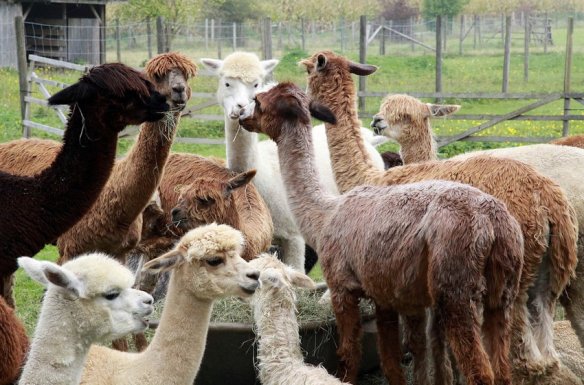
Multicolor Alpacas

My apologies to all the Star Wars fans, but this week our craft project is all about Alpacas. 

Baby Alpaca

This baby alpaca looks so soft and cuddly like a stuffed animal. 

Adult Alpaca

Adults have long shaggy fur, which is used to make yarn for blankets, sweaters and other garments. 

White Alpaca

Some have monochromatic fur, such as the one pictured above. 

Brown & White Alpaca

Alpaca fur tends to be thick and plush in a variety of shades and a few fashion-forward combinations.  Whatever your preferences, you can’t go wrong applying those creative choices to this fun project. 

How to Paint a Wooden Alpaca:

Raw Wood Alpaca

Alpaca Raw Wood

Thick wood has been cut out in the shape of an alpaca.  Both sides and all the edges will need to be painted.  Due to the raw nature of the wood, it may require a little sanding, especially along the edges. 

Supplies

Alpaca Paints
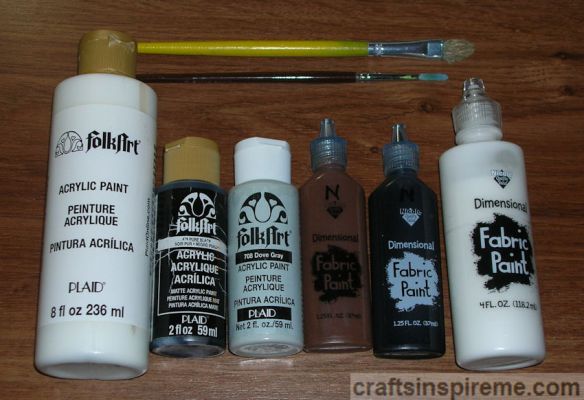
  • Supplies:
    Wooden Alpaca (6-1/4” high x 4-1/2” wide x 1-1/2” thick)
    Acrylic Paints – gray, white, black
    Bottles Fabric Paint – brown, white, black
    Paintbrushes
    Sandpaper
    Black Sharpie Marker or pencil

Paint Base Color

Alpaca Gray Paint

Using acrylic gray paint and a brush, paint both sides of the body and all the edges. 

Paint Accent Colors & Draw Eye Detail

Alpaca Gray & White Paint

Apply white acrylic paint with a brush on the head, neck, lower legs and tail.  With a pencil or marker, draw the eyes. 

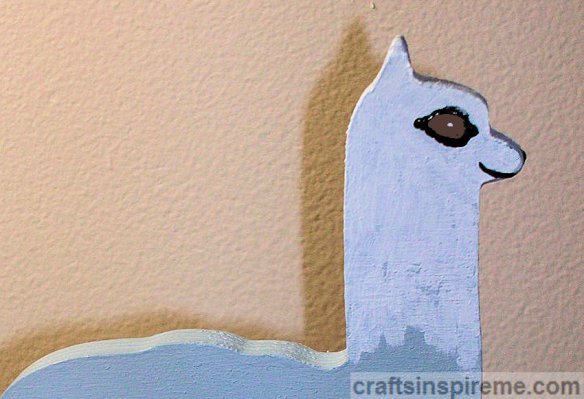
Define Facial Details

Alpaca Facial Details Painted

Using a combination of acrylic and fabric paints, add the eyes, nose and mouth. 

Textured Fur Detail

3D Paint Leg Fur Detail

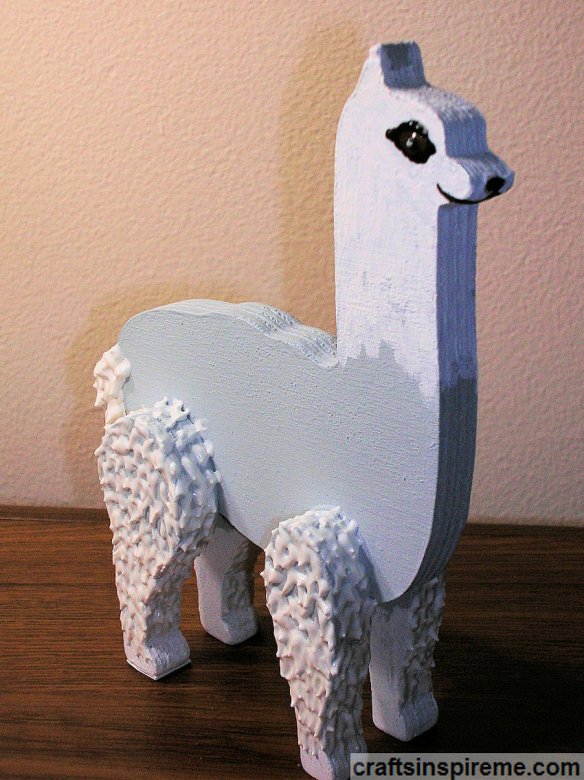
Creating thick, three-dimensional fur is easy with fabric paint.  You must start at the BOTTOM and work your way up using short downward strokes.  Keep the placement and stroke size random, layering new fur over the previous sections as you work your way to the top.  Allow the paint to dry overnight because it shrinks as it dries.  Repeat this process until you achieve the desired appearance. 

Paint White Textured Fur

3D Paint Fur Legs & Tail

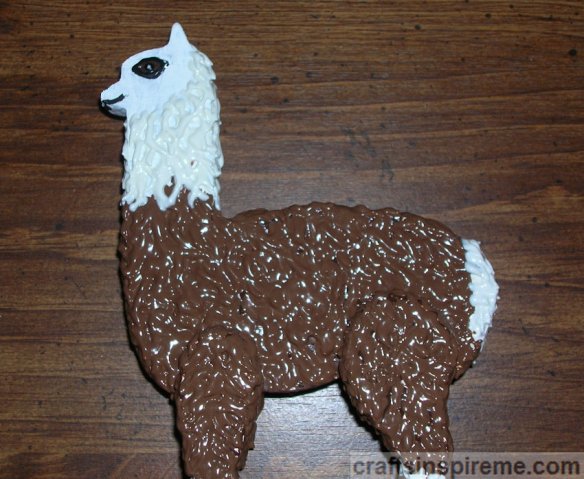
This photo shows the completed white fur on the legs and tail.  Repeat this process on the other side. 

Note: To achieve a very thick fur coat, you may need several bottles of fabric paint. 

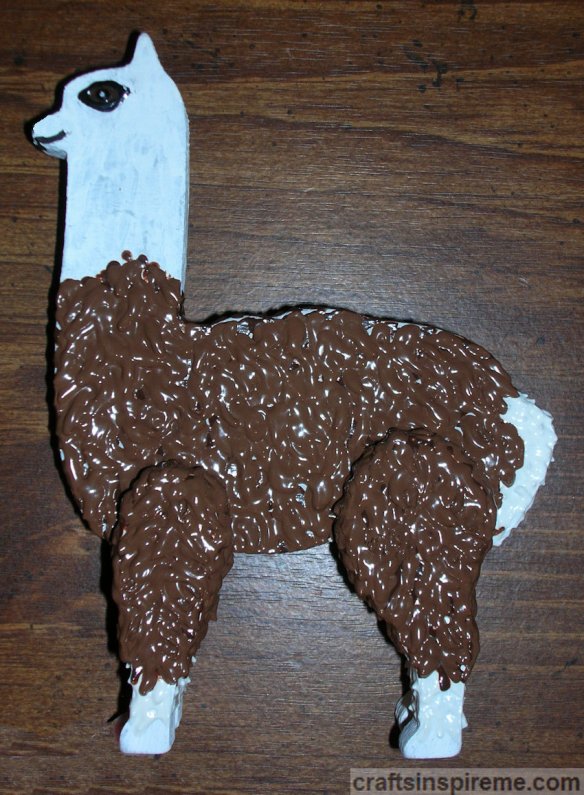
Paint Brown Textured Fur

3D Paint Fur Torso

Apply brown fabric paint on the torso, and upper legs, using the same textured process described above. 

Paint Additional Layers of Textured Fur

3D Paint Fur Layers Torso

Repeat the painted fur process as many times as needed to create a thick fur coat. 

Paint White Textured Fur

3D Paint Fur Neck

Once again using the white fabric paint, start creating the fur at the bottom of the neck and work upward. 

Paint Additional Layers of White Textured Fur

3D Paint Fur Neck & Tail

Repeat the process to achieve desired thickness.  Remember to thoroughly cover the edges too.  You may also want to add more fur on the tail as well for a bushy effect.  Allow time for the paint to dry between coats so that you can see which areas need more work. 

Finished Alpaca

Finished Alpaca

Congratulations!  You are now the proud parent of an adorable alpaca! 

Finished Details

Finished Alpaca Details

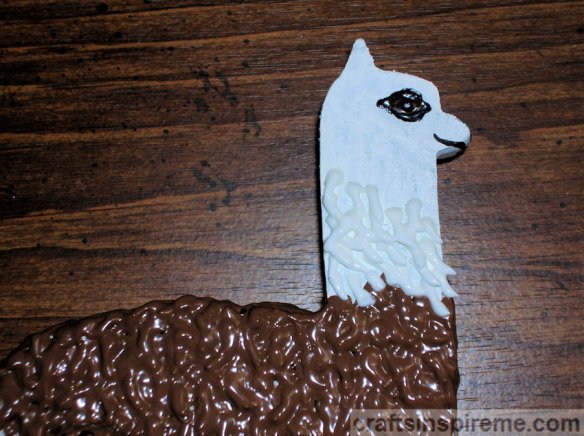
As you can see in this photo, the fur continues up over the top of the head, including bangs on forehead. 

Alpaca – Before & After

Alpaca Before & After2

We started with a plain wood figure, and with little effort and patience during drying times, this cute alpaca is ready to adorn your home or be given as a gift.  Either way, smiles are sure to follow. 

Thanks for Reading & Happy Crafting!
Color Selection 101

Artist's Paint Palette
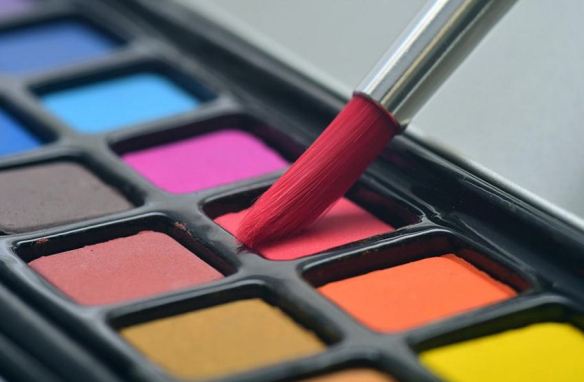
Choosing colors is one of the most difficult parts of any project. Fortunately the ultimate artist, Mother Nature, has already done most of the work for us. Below are assorted nature photos to inspire your exploration of the infinite possibilities of color.

The Color Wheel
Color Wheel
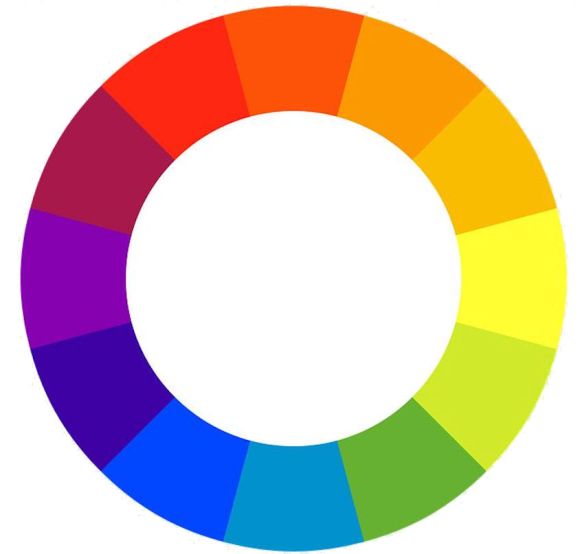
A Color Wheel – all the colors of the visible spectrum, that is, visible to the human eye.

Primary Colors
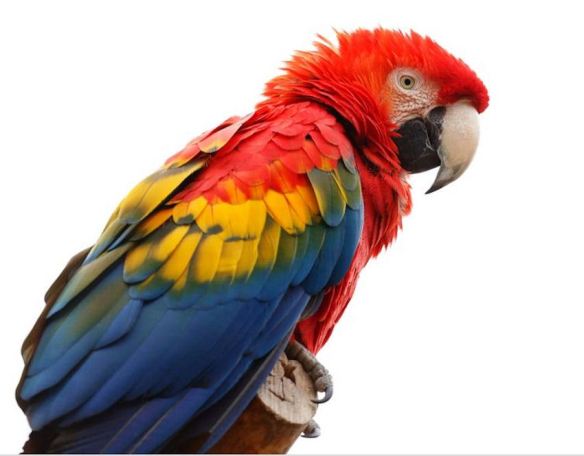
Primary Colors - Parrot
Primary Colors: Red, Blue, & Yellow – base colors found in nature.

Secondary Colors
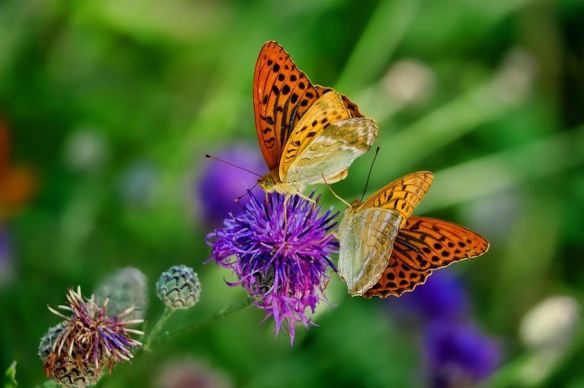
Secondary Colors-Butterflies
Secondary Colors: Green, Orange, & Purple – colors made by mixing two primary colors together.

Black & White
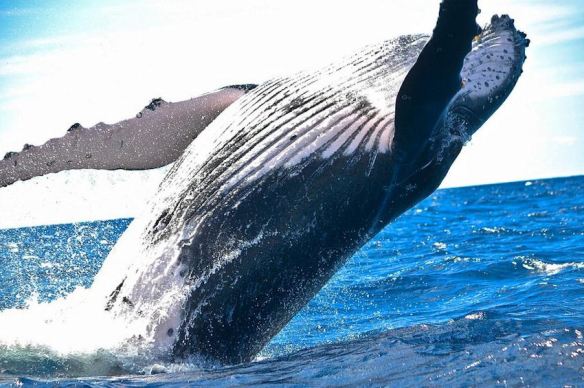
Black & White - Whale
White & Black – produce shades of color from light to dark. Black and white is a classic combo often used in the textile and interior design industries. Turn the ordinary to extraordinary by adding brilliant jewel tone colors, such as sapphire blue, emerald green or ruby red.

Complementary Colors
Complementary Colors: Opposites on the color wheel (red & green; purple & yellow; blue & orange). When used together, they produce the highest contrasts.

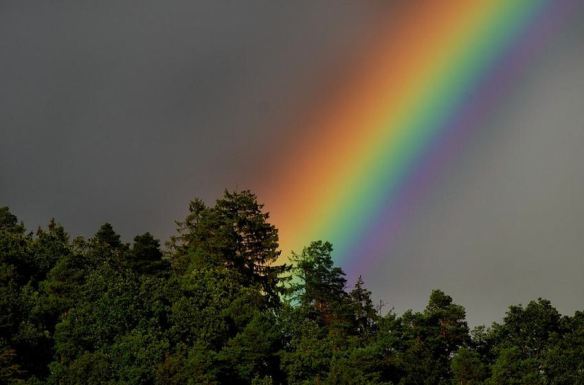
Rainbow
Rainbow
All the colors of the spectrum – Red, Orange, Yellow, Green, Blue & Violet – in that exact order can be seen in this rainbow. If you want to create a realistic rainbow effect, be sure to get the color order correct.

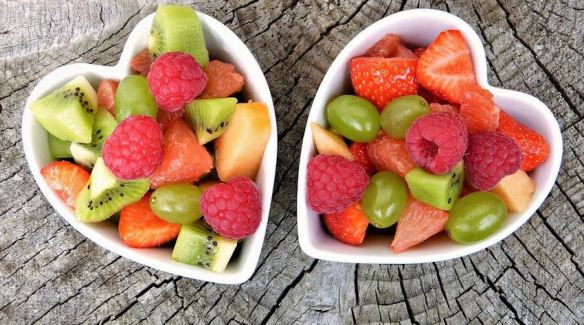
Fresh Picked Fruit
Fresh Picked Fruit
Pastel Red, Green, Fuchsia & Orange – These are great spring and summer colors.

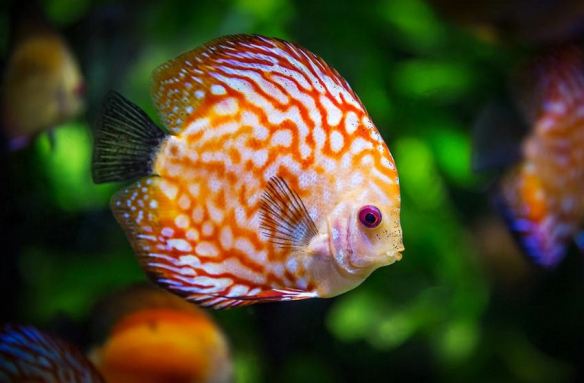
Tropical Fish
Tropical Fish
Golden & Reddish Browns with White, set against a Green background – Brown & White are another classic combo, which look great with jewel tones.

Tropical Beach
Tropical Beach
Blues, Greens, & Tans – whether you prefer vacations on the beach or in the mountains, this combination of colors has a familiar relaxing affect.

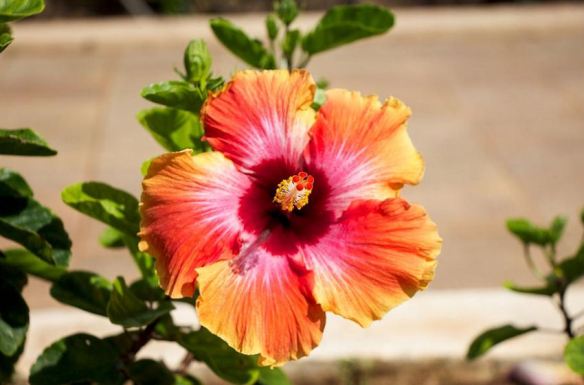
Hibiscus Bloom
Hibiscus Bloom
Red, Orange, Yellow & touches of Pink & White – Warm pastels with a dramatic red center attract attention.

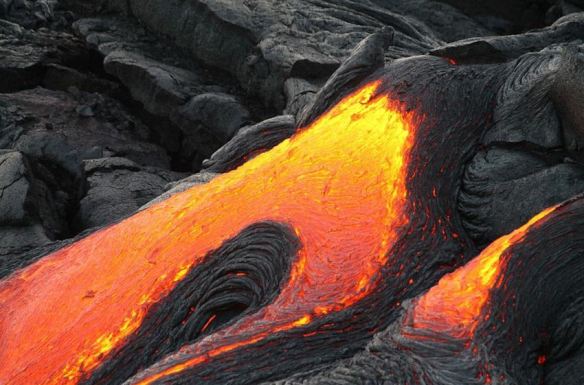
Molten Lava
Molten Lava
Black, Orange, & Yellow – These colors remind me of my favorite holiday, Halloween.

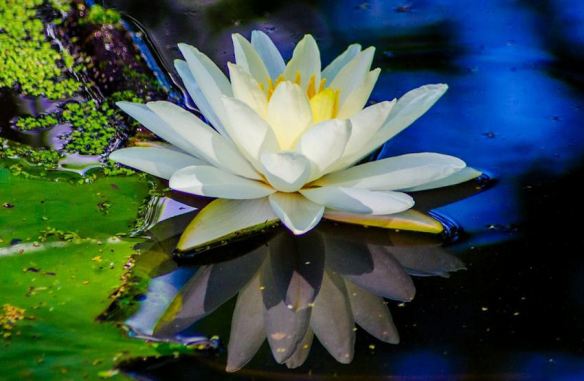
Floating Lotus Blossom
Pure White & Yellow offset by Green, Blue & Black – White is such a cool, crisp color in summer, and coordinates with any colors in warm or cool tones.

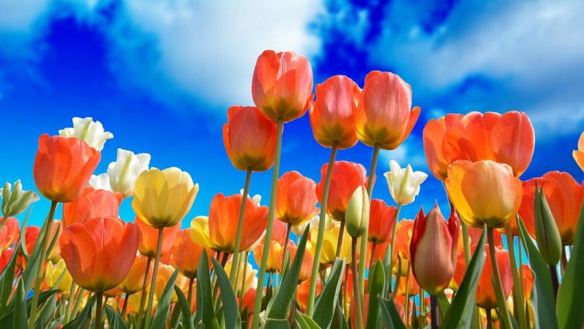
Field of Tulips
Field of Tulips
Orange, Green, & Yellow contrast with Blue – Pastels come alive with a punch of color.

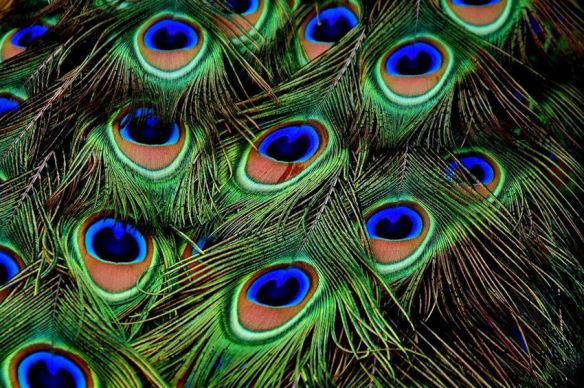
Peacock Feathers
Peacock Feathers
Blue, Green, Gold, & Black – Exotic & luxurious is the vibe created by these colors. The electric blue set against the black makes a bold statement with the naturally shimmering gold and green.

Cherry Blossoms
Cherry Blossoms
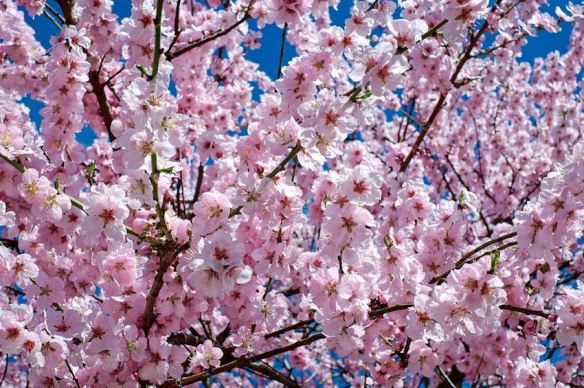
Pink & Blue – In the case of these cherry blossoms and blue sky, bold colors would be overpowering. Such tiny, delicate blooms call for gentle, soft colors. Is it any wonder these colors are often used for baby nurseries?

Pansies
Pansies
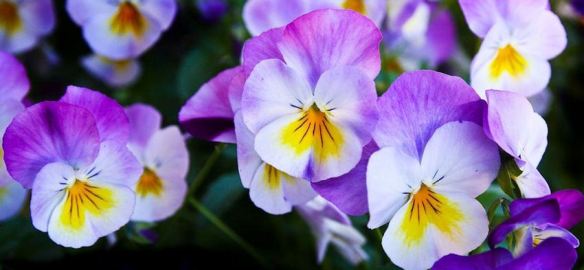
Purple, White & Yellow – The frilled purple petals resemble watercolors, while the yellow centers look like they were hand painted in this striking palette.

Rainbow Lorakeets
Rainbow Lorakeets
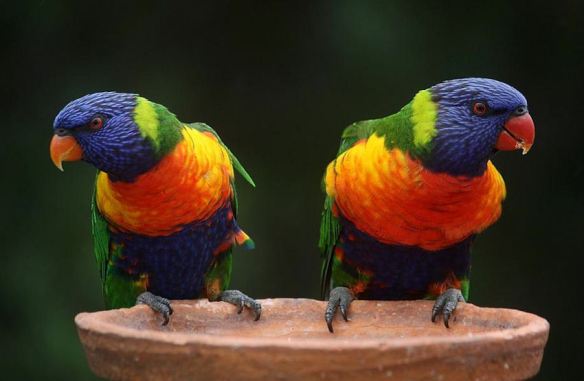
It’s hard to believe that one animal could have all the colors of the rainbow, except purple, and yet here it is in two small parrots. If Mother Nature can come with this, imagine what you can do.

Hummingbird Fuchsia
Fuchsia
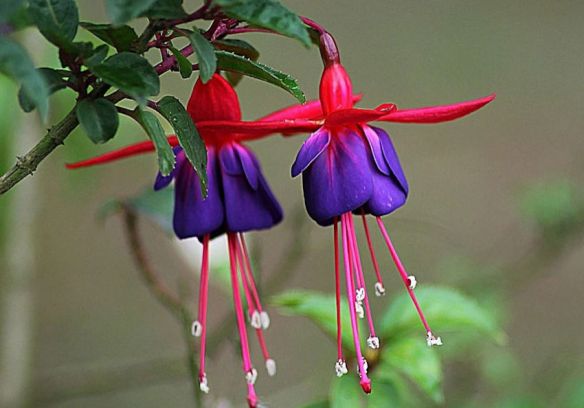
Fuchsia and Purple are striking together as well as exotic.

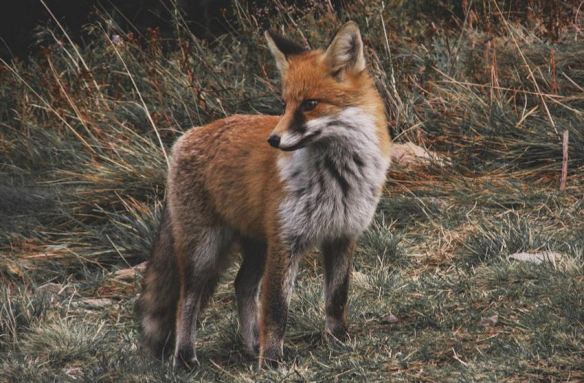
Red Fox
Red Fox
Reddish-orange with white & black accents, is cheerful by day, but sexy and seductive by night.

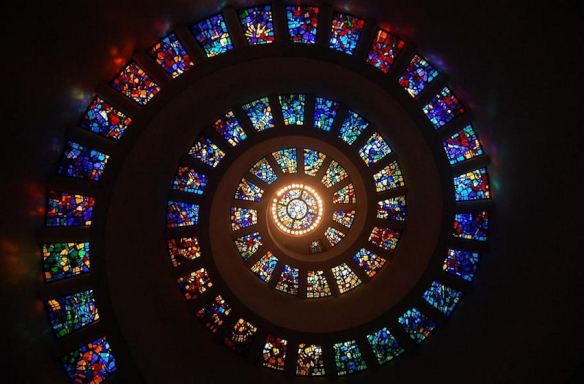
Spiral Stained Glass Windows
Blue & Red with Green, Orange, Purple & Yellow accents – The spiral draws your eye toward the center, while the blended colors move you along one frame at a time.

Sunset #1
Sunset - Cool tones
Purple, Yellow, & Blue – Cool colors of evening (blues & purples) provide the dramatic backdrop for the vibrant yellow sun setting at the distant horizon. This palette has a dreamy, relaxing quality.

Sunset #2
Sunset - Warm tones
Red, Yellow, & Orange with touches of Pink & Purple – Blended warm colors have an energetic, motivational effect.

The next time you are looking for some color inspiration for your next project, take a look outside. Mother Nature has provided a feast for the eyes. Don’t be afraid to experiment. You will be pleasantly surprised.  To learn more about color, please read “World of Color – Part 1” and “World of Color- Part 2.”

Thanks for reading & Happy Crafting!

The Art of Cake Decorating

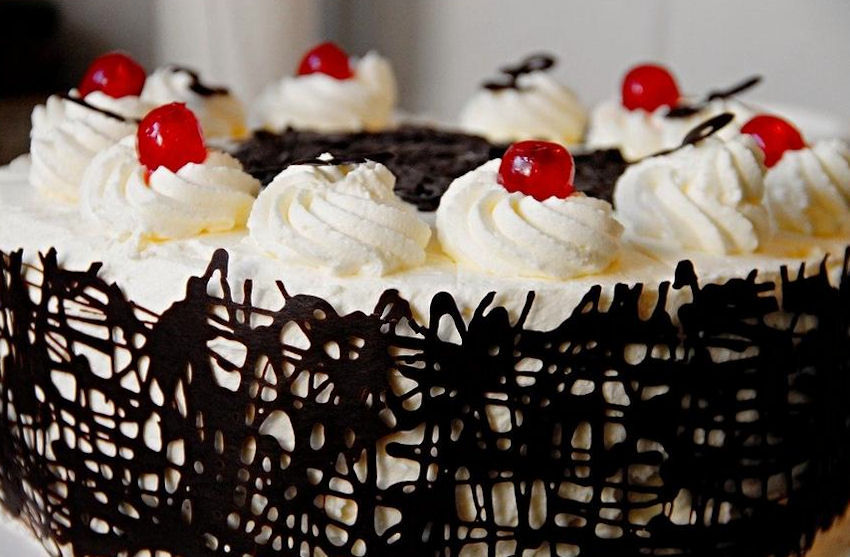
Chocolate Cream Cake

White icing, piped details topped with maraschino cherries and chocolate shavings make this Black Forest cake outstanding, but the real showstopper is the chocolate latticework wrapped around the sides. 

I have a confession to make – researching and writing this post made me hungry for dessert. Before you continue reading, I suggest having a treat ready to eat, or grab the car keys and run to the bakery. Okay, now let us explore cake decorating.

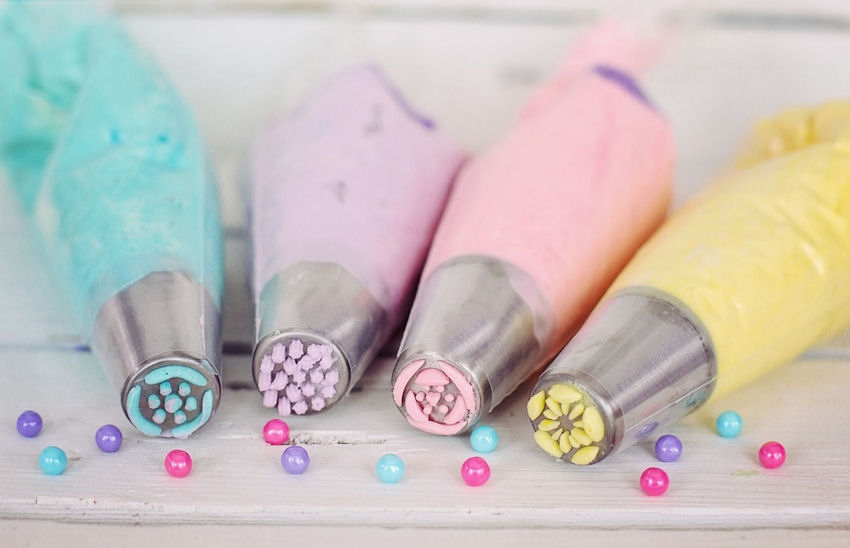
Icing Piping Bags

Icing Decorating Bags

Cake decorating bags can be filled with a variety of icings and each metal tip creates different designs, from flowers, to ribbons, stars and many more.  Piping bags can also be used for fillings in pastries and donuts. 

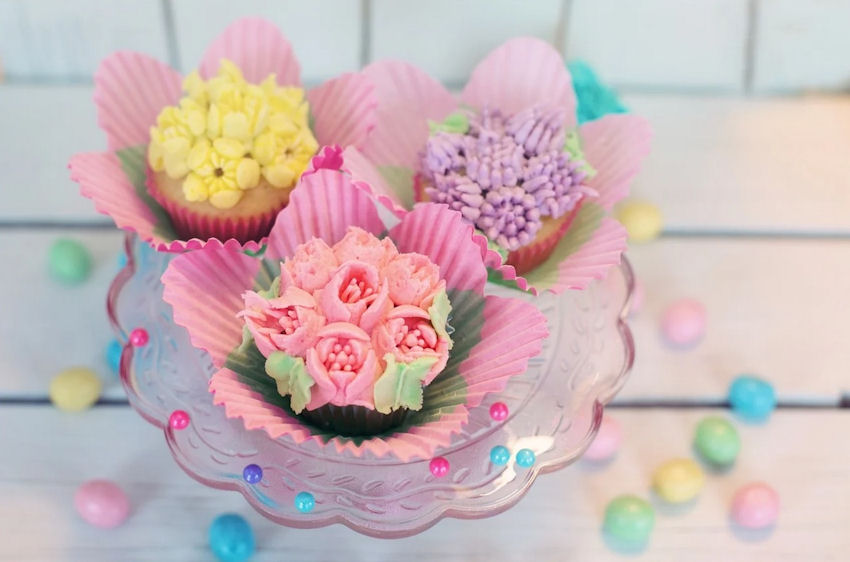
Piped Flowers

Floral Cupcakes

The piping bags shown in the previous photo produced these unique floral motifs. 

Buttercream Roses

Buttercream Roses

Piped buttercream frosting is a colorful and flavorful choice for cake decorating. 

Owl Fondant Cake

This adorable owl cake is decorated with fondant, which is made from sugar paste, rolled out into sheets, and then cut into any desired shapes.

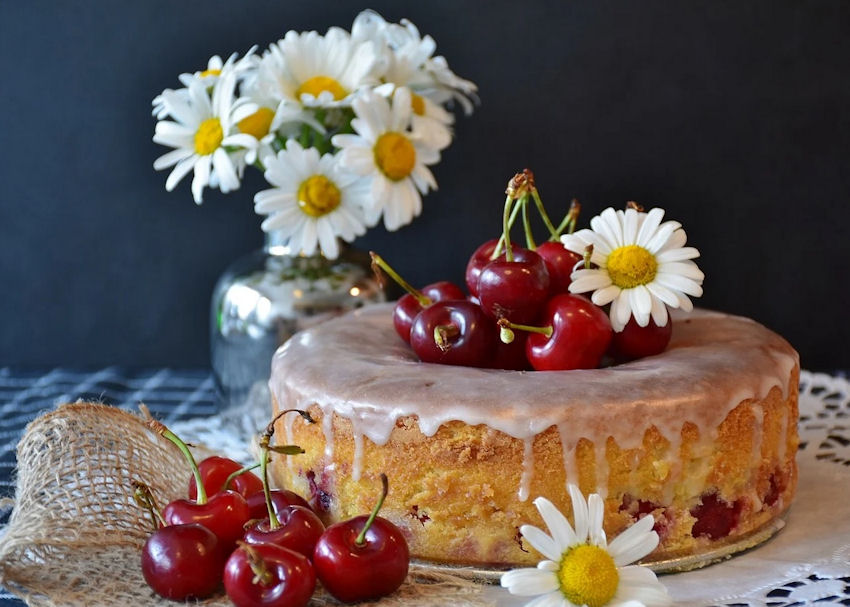
Glazed Icing

Confectioner’s Sugar drizzled over this cake is quick and easy.  The clustered cherries hint at the fruit filling hidden with this single layer cake. 

Marzipan

Marzipan is made from almond paste and is a favorite candy treat, which adds a bit of whimsy to cakes as well as cupcakes. 

Modeling Chocolate

If you always wanted to try sculpture, here is your chance to create a beautiful art piece and it’s edible too!  While smaller decorations can be made with fondant or gum paste, modeling chocolate is much stronger, enabling the creation of larger figures, such as the Disney characters shown above. 

Rainbow Layer Cake

An easy way to add color to any cake is by using rainbow colored layers.

Orange Cheesecake

This cheesecake has a translucent topping and center filling made from orange juice concentrate and sugar.  An unexpected block pattern is only revealed when sliced. 

Red Velvet Cake

Rich red crumbles hint at the alternating layers of moist chocolate cake and cream cheese icing hidden within this decadent dessert. 

Strawberry Shortcake

Fresh fruit garnishes and a little powdered sugar are all you need to top off this summertime favorite. 

Chocolate Tarts

Most people love chocolate and this dessert does not disappoint.  Chocolate whipped cream is sandwiched between the layers of cake and is also piped on top, garnished with chocolate shavings and raspberries. 

Marbleized Cake

A marbleized effect is achieved by piping chocolate frosting over vanilla and then running a knife or spatula through it. 

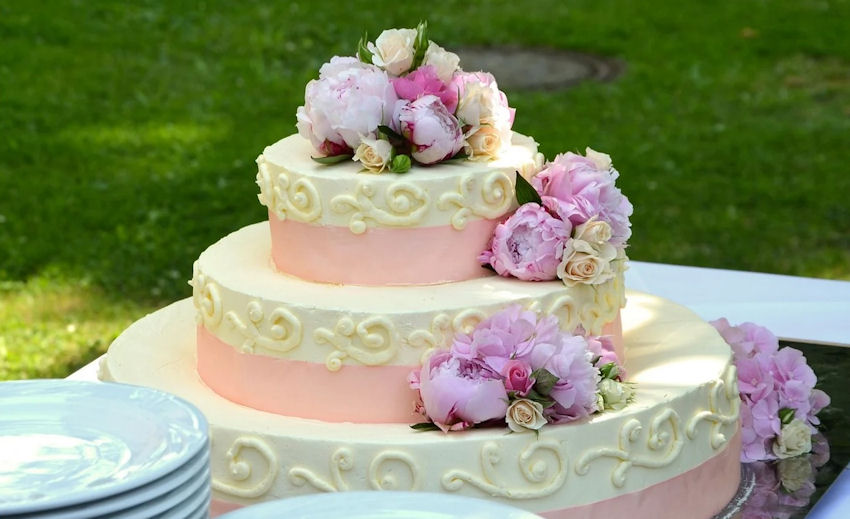
Fondant with Piping & Roses

This lovely wedding cake has pink and white fondant, with piped icing details and fresh-cut flowers.

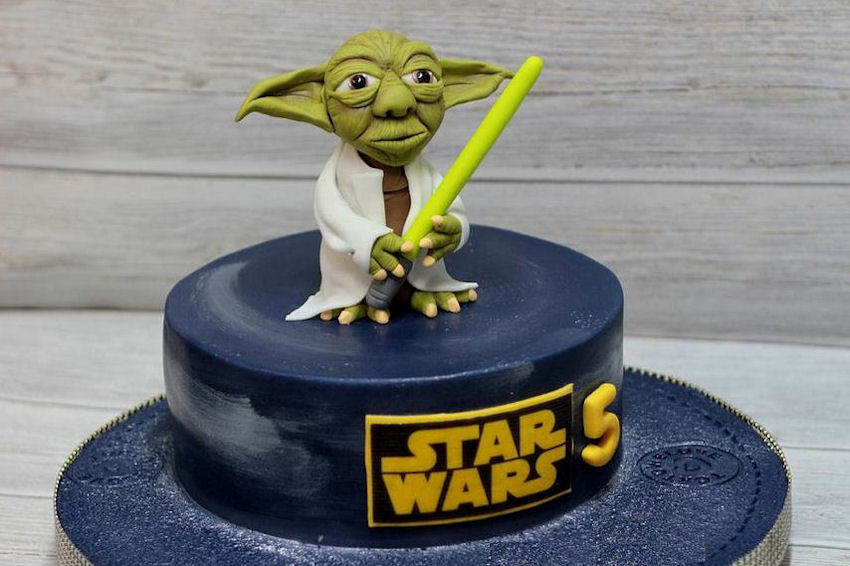
Star Wars Theme Cake – (Fondant & Modeling Chocolate)

Special occasions present perfect opportunities for themed cakes.  Any child would be thrilled to have Yoda at his or her birthday party.  A few “big” kids would love it too! 

Mosaic Fondant Cake

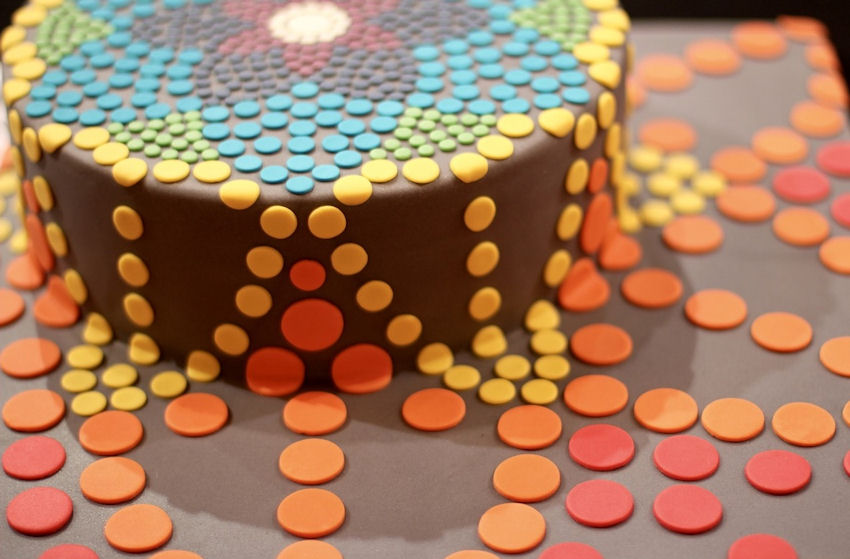
This cake and display tray have been covered with chocolate fondant for a seamless look.  Multi-color fondant sheets are cut into circles of various sizes and individually placed in an intricate mosaic pattern. 

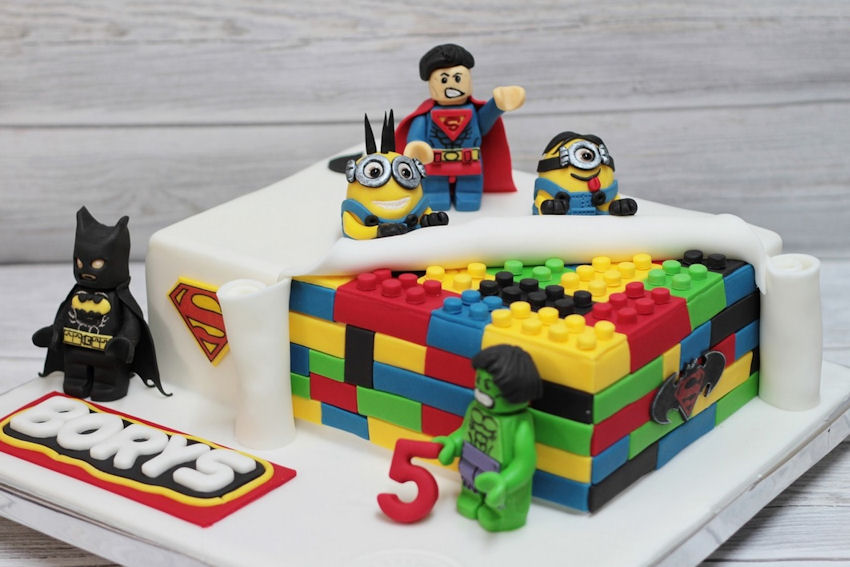
Modeling Chocolate Lego Cake

The figures and Legos are modeling chocolate, while the white icing is fondant.  Isn’t it amazing how realistic the Lego blocks look? 

Designer Cakes

These wintry snowmen are decorated with modeling chocolate, piping, and macaroons.  Sprinkled granulated sugar resembles the snow and ice. 

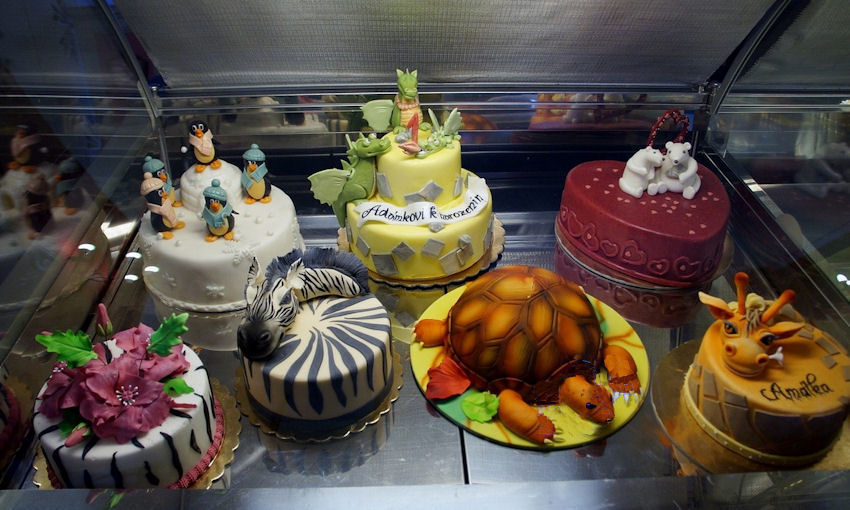
Designer Cakes

Want to know the secret to making large decorations like the giraffe, the zebra and the turtle’s head and legs?  Rice cereal treats are covered with fondant to seamlessly blend with the cake. 

Designer Textured Cakes

Both of these cakes offer incredible color and texture.  On the left, the ombré effect of the piped roses leads the eye toward the sparkling glass bride and groom topper.  Piping, stamping, gum paste, and candy making techniques have been beautifully combined in this unique garden gazebo.  

Designer Bold Colorful Cakes

Bold colors are certainly eye-catching.  The first, known as a topsy-turvy cake, is wrapped in fondant and decorated with geometric and floral cut fondant.  The floral cake has been hand-painted with edible inks, creating the look of stained glass. 

Designer Pastel Floral Cake

This floral cake is a real labor of love.  Each gum paste flower, leaf and butterfly is made by hand and set in place to create the cascading garden.  As the design nears completion, iridescent edible inks are brushed on to provide depth and realistic details in this incredible wedding cake. 

I hope you are inspired to give cake decorating a try.  A visit to your local craft store will give you additional ideas, and you will see an amazing selection of the candies, pre-mixed fondants, and gel icings, as well as tools of the trade and specialty pans to make your next dessert a masterpiece.  

Thanks for Reading & Happy Crafting!
Celebrating 500 Followers

Fireworks

It is amazing to see that I have reached a major blogging milestone: 500 Followers.  My sincere thanks to each and every one of you.  Whether you stop by for a quick read, or settle in and stay for a while, your presence is greatly appreciated. 

Inspirational Sunset

We share images and words, sending a ripple of inspiration across the Internet and around the world. 

Arts & Crafts

We express ourselves through photography, music, poetry, arts & crafts, and many other ways too numerous to mention.  It does not matter what approach you choose.  By sharing our gifts, we help each other to grow, learn, and discover hidden talents on this creative journey called life. 

Watercolor Thank You

Thanks for reading, liking, commenting & following!

Happy Crafting!

How Do You Like Your Eggs?

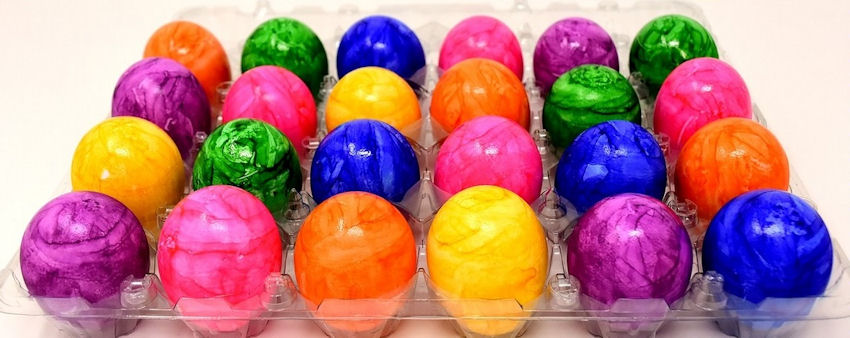
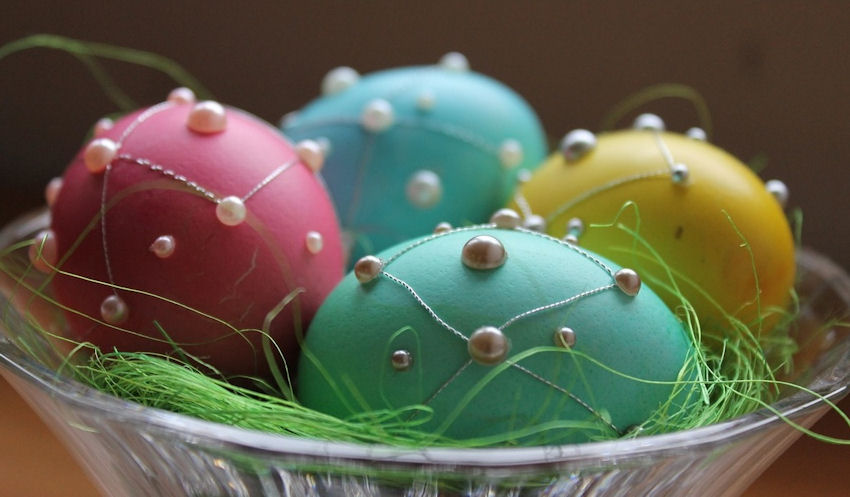
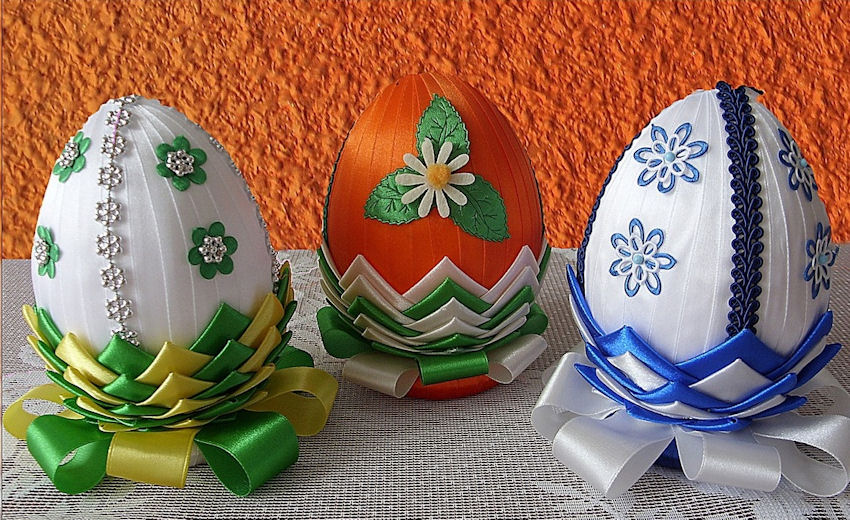
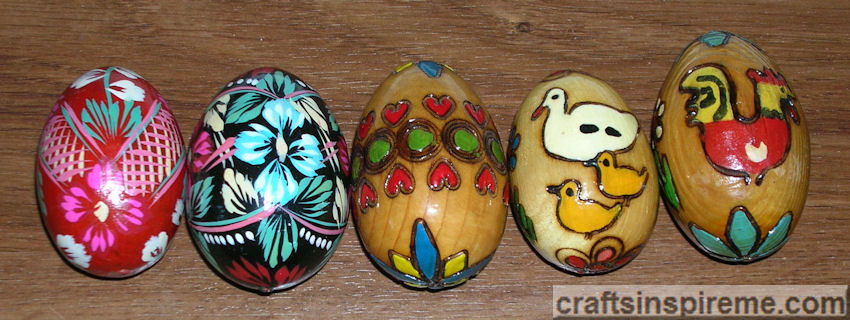
It is an age-old question.  In this case, we are not talking about breakfast.  Instead, let’s talk about egg decorating.  The eggs can be hard-boiled or blown eggs, as well as wooden, ceramic, and plastic eggs.  Decorations include paints, markers, ribbon, fabric, glitter, string, quilling paper, and stickers.  Below are several examples to inspire you:

Strategy Meeting: Egg Production (Hen) & Egg Distribution (Bunny) lol

Dyed Eggs

Iridescent Eggs

Pearlescent Eggs

Paint Pour Eggs

Air-Brushed Eggs

Hand Painting Supplies

Hand Painted Watercolor Eggs

Hand Painted Pastel Eggs

Hand Painted Multicolor Eggs

Hand Painted 3D Multicolor Eggs

Hand Painted Egg Ornament

Hand Painted Egg Artwork

Dyed Eggs with Stickers

Dyed & Beaded Eggs with Metallic Trim

Dyed & Woven Bead Wrapped Eggs

Fabric Wrapped Eggs with Ribbon Trim

Ribbon Wrapped Eggs

Dyed Eggs with White Marker Designs

Dyed Eggs with Multicolor Marker Designs

Decoupage Egg Ornament

Quilled Eggs

Carved & Painted Wooden Eggs

Multicolor String Wrapped Egg Ornaments

Express Delivery Crew

With so many eggs to deliver this year, the Easter Bunny hired some extra helping hands (paws)!  lol

I hope your creative ideas are flowing.  Do you have a favorite decorating technique?  I look forward to hearing your ideas.  Have fun decorating and thanks for reading.

Happy Easter & Happy Crafting!

The Bunny Hop – Painted Wooden Rabbit

Before we begin this Easter-themed project, we’ll need a little inspiration. Let’s take a look at a few of Mother Nature’s color scheme choices in the adorable bunny photos below:

Tan Baby Bunny
Baby bunnies are just so cute! That’s a lot of love wrapped in a soft tan and cream coat.

Gray & White Bunny
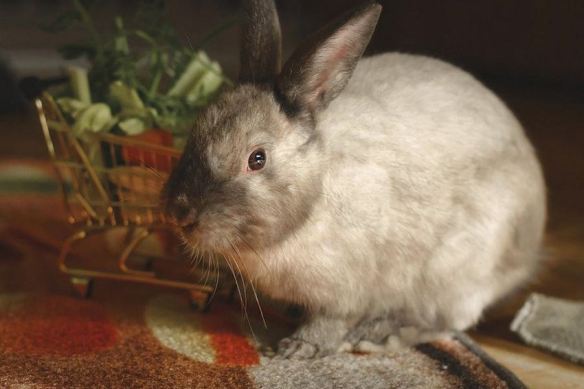
This stylish rabbit is modeling the very popular gray and white color combo.

Tan & Brown Bunny
Wild rabbits often have a blended fur coat of brown, tan and black to help camouflage them from predators. The one pictured above looks perfectly content to nap where he is without a care in the world.

Black & White Bunny
Last but not least is this precious black and white baby. His delicate features, including his button nose, inner ears and the outline of his eyes, are a soft pink.

Now that we’ve seen a few ideas, let’s get started painting!

How to Paint a Wooden Rabbit:

Raw Wood Bunny
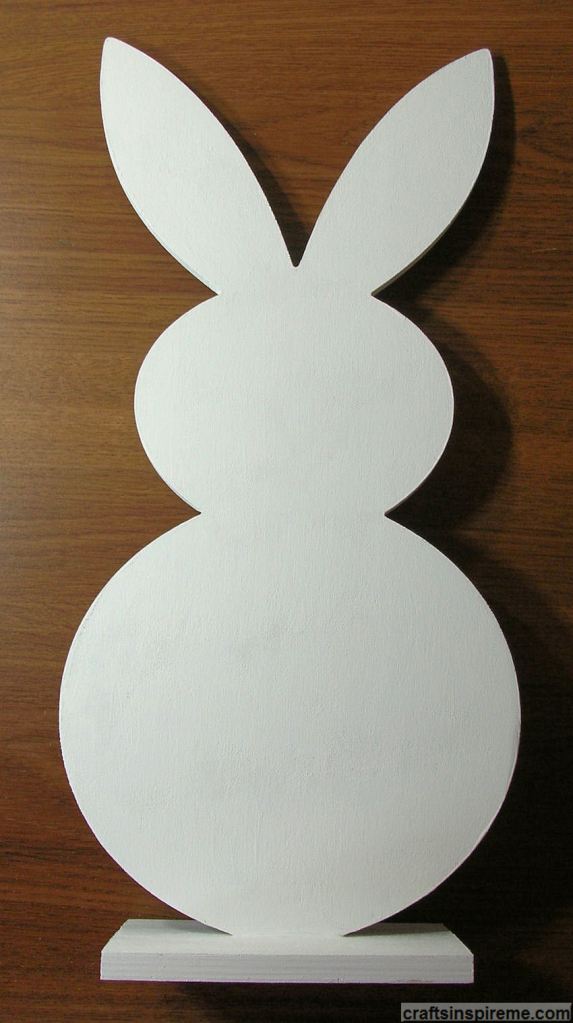
Thick wood has been cut out in the shape of a rabbit and has the advantage of strong, rectangular base. Both sides and all the edges will need to be painted. Due to the raw nature of the wood, it may require a little sanding, especially along the edges.

Bunny Supplies
Supplies:
Wooden Rabbit (17” high x 8” wide x 1/4” thick) (Base is 5-3/4” wide x 4”deep)
Acrylic Paints – brown, black, gray, tan, green & white
Fan paintbrush, small detail paintbrush and thicker brush for base coats
Sandpaper
Optional: Fabric paints – black, brown, white (Refer to Advanced section below)

Painted White Bunny
Step 1 – Paint the rabbit with 2) coats of white acrylic paint, including both sides and all edges.

Painted Back Bunny
Step 2 – Start painting the fur on the back. Experiment with colors and brush techniques. I poured black, brown and gray paint onto an artist’s palette. Dip a fan brush into each color and then apply to wood surface to create a fur-like effect. Because the paints have not been mixed, each new brush stroke will have a slightly different combination of colors, just like real fur. Repeat thus process until the back is completed. The white tail will be added later.

Layout Details Front Bunny
Step 3 – On the front, draw the face (eyes, eyelids, eyelashes, muzzle with nose, mouth, whiskers), ears and feet with a pencil. Paint the inside of the ears and eyelids tan.

Painted Front Bunny
Step 4 – Create the fur by repeating the procedures in Step 2. Be sure to make long brush strokes along the edges of the ears to resemble thick fur. You can leave the eyes, muzzle, and feet white for now. These areas will be detailed in the next step.

Bunny Closeup1
Step 5 – Paint the facial details. I painted the eyes, eyelashes, nose, mouth and whiskers black.

Bunny Closeup 2
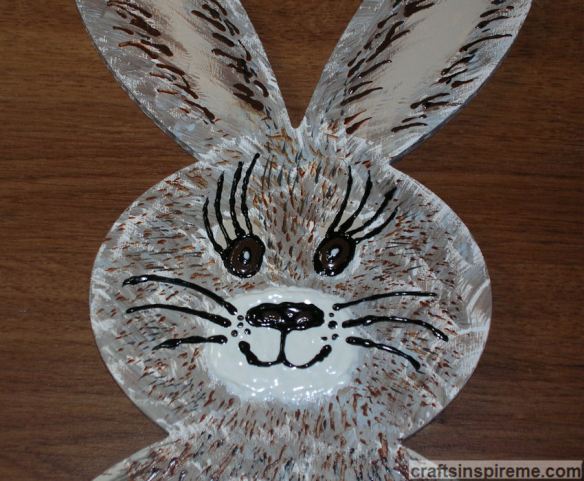
Step 5A – This is an alternate version for the eyes and nose. A brown iris has been added to each eye, the eyelashes have been extended, and brown nostrils define the nose. For a more lively expression, don’t forget to put a dot of white in the pupil of each eye.

Finished Bunny
Step 6 – The finished rabbit has white feet with black lines to define the toes. The base was painted with two coats of green.

Finished Bunny Tail
Step 7 – Paint a big, white fluffy tail on the back.

At this point your project is finished and ready to display. If you would like to take this design to the next level, please follow the steps below.

Advanced Rabbit in 3D
Followers of this blog know how much I love creating 3D details on wood projects using fabric paints. If you appreciate three-dimensional effects, this section is for you! Unless otherwise noted, all paints listed below are dimensional fabric paints.

3D Bunny Face
Start by painting 2 thick coats of white fabric paint on the muzzle, and brown paint for the eyes.

3D Bunny Feet
Next paint the feet with 2 thick coats of white paint.

3D Face Details
To complete the face, use black paint for the nose, mouth, whiskers, eyelashes, and the outline around the eyes. Add a black pupil in each eye. Paint a white dot in the center of each pupil, and use brown paint in each nostril.

3D Body Details
Add long brown fur along the inner edges of both ears and define the two front legs using the same paint. Add the black lines to define the toes on each foot.

Detail Facial Fur
Using short strokes, bring the black and brown fur mixture up into the face.

Detail Legs and Feet
Layer additional black and brown fur to define the body, and add the two back feet.

Finished 3D Bunny Front
Because the rear legs are in the background, keep the paint lighter by using tiny strokes with just the brown paint in an upward direction. If you want additional fur texture, you could use acrylic paints and a brush to thicken the fur coat with highlights and lowlights.

Finished 3D Bunny Back
The last step is painting the tail with 3 coats of white fabric paint.

Mission accomplished! This cute little guy is ready to be displayed in your home, bringing joy to your life for years to come.

Happy Easter and Happy Crafting!

Scarf Bandit Update

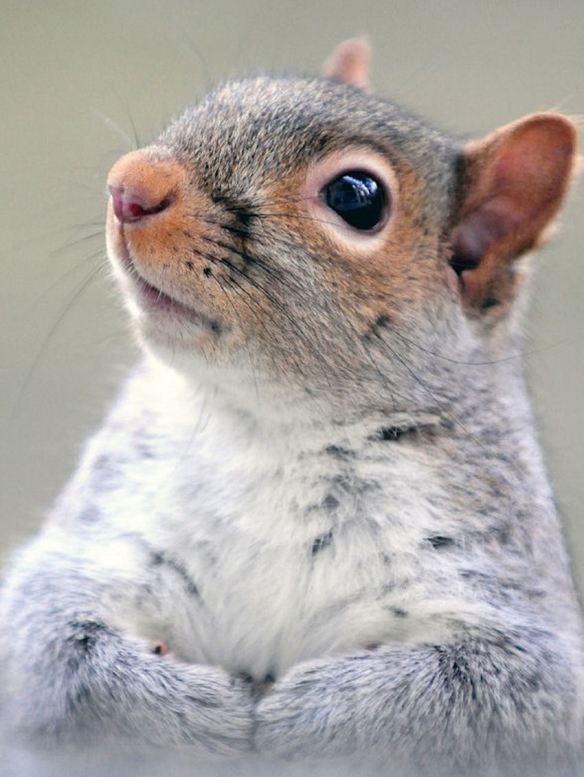
The Prime Suspect
Back in December 2020, I posted the true story of a squirrel stealing a scarf from an outdoor Christmas elf.  (To read the full story, please click here.)

I am truly amazed by the accomplishments of this squirrel.  It must have taken a lot of tugging to remove the scarf.  I wish I had pictures of him dragging it across the lawn and jumping up onto a tree trunk with it bunched up in his mouth.  From time to time, he stopped to readjust the scarf with his paws.  I was sure he would drop it, but he hung onto it.  At one point, the scarf was caught on bark and branches, but the squirrel kept tugging with his whole body until he pulled it free and took his hard-won prize into his nest.  Such determination and skill!
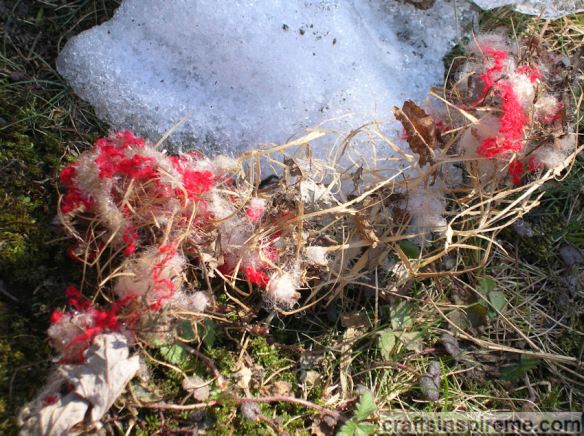
Shredded Scarf & Straw
I did not expect to ever see that scarf again.  We recently had several snowstorms.  The mounds of snow on our lawn resemble icebergs and are very slow to melt.  Much to my surprise, I discovered shredded pieces of the stolen scarf mixed with pieces of straw, as shown in the photo above.  I assumed the scarf would remain in one piece to be used as a blanket.  Instead, this creative little squirrel invented outdoor insulation!  What will this clever home improvement specialist do next?  Stay tuned!

Happy Crafting!
Celtic Crafts

Rainbow & Pot of Gold
Did you ever follow a rainbow in search of a pot of gold?  Those sneaky Leprechauns do an incredibly good job hiding it, but I will keep searching, nonetheless.  St. Patrick’s Day is celebrated with shamrocks, corned beef and cabbage, beer, and all things green.

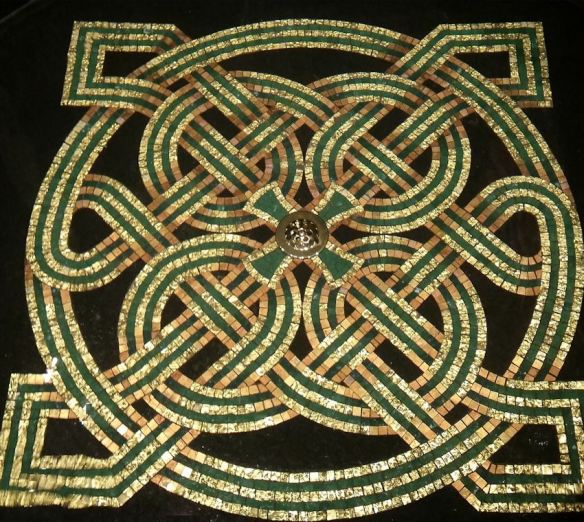
Celtic Knot Mosaics
Intricate Celtic knot work designs can be found on everything from jewelry to T-shirts and even mosaic tiles like the one shown above.

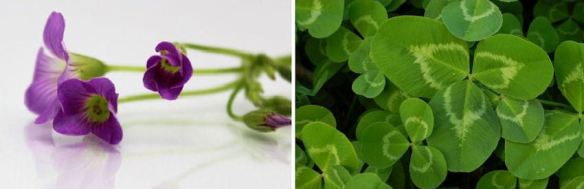
Clover Flowers
Shamrocks, a.k.a. clover, are probably the most recognizable symbols of St. Patrick’s Day.  Typically, you will see nothing but green leaves, however these plants have some very vibrant flowers such as the purple blooms shown above.  (Nice color combo!)

Festive Attire & Chocolate Coins
Wearing green is a great way to show your Irish spirit, and you don’t have to be Irish to take part in the fun!  To satisfy your sweet tooth, homemade chocolate coins wrapped in gold foil will certainly do the trick.

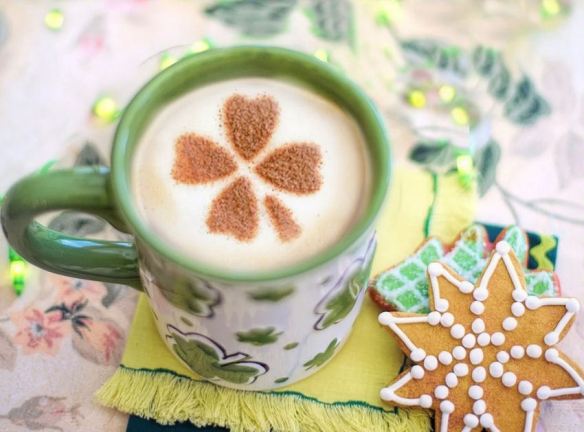
Irish Coffee
This may look like an ordinary cup of coffee but hidden in every cup of Irish Coffee is a shot of Irish whiskey.

Irish Soda Bread
Irish soda bread is made with baking soda instead of yeast and often contains raisins.

Knitting Wool
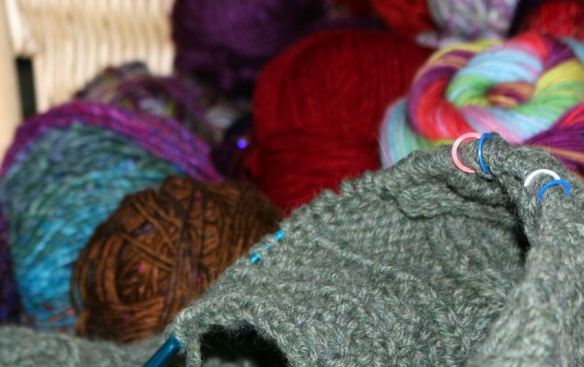
Ireland is famous for its warm cable knit sweaters made from their finest wool.

Paper Shamrocks
For those who love paper crafts, decorations can include leprechauns, shamrocks, pots of gold, mugs of beer, and rainbows.

Shamrock Cookies
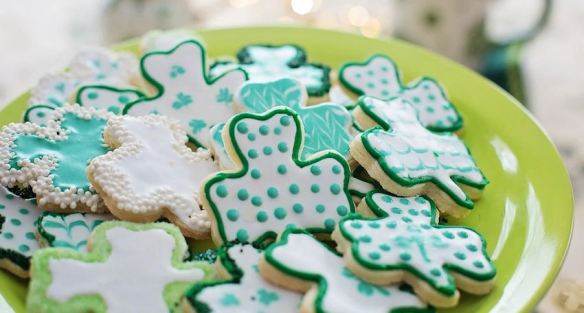
Homemade cookies are a delicious way to celebrate any holiday.

Celtic Cross
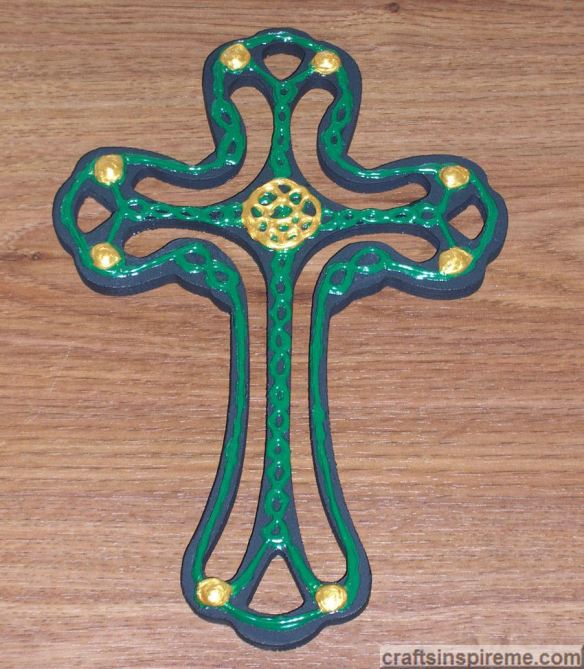
If you love painting, consider incorporating Celtic designs into your next project.  Creating these woven patterns is challenging and fun. For instructions to make this cross, please read: “At the Crossroads.”

Pint of Guiness
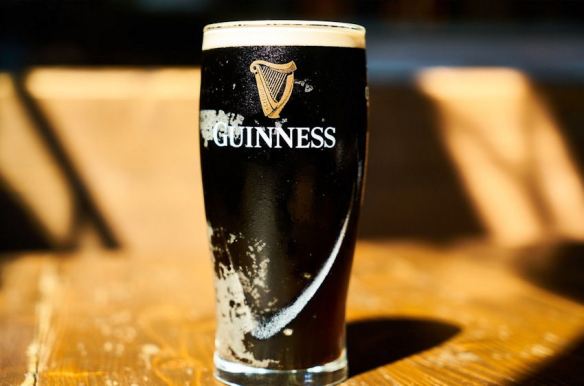
Making Guinness beer at home might not be in your skill set, but you can turn plain pilsners into beautiful Celtic glasses, for serving the perfect pint, by using glass paints and your creative Celtic flair.

Irish Embroidery
Embroidery offers many opportunities to showcase your needlework skills in both design and color palette.  There are also computerized embroidery machines with plenty of festive templates for every occasion.

Ceramic Irish Cottage
Ceramics studios often have ready to paint statues and decorative items.  After the painting is complete, it is fired in a kiln and is ready to display or to give as a gift.

St. Patrick’s Day invites everyone to be Irish for the day and to have a grand time doing it.  Don’t forget to wear something green.  May the luck of the Irish with you!
Happy St. Patrick’s Day and Happy Crafting!