Lilacs are such beautiful flowers, and their scent is intoxicating. I wish they could bloom all summer, but we can only enjoy them for a few weeks each spring. By creating a silk wreath, you can enjoy lilac blooms year-round. Let’s get started.
Heart- Shaped Grapevine Wreath
I chose a heart-shaped grapevine, but you can use any shape wreath made from whatever material you prefer.
Flower Layout
While shopping for a wreath, experiment with flower colors and placement. You will also need wire cutters and floral wire. As an alternative to wire, you could use brown twine.
Wire Floral Picks
Choose a starting point and begin attaching each floral pick. Because I am working with a heart, I started at the top center point, and moved along the left side, placing each bloom as though it is growing upward.
Progress Photo
Continue adding flowers. When you reach the bottom of the heart, turn the blooms to climb up the right side.
Progress Photo
Adjust the flowers and leaves to fill in any gaps. Trim any visible wires as needed or tuck them into the back of the wreath.
Finished Wreath
I used a piece of purple ribbon to hang the wreath upon a wall. As an optional step, you can recreate that heavenly scent by simply spritzing the finished wreath with lilac essential oil.
I hope you enjoyed this project. Wreath making is a fun and easy craft anyone can do. Over time, the wreath can be easily updated with new flowers to coordinate with your décor.
Sixty-five million years ago the Tyrannosaurus Rex, also known as T-Rex, spent his days hunting, eating, and making little dinosaurs. Archaeologists, writers, and world-renowned movie directors have been thrilling us ever since with all the gory details of this master predator.
Did they roar like lions? Were they solitary animals or did they mate for life? Having such short arms, I wonder, how did they get back up after a fall?
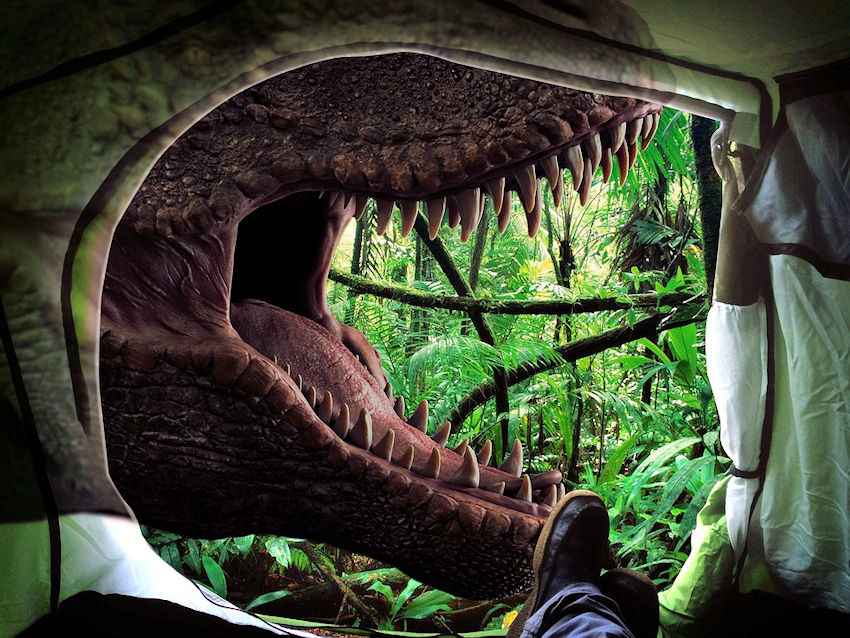
After viewing this photo, who wants to go camping? (lol) The mere thought of facing a creature, capable of eating its prey whole, leaves us with mixed feelings of fear and awe. And we love it. To bring a few of those Jurassic thrills into our lives, let’s jump into our next project:
Inspiration
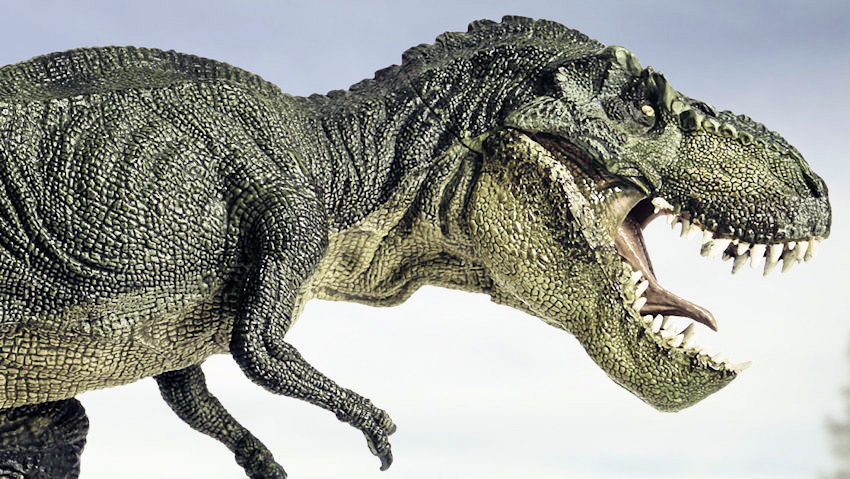
Huge jaws, piercing eyes, and razor-sharp teeth – what’s not to love?
Inspiration
When we look at large lizards alive today, we can visualize tyrannosaurs having thick, textured skin, consisting of scales and bony plates, with a ridge along the spine.
Inspiration
Predators typically have camouflaging patterns and colors to give them an advantage while hunting. With these ideas in mind, we can begin the creative process to bring the T-Rex back to life. Let’s go!
How to Paint an LED Tyrannosaurus Rex:
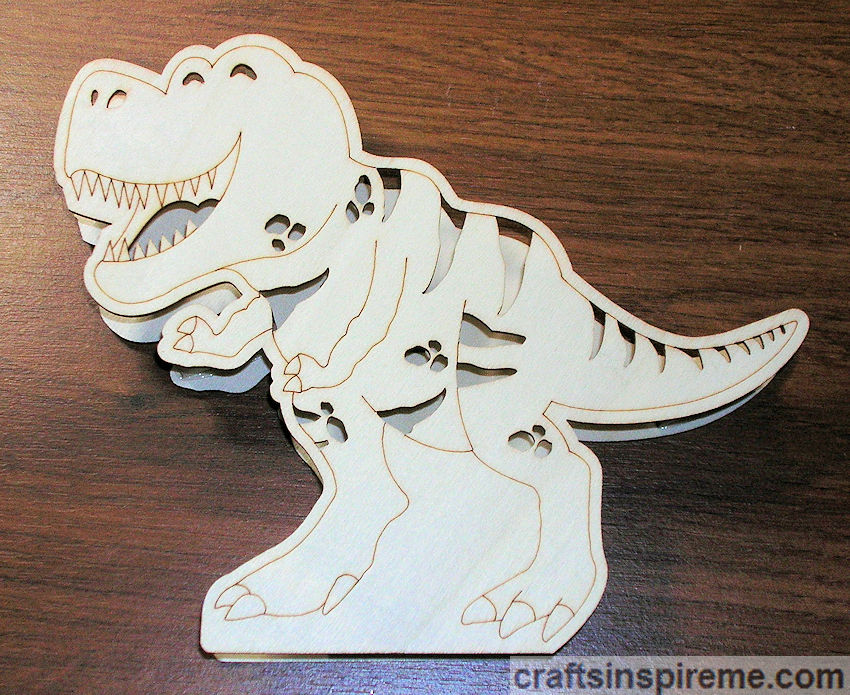
Raw Wood T- Rex, Front
This wooden T-Rex (available at Michaels) has preprinted details and cut outs to enable green light from a concealed LED bulb to penetrate the figure and cause an eerie glow in the surrounding area.
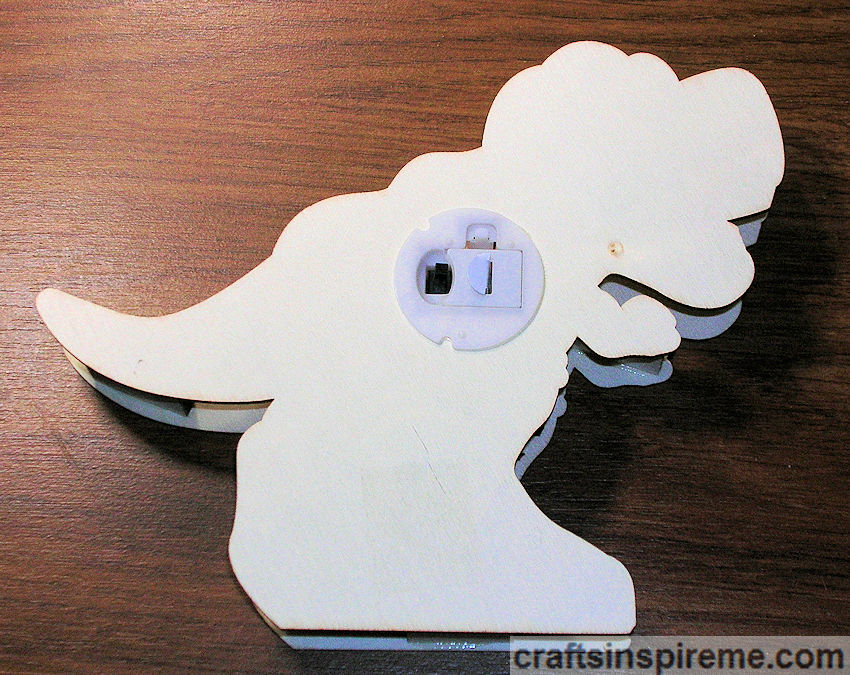
Raw Wood T- Rex, Back
The back is plain wood with the on/off switch and battery compartment. The wood on the front is smooth, however you might want to sand the back lightly, however that is entirely up to you.
Supplies
Supplies:
LED Wooden T-Rex (5-3/4” high x 7” wide x 1” thick)
Acrylic Paints – Cappuccino, Light Fuchsia, & Dove Gray
Paintbrushes
Markers – Brown & Black
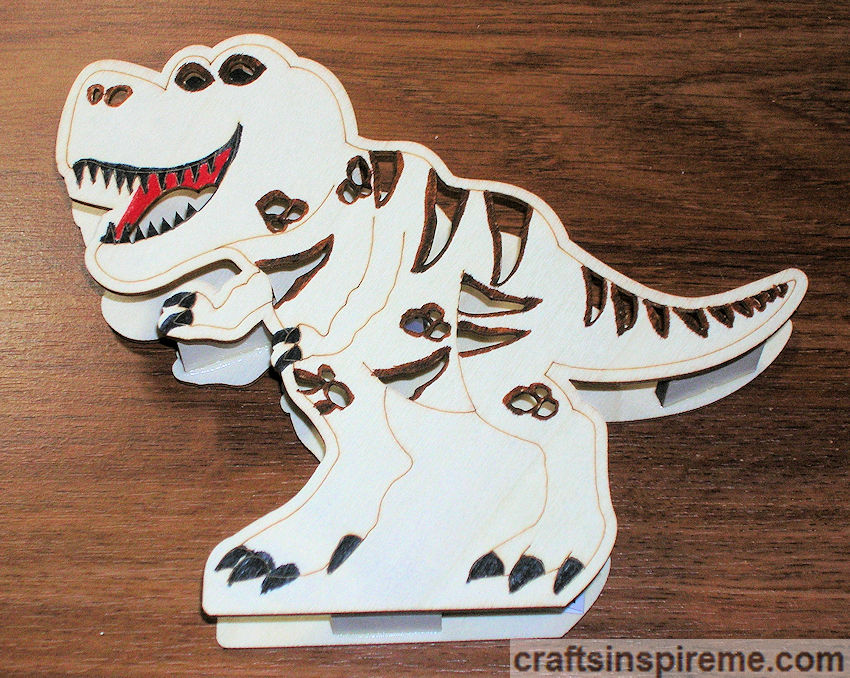
Marker Drawn Details
Use magic markers to figure out the color scheme.
Painted Basecoat, Front
Paint the entire body with the basecoat.
Painted Basecoat, Back
Paint the basecoat on the back. I did not add any details, but you can if you wish.
Marker Drawn Details
Go over the details with markers.
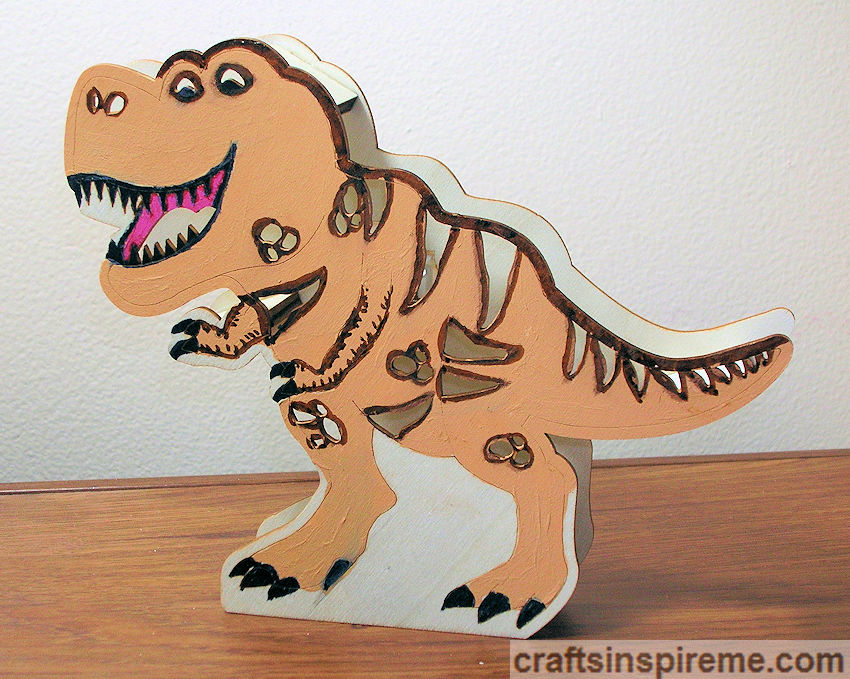
Painted Gray Background
Paint the background gray to contrast with the tan body. At this point you could stop.
If you have been following this blog for a while, you know there is a more advanced painted version. Please read on to discover how to give this dinosaur a more reptilian appearance.
Advanced 3D Painting:
Three-Dimensional Fabric Paints
Supplies:
1) Bottle fabric paint – Brown
1) Bottle fabric paint – Black
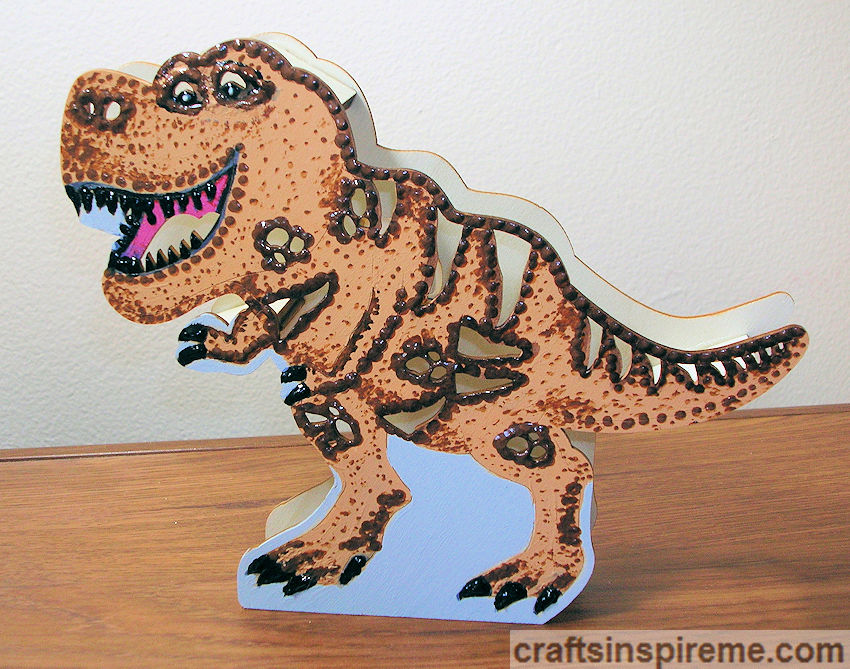
Painted 3D Details
Using brown fabric paint, apply nubby texture to the body. The black paint is for the teeth, pupils, and claws. I outlined the eyes in black too but didn’t like it. To me, he appeared to be wearing a pair of sunglasses. (lol) You can see the revision below.
Completed T-Rex
This is the completed Tyrannosaurus Rex in all his glory.
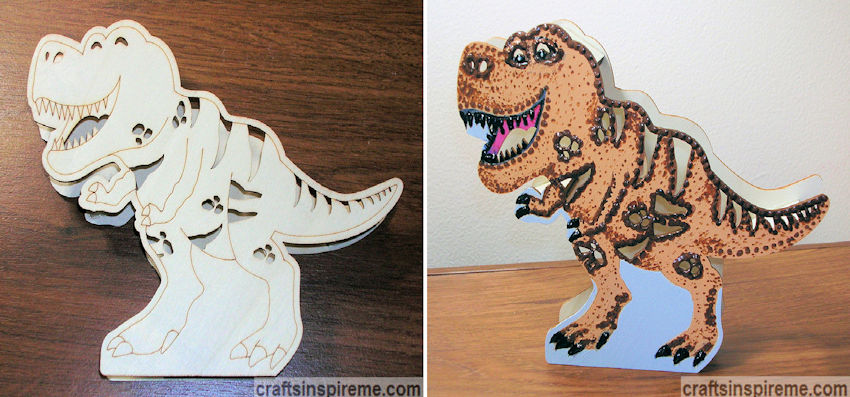
T-Rex Before & After
I am always surprised seeing the plain original wood side by side with the completed project. Caught up in the creative process, it’s easy to forget where we started.
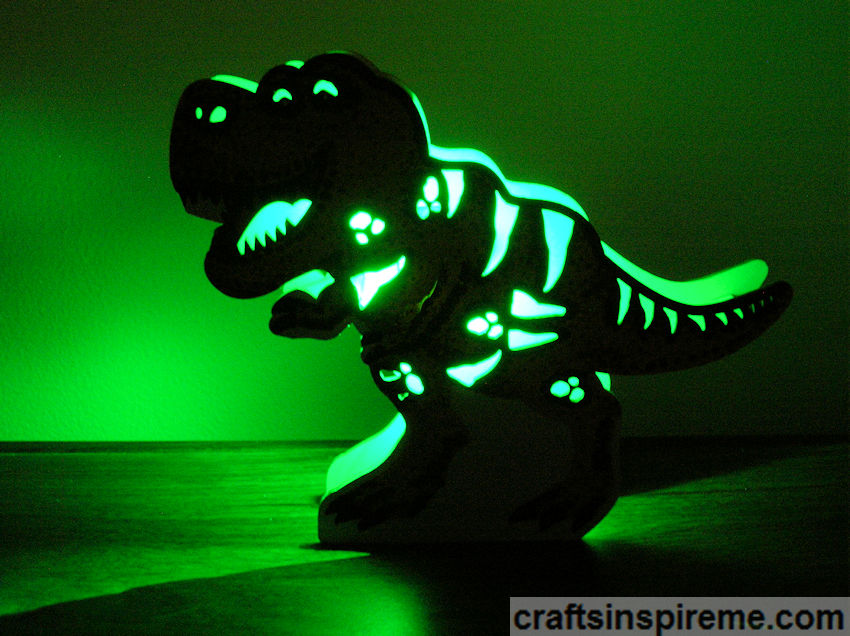
Lit T-Rex with Flash
This photo, taken using flash photography, shows the soft glow of the LED light.
Lit T-Rex without Flash
In a dark room, this T-Rex makes a cool nightlight.
I hope you enjoyed this transformative journey. Thank you for coming along for the ride. What is your favorite dinosaur and why? Please let me know in the comments section.
Have you ever wanted to give painting a try? Anyone can paint. With a little patience and a lot of creativity, you will feel like an accomplished artist in no time. It’s fun, relaxing and reduces stress. What are you waiting for? Let’s get started!
Acrylic Painting: Bold colors, unlimited finishes and surfaces, ease of use
Paint by Number
One of the easiest ways for beginners is with an acrylic “Paint by Number” kit, which comes complete with paints, brushes, and a preprinted canvas. Simply match the numbered paints with their corresponding locations on the canvas. There is a wide range of themes for all ages and skill levels.
Decorative Painting & Wall Art
Acrylic paints can be used in almost any application. Brushes are cleaned with soap and water, and the paints have low or no odor, which is great for those sensitive to strong fumes.
Furniture Painting
Make a new piece of furniture look like an old friend with decorative designs and an antiquing finish.
Statues & Figurines
Upcycle a garage sale purchase with a fresh coat of paint and colorful accents.
Faux Finishes & Decorative Painting
Upgrade walls, or any surface with acrylic faux finishes and decorative painting, including Sponge Painting, Marbleized, Faux Wood Grain, Crackle, Metallic, Plaster, Textured, Stenciling, Stippling, Mural Painting, & Tromp l’oeil.
Airbrush Painting: Street art, murals, and no size limitations
Airbrushing
Airbrushing requires compressed air to disperse paint onto any surface. Cans of spray paint work in the same way and are often used on building-sized murals.
Large-Scale Painting
This handsome German shepherd painting disguises an otherwise unsightly telecommunications box.
Automobile Painting
Riding in style has a whole new meaning when your car becomes a mobile work of art.
Mural Painting
Let imagination run wild as any wall, inside or out, can be adorned with flights of fancy.
Tromp l’oeil Painting
Tromp l’oeil means “Fool the Eye” and in this photo three-dimensional painting turns this electrical transformer into a lovely stable, complete with bales of hay and a friendly face.
Fabric Painting: Art, fashion, and home furnishings
Hand Painting
Fabric markers can be used to layout your design, followed by fabric paint applied via brush or easy-squeeze bottles for three-dimensional paints.
Silk-Screening
Silk-screening is like stenciling for fabrics. A separate screen is used for each color, which is applied using a squeegee.
3-D Painting & Appliques
Fabric paints can be applied to any surface, bringing designs to life in three dimensions. They also function as glue, sealing the edges of appliques and adhering beads and other embellishments.
Tie Dyeing
Tie dyeing is easy for kids of all ages, and the end results are always a surprise.
Designing Home Furnishing & Apparel Fabrics
Large-scale patterns are perfect for upholstery, draperies, and pillows. Apparel styles are constantly changing. Launch the next fashion trend by creating and wearing your own designs.
Glass Painting: Illuminating color, and painting with light
Wall Hangings & Suncatchers
Luminous colors and intricate eye-catching details, hallmarks of stained glass, bring character and beautiful style to any décor.
Mosaic Glass Gems & Jewelry
Earrings, bracelets, necklaces sparkle with colorful glass beads. Mosaic glass gems are perfect accent on crafts as well as vases, flowerpots, etc.
Glassware
Drinking glasses and pitchers take center stage with hand-painted colorful accents.
Christmas Ornaments
With a box of clear glass ornaments, you can let your creativity sore. Paints can be applied inside and out, and the finishes range from metallic, pearlescent, iridescent, and glitter in every color of the rainbow.
Stained Glass Windows
Museums, churches, and many secular buildings are adorned with spectacular stained glass. Sunbeams are transformed into a dazzling kaleidoscope of heavenly light.
Painting Gallery:
Acrylic Painting, Airbrushing, & Paint Pens
Airbrushing
Acrylic Painting & Airbrushing
Fabric Painting
Glass Painting
Airbrushing
Acrylic Painting
Acrylic Painting & Airbrushing
Glass Painting
Acrylic Painting
Acrylic Painting & 3D Fabric Painting
Glass Painting
Painting is a wonderful pastime, which enriches your life and can be easily shared with family and friends. No matter what your style and interests may be, there’s a type of painting to challenge your skills and engage your mind for experiences that will last a lifetime. Enjoy the journey!
One of the most easily identifiable animals upon the face of the earth is the giraffe. There is nothing else like it – that long neck, towering legs and a fur pattern that resembles mosaics. Giraffes are so tall, that the babies are born at a minimum height of six-feet tall to feed from the mother.
Each subspecies has unique fur patterns and colors. There is a ridge on the forehead and two horn-like protrusions on top of the head.
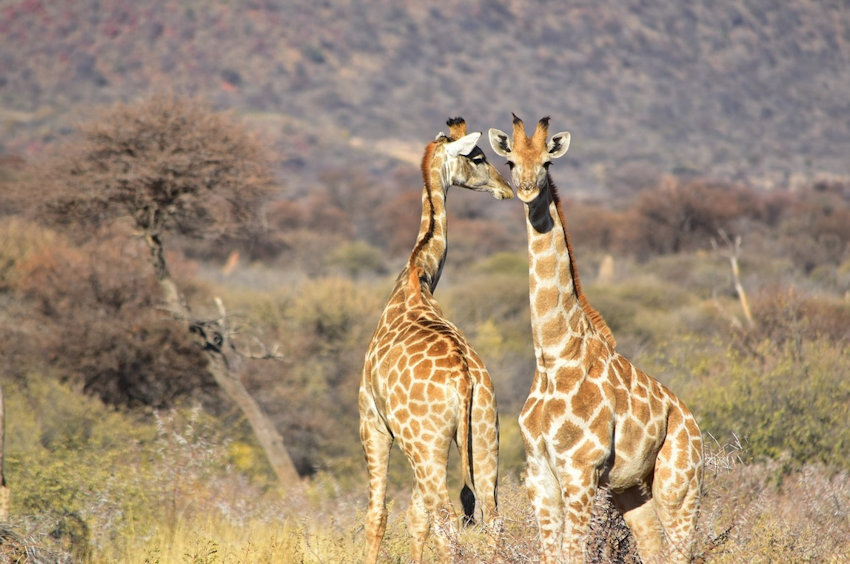
Some have spots down the length of their legs, while others have solid tan or white below the knee. For this project, you will need to look at giraffe photos and decide which pattern you prefer.
How to Paint a Wooden Giraffe:
Raw Wood Giraffe
Both sides and all the edges will need to be sanded and painted. Ensure the giraffe stands without wobbling. If needed, restore balance by gluing pieces of thin cardstock to the bottom the feet.
Supplies
Supplies:
Wooden Giraffe (8-1/4” high x 4-1/4” wide x 1-1/4” thick)
Acrylic Paints – red, brown, orange, black, tan
Bottles Fabric Paint – brown, black
Paintbrushes
Sandpaper
Pencil
Sand & Paint Base Color
After sanding, paint the entire body tan.
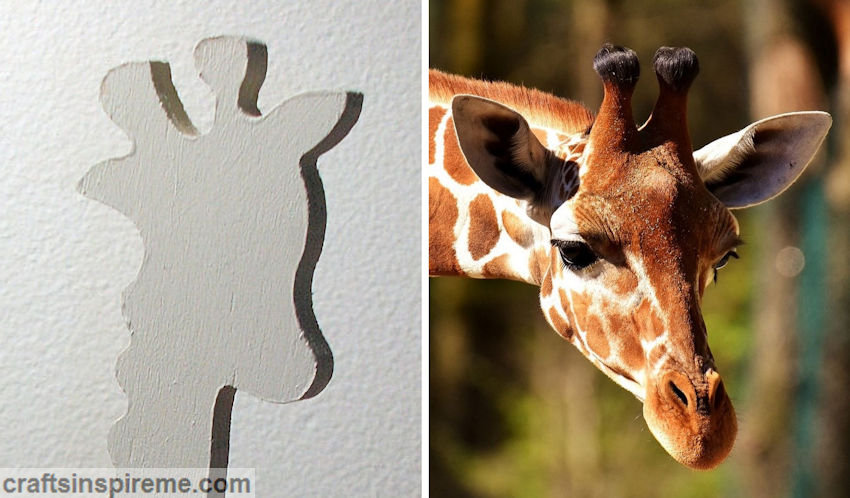
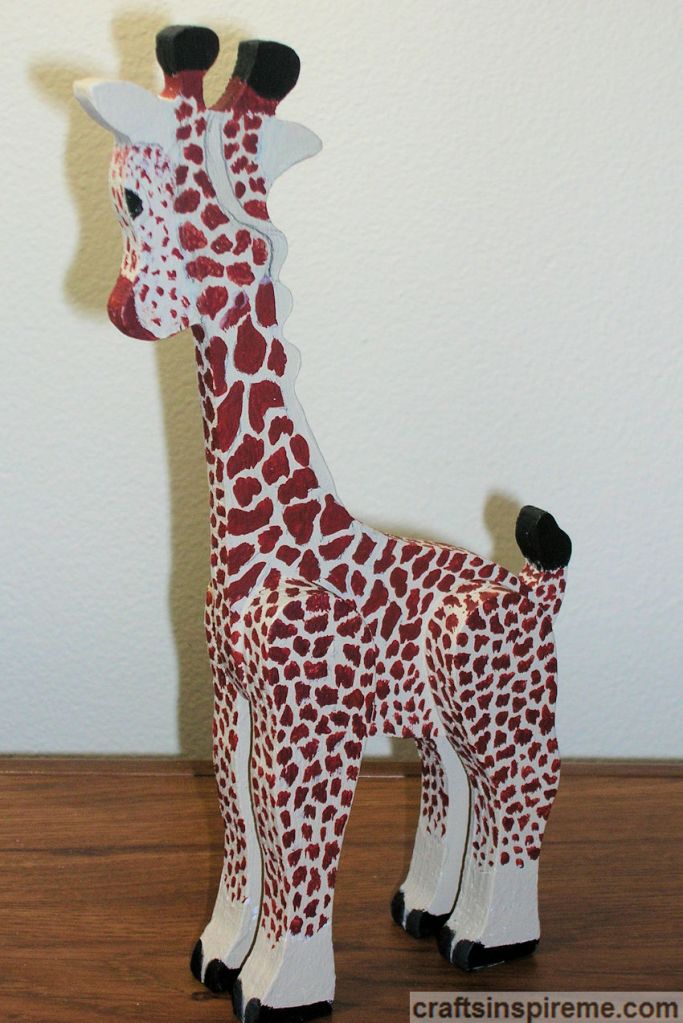
Reference – Giraffe’s Face
I bet you didn’t expect to have a Giraffe anatomy lesson! Typically, wood craft animals stand facing forward. If you look at the close-up photos above, you will notice this giraffe is turning his head to the side. This effects both sides of the head. Both eyes need to be on the same side. We will address the back of the head in a later step.
Hand Draw Details
Because this appears to be a baby giraffe, the facial features are cute but small, including the ridge between the eyes. I began drawing some of the spots to understand what the layout should be. To keep the pencil lines to a minimum, the remainder of the spots were freehanded with the paint brush.
Mix Custom Paint Color
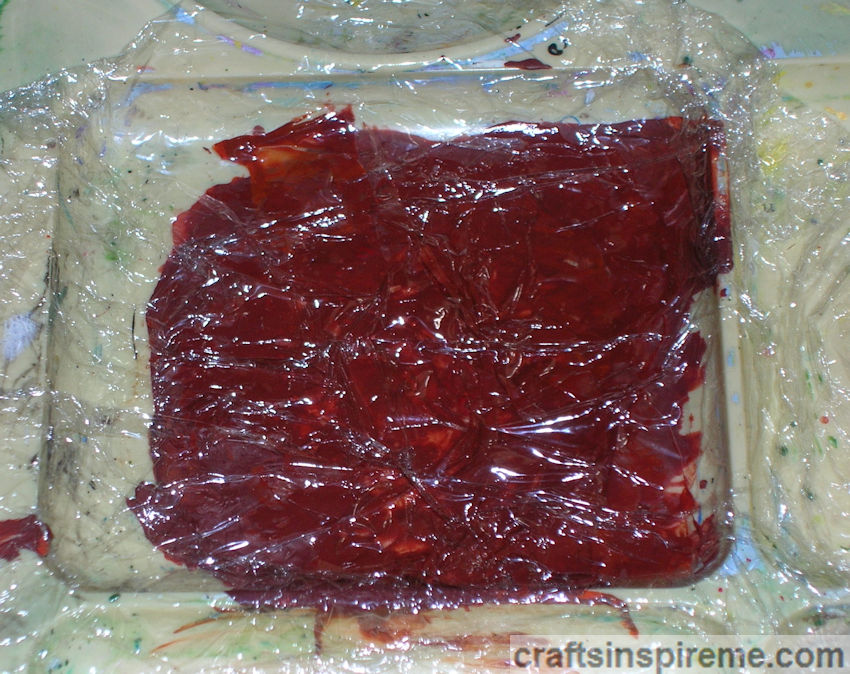
Be sure to mix enough paint for the giraffe’s spots to last throughout the project. To keep the paint moist on a paint palette, cover it with plastic wrap, ensuring the plastic is pressed down upon the paint surface and the edges are sealed. You may need to moisten the paint, but the color will be preserved. I created a reddish-brown by mixing brown, red and orange acrylic paints.
Paint the Spots on the Neck
Use a fine brush for the spots. Be sure to leave space in between, which resembles mosaic tile set in grout.
Paint Spots – Right Side
As you work your way down the body, the size of the spots diminishes. Be sure to paint spots on the edges, including the front and back of each leg and the neck too.
Paint Spots – Left Side
For this step, the following areas will remain tan: the back of the head, the mane, the inside of each leg, the feet, and the tail.
Defining the Details – Right Side
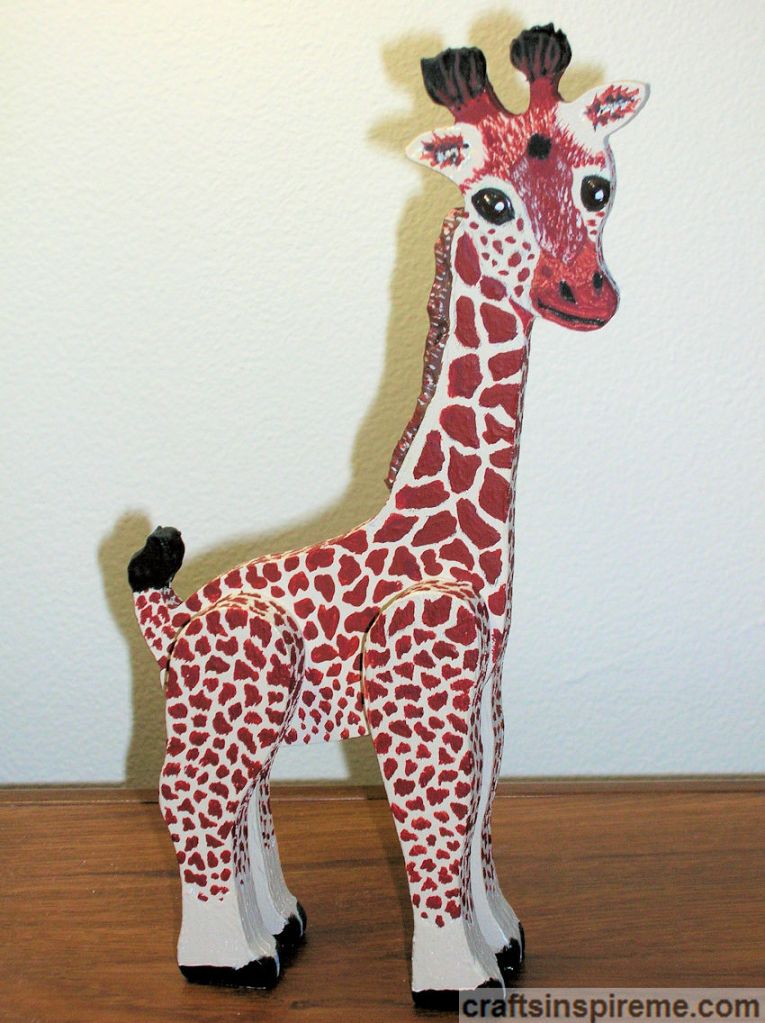
Paint the head and facial details, except for the eyes, which will be completed in a later step. Paint the tail and hooves black. The muzzle and fur between the eyes are darker, while the cheeks are lightly spotted. The “horns” are a combination of black and brown.
Reference – Back of Giraffe’s Head
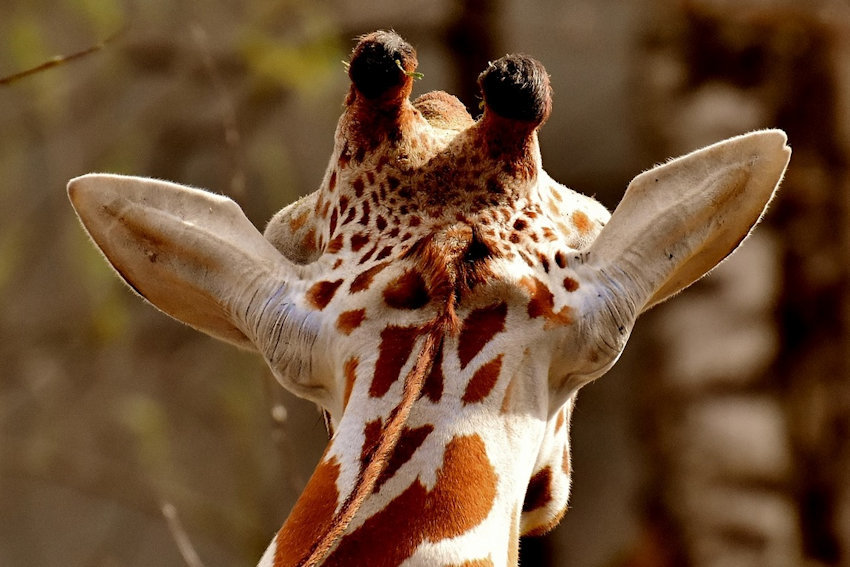
Figuring out the back of the head was difficult. Because our giraffe is looking off to the side, you will only see a portion of the face.
Reference – Back of Head & Mane
When the giraffe moves his head and neck, the mane twists and turns.
Reference – Back of Head & Mane
There are no spots on the ears. Notice how the mane twists as the neck shifts.
Defining the Details – Left Side
Draw the details on the back of the head. Be sure to show the twisting mane. Paint all the details except for the mane.
Paint 3D Details – Right Side
The eyes are painted with brown fabric paint for a 3D effect and outlined in black. After it dries, add black pupils and white dots in the center to bring life to the eyes. Using brown fabric paint, create a raised mane, centered down the entire length of the neck. It will take two coats to make the furry mane to stand upright. Create fur on the “horns” with black fabric paint.
Paint 3D Details – Left Side
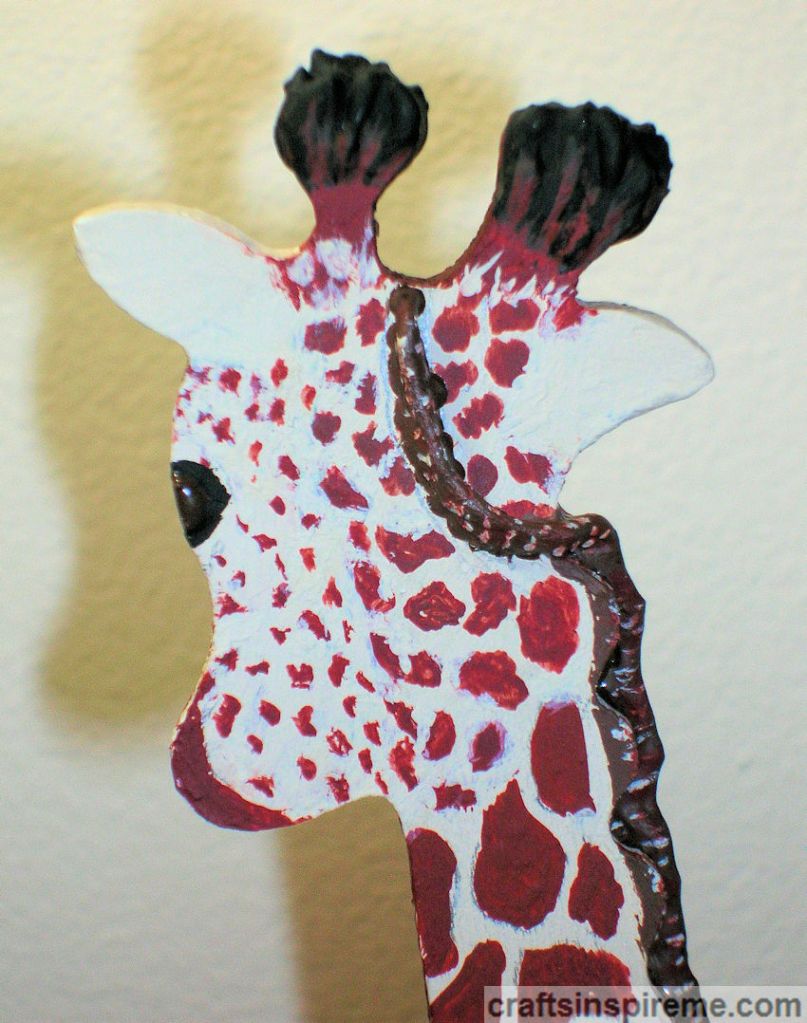
Paint the eye with brown fabric paint and outline with black. Using brown fabric paint, complete the twisted mane on the back of the head. Create fur on the “horns” with black fabric paint. Allow it to dry overnight.
Finished Close Up – Face
The following steps apply to both sides: Because fabric paint is shiny, paint over the mane with brown acrylic and then highlight it with reddish brown and tan. Paint the horns with black acrylic. Some reddish-brown paint was brushed into the ears and up onto the furry horns.
Finished Close Up – Back of Head
Touch up any details as needed. The spots on the left side of the neck, closest to the face, curve toward the face to give a three-dimensional roundness to the upper portion of the neck.
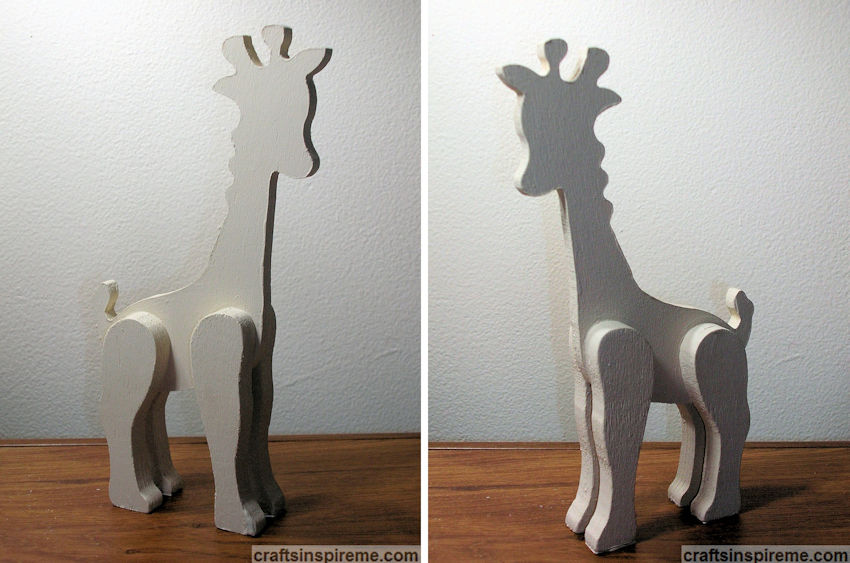
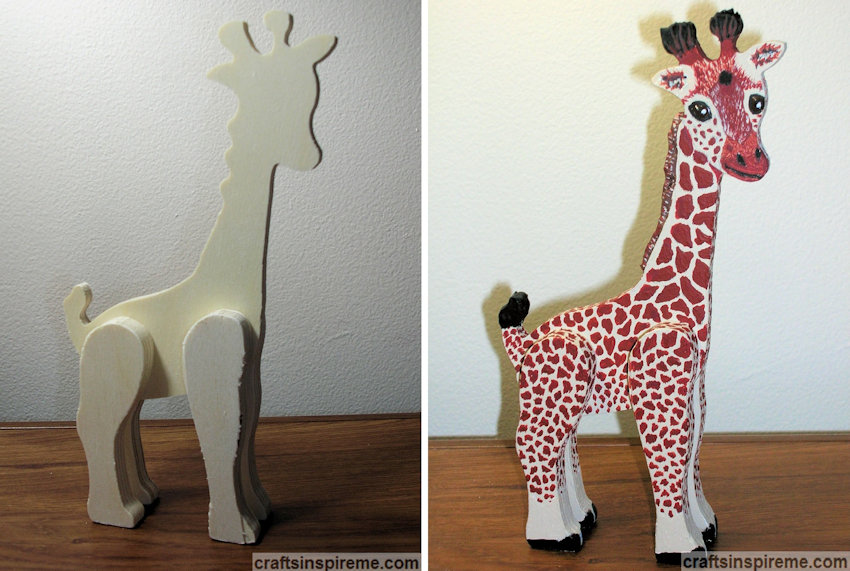
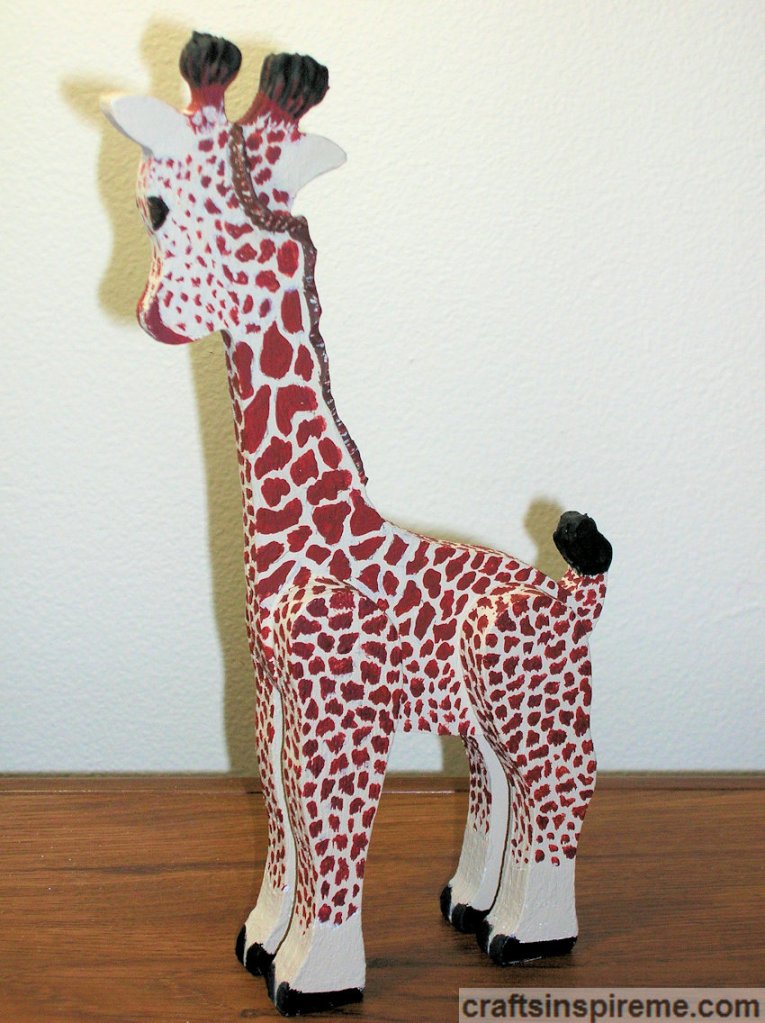
Giraffe – Before & After
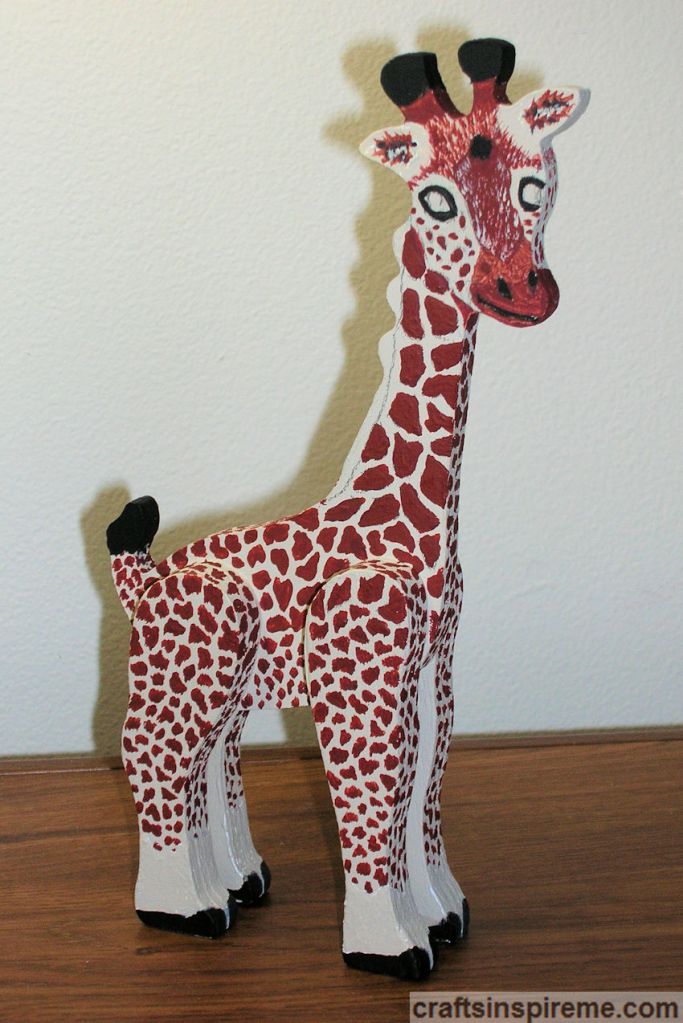
Here is a side-by-side comparison of the original raw wood giraffe and the fully detailed project at completion.
I had a lot of fun painting this little guy. Figuring out the anatomy was challenging and rewarding. There are many wooden animal crafts waiting for good homes. Check out your local craft stores or the internet to find one you will love. Good luck!
Collages can be created by two different methods: 1) “Old School” Traditional -Assemble and glue groups of photos onto a backer board, or 2) High Tech – Use photo editing software. Both methods are fun and produce impressive results. Let’s look at several possibilities…
“Old School” Collages:
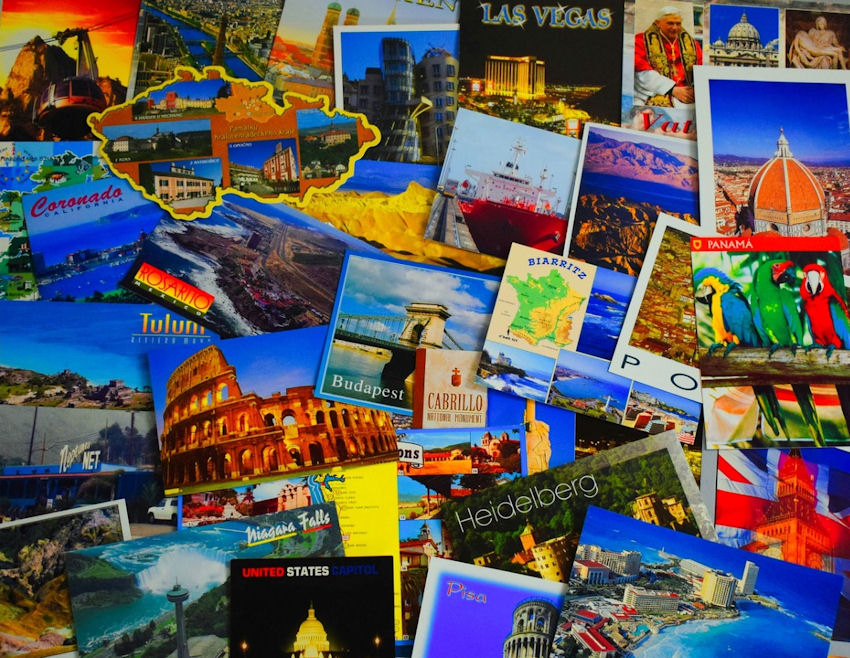
Postcard Collage
Many people collect postcards during their travels. Instead of stuffing them in a drawer, create a collage, frame it, and hand it up so you can reminisce about past vacations and dream of future destinations.
Vision Board
What are your dreams? A vision board helps focus mental and physical energy toward achieving your goals. Magazines, catalogs, travel guides and brochures provide great source material for collages.
For more information about traditional collage making, please click here.
Digital Collages:
Horizontal Grid (a.k.a. Photo Montage)
A horizontal collage is a great way of displaying your favorite photos, such as family members, fur babies, or anything else that warms your heart.
Horizontal Grid
Whatever you love – fireworks, lighthouses, beaches – can be assembled into a frameable work of art.
Layered Images
Compose a one-of-a-kind masterpiece by overlaying multiple images.
Symmetrical Grid
Displaying your collectibles, such as antique door hardware, requires a lot of space, but a photo montage makes it easy to enjoy your collection on a daily basis.
Asymmetrical Grid
The placement and sizes of photos can be easily modified to create a visually pleasing composition.
Custom Grid
With photo editing software, you can experiment with colors, layers, and special effects. Bring your imagination to life right before your eyes.
Hybrid Collages:
Bold Design
Much like the traditional collage making process, images from different photos can be digitally “cut and pasted” onto new backgrounds.
Action Adventure
Spice up your family vacation photos with a few thrills and chills.
Out of this World
To achieve this otherworldly image, photograph a model leaning upon a beach ball. Cut & paste it onto a star filled background. Replace the ball with a photo of the earth and add a planet or two. Enjoy!
Mandalas
Drawing, painting, or traditional collage making would take forever to create this complex mandala. Thanks to digital technology, you can create one quarter of this design and then mirror it vertically and horizontally to complete the circle. You could add three-dimensional sparkle by gluing beads to the completed composition.
Mixed Media Collages:
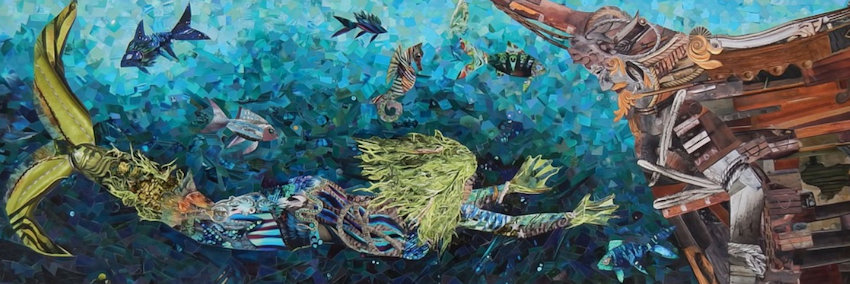
Siren of the Sea
This mermaid and sunken ship can be made using a combination of traditional and digital collage making. The background would be easier to create digitally. After printing out the full-size image, the mermaid and ship could be hand drawn. Based upon desired colors, textures and patterns, pieces cut from the pages of magazines can be glued in place, producing a three-dimensional effect.
Flower Power
Who wouldn’t love eternal spring? Make it a reality by starting with a photo of a beautiful flower garden. Enhance it by cutting and pasting layers of colorful flowers on top of the finished image.
Creature of the Night
A digital sepia tone background can be printed full size on canvas. The owl is drawn and detailed with a combination of markers and paint. Genuine feathers, layered and glued upon the wings, bring this owl off the canvas and into the viewer’s world.
Abstract Words
It is said you should choose your words carefully. Choose a poem or quotes, whatever appeals to you. Layered colors, words, and embossed textures harmonize, creating visual movement and a palpable sense of warmth and peace in this abstract masterpiece.
The Cat’s Meow
What do you think he sees? A bird? A butterfly? Maybe a mouse? Whatever it is, those reflective amber eyes capture our attention. The antiqued background, with embossed floral motifs and pen and ink style writing, ensures this quizzical feline remains center stage. Additional detailing of the cat’s body and punching up the contrast of the purple and green flowers around him will make it appear as if he is sitting in front of a wall.
I hope these collages have inspired you to playfully experiment with the infinite possibilities of photography and collages to create personalized art to be enjoyed for years to come. Please let me know your thoughts in the comments section. Good luck with all your future creative projects.
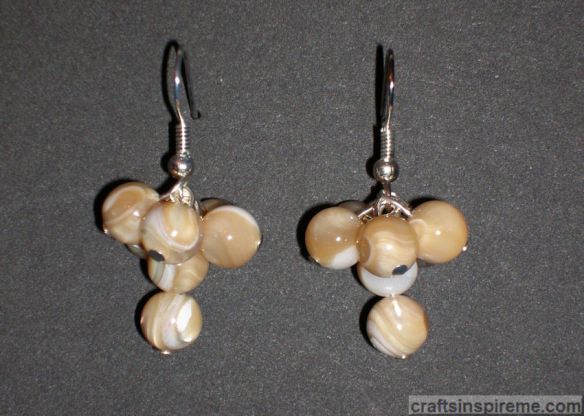
Mother of Pearl comes from mollusks, and is naturally a blend of tan, cream and white, with an iridescent finish. It can be bleached white, or dyed and color of the rainbow. Mother of Pearl beads come in an amazing range of shapes and sizes, while the thicker pieces are carved into cameos and pins, or cut into squares as mosaic tiles. Let’s turn a few round beads into a lovely pair of earrings.
How to Make Natural Mother of Pearl Cluster Earrings
These 1-1/2” long Natural Mother of Pearl earrings swing and shift with your movements, and they’re a neutral color, which coordinates with whatever you’re wearing. In this design, five beads orbit around a dangling two bead central core. These earrings are a little challenging in Step 6. At times you may feel like you have fumble fingers. If you are looking for an easy pair of earrings for beginners, please click here.
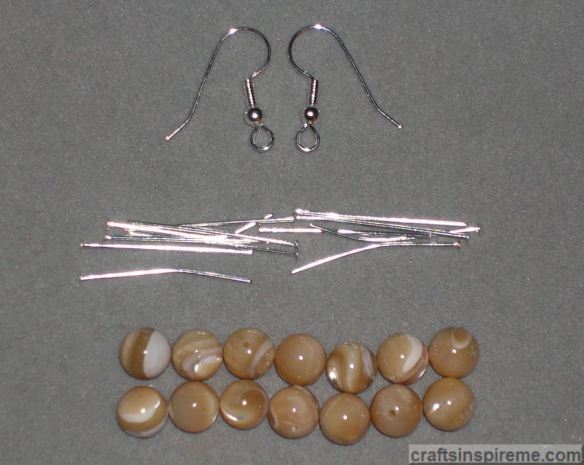
Required Beads & Findings:
Supplies:
To make this pair of earrings you will need:
12) Silver plated Head Pins – 1” length,
14) 7-7.5mm round Natural Mother of Pearl beads,
2) Silver plated Surgical Steel Fishhook Earwires with ball & coil
(Please note: Head pins are the foundation of these earrings. They are inexpensive and come in big packages. Be sure to have several on hand just in case. Craft stores carry jewelry making supplies, including beads, accents, and tools. If you get hooked on jewelry making and yearn for the ultimate selections, look no further than FireMountainGems.com)
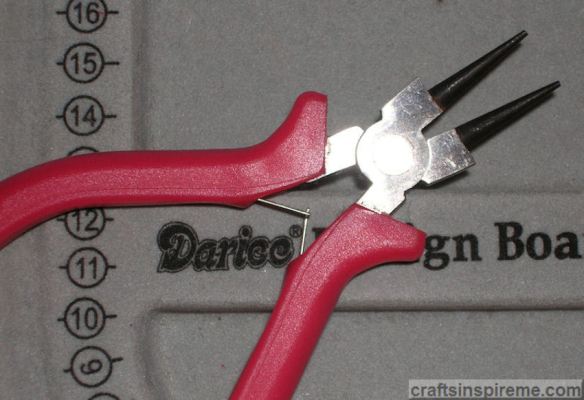
Required Jewelry Making Tools: Round Nose Pliers – the smooth, round tips on these pliers make it easy and safe to manipulate wire, pins, and small jewelry metal pieces known as findings. Please don’t use standard pliers, which have teeth that will damage delicate precious metals.
Jewelry Wire Cutters – a sharp pair of wire cutters makes jewelry making so much easier. Do not use them for other crafts, such as floral arranging, which can damage the blades.
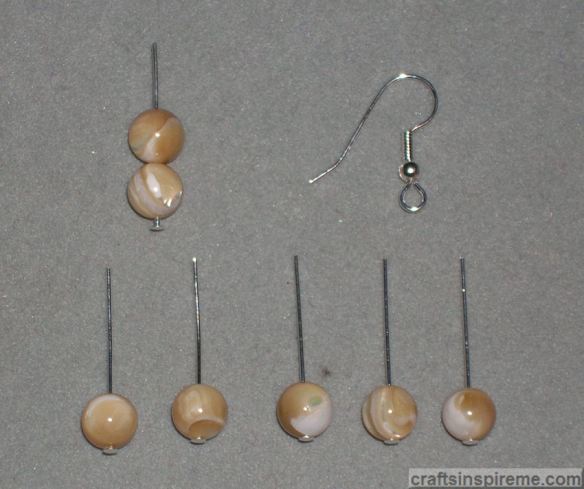
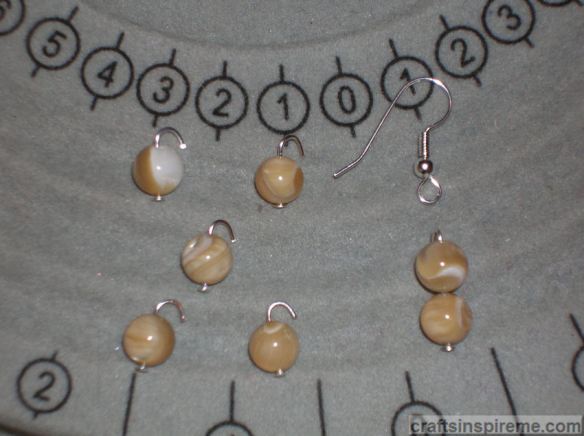
Earring Making Instructions: Step 1: Slide the beads onto head pins as shown.
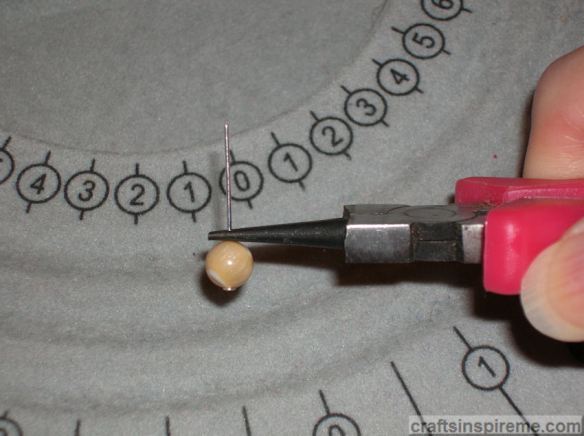
Step 2: With the round nose pliers in your right hand, grip the wire just above the Mother of Pearl bead. Hold the pliers in this position for the next step.
Step 3: Grasp the end of the head pin with your left thumb and index finger, and bend the wire toward you. Continue bending the pin over the tip of the pliers until it touches the Mother of Pearl bead.
The reshaped pins will look like the photo above.
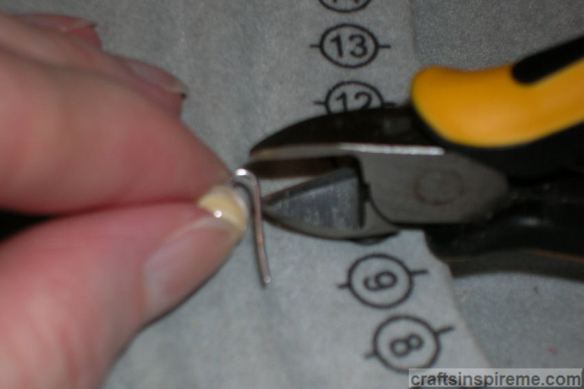
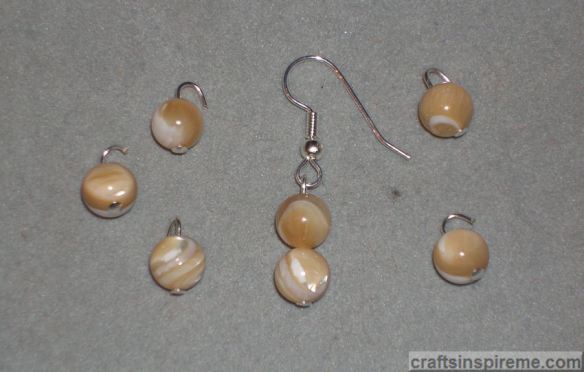
Step 4: Cut off the excess wire. Leave enough wire to form a small loop above the bead. This may take a few tries. Don’t worry if you cut it too short. Simply use a new head pin and repeat the steps.
This photo shows the beads with trimmed pins.
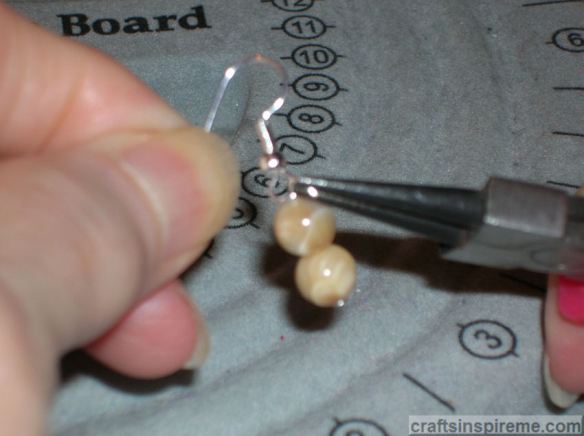
Step 5: Hook the double bead pin onto the loop on the bottom of the fishhook earwire, and close the loop using the round nose pliers.
The earring will look like the above photo.
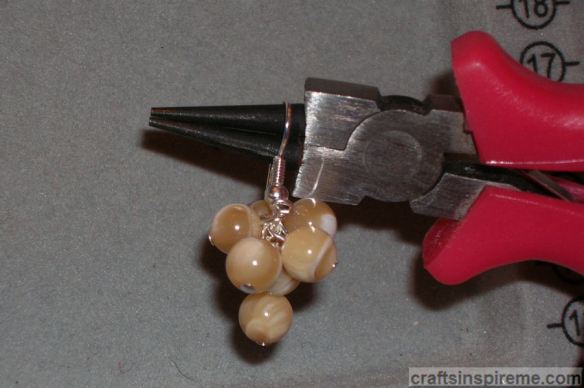
Step 6: Attach the first “satellite” bead to the earwire in the same way.
The earring now has a center core and one satellite bead. Repeat this step for the remaining four beads. If you have trouble getting the beads to lay correctly, remove the dangling two bead central core. Shift the five satellite beads with your fingers until they form a circle around the earwire, and then reattach the two bead central core.
Congratulations! You have successfully made a pair of Mother of Pearl cluster earrings.
Here’s the same pair of earring made with Black Onyx beads. Note how the color dramatically changes the look. You could also experiment with different gemstones, glass or wood beads.
Jewelry making is a great way to explore your creativity. There are so many options available that it’s hard to choose. After making several items for yourself, keep in mind that people love receiving jewelry as gifts.
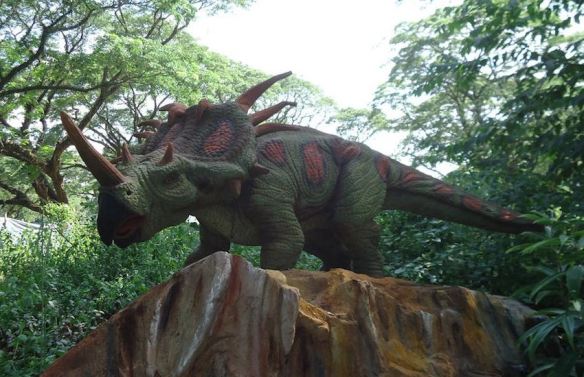
Whose turn is it to walk the dog – I mean dinosaur? Something tells me that 25-foot leash will not be long enough! Dinosaurs are real fan favorites. You can’t get much wilder than that. And what’s not to love?
A Dinosaur Nursery – They’re kind of cute at this stage.
Somewhere between adolescence and adulthood they seem to lose their charm! (lol)
Even when they’re dead, they instill an odd mixture of fear and fascination. Movie Director Steven Spielberg brought dinosaurs back to life on the big screen in the epic movie, Jurassic Park – an emotional roller coaster, that started with awe and wonder, but quickly escalated to bone chilling terror.
We love dinosaurs anyway. Want proof? Look at all the books, movies, television shows, and merchandise. At some point, every kid draws and colors his or her favorite dinosaur. Here’s your chance to feel like a kid again. Grab some paints and brushes and let’s go!
How to Paint a Wooden Stegosaurus
With a little paint you can design your own dinosaur. It can be as simple as a single coat of paint, or as detailed as you like. First we need a little inspiration.
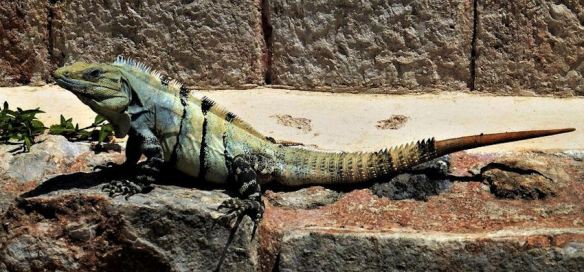
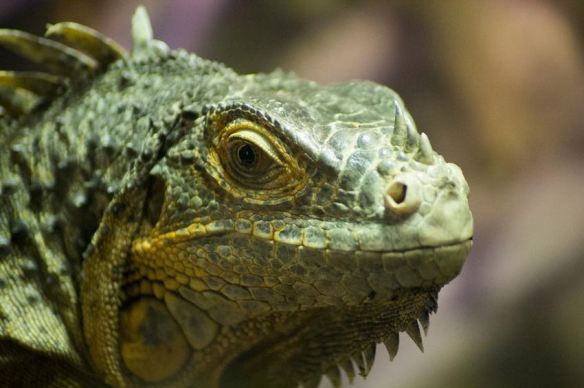
Since dinosaurs lived sixty-five million years ago, there’s no one around to tell us exactly what they looked like. For this project, photos of creatures living today, such as iguanas and lizards, can be inspirational. Check out those spines!
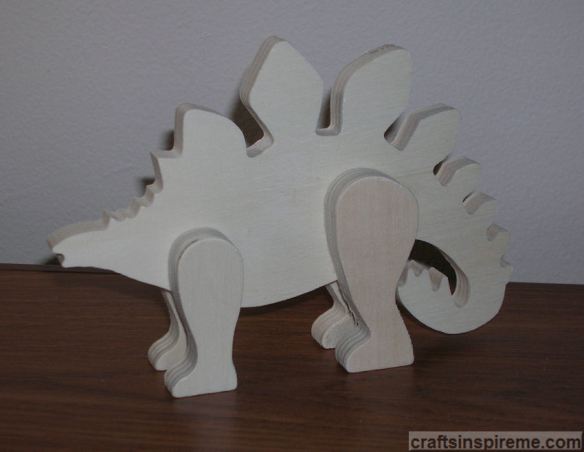
This carved wood stegosaurus, available at AC Moore, has sturdy legs, making it a freestanding, three-dimensional piece. Both sides and all the edges will need to be painted. Due to the raw nature of wood, it may require sanding, especially along the edges. (There are several types of animals in this carved wood collection. To see a painted flamingo project, please click here.)
Supplies:
Wooden Stegosaurus (4-1/4” high x 7-1/4” wide x 1-1/4” thick)
Acrylic Paints – black, brown & metallic green
1) Bottle fabric paint – brown
Paintbrushes
Sandpaper
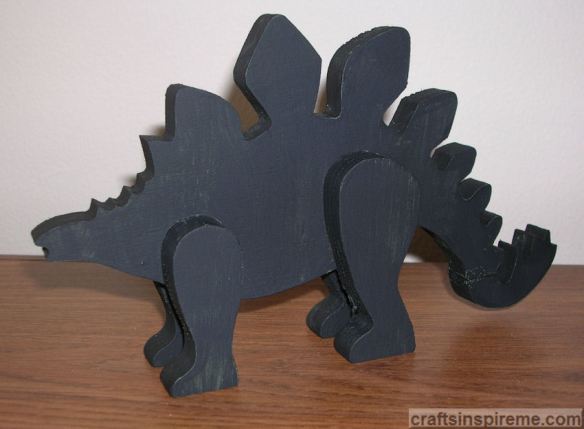
Step 1 – Paint the dinosaur with green acrylic paint, including both sides and all edges. The great thing about paint is that it’s cheap. Feel free to experiment. If you don’t like the results, it can be easily changed.
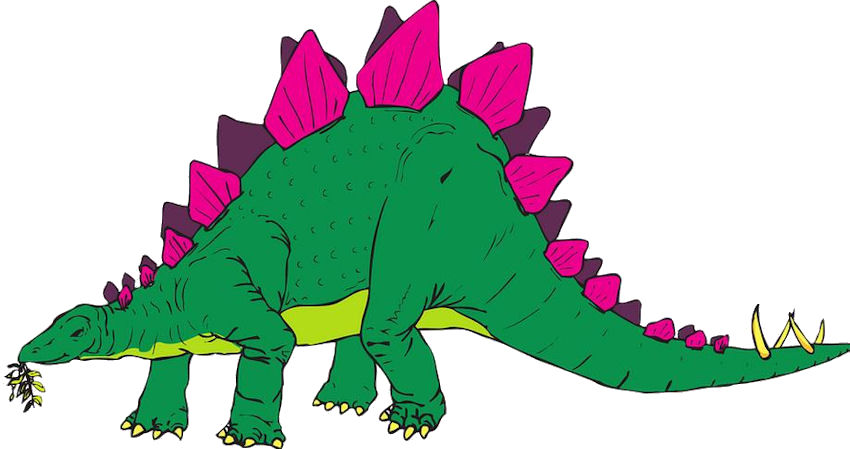
Seeing it in color revealed a major anatomical mistake in the tail design. If you loved dinosaurs as a kid, you’ll remember that the stegosaurus has spikes on the top of its tail. The artist chose to curl the tail underneath, and as a result, mistakenly placed the spikes on the underside of the tail. This poor animal would have trouble walking because the spikes would continually get caught on the ground as it moved through the forest, making it easy prey.
Step 2 – To make it right, cut off the tip of the tail as shown.
Step 3 – Turn the cut tail piece around, and glue it in place. Paint the entire figure black as a base coat, which will help delineate the scales added in a later step. Looks much better doesn’t it?
Step 4 – Paint the top of the head, the back plates, and the tail with brown fabric paint. Paint the sides of each plate with green fabric paint and add spikes along the sides of the tail. Brown acrylic paint was applied with a brush in between the back plates, because it was too narrow to fit the tube of fabric paint.
Step 5 – Add brown fabric paint on top of each leg and more spikes along the entire length of body. Create a scale pattern on the body using metallic green paint, and use the same color in the sides of the plates on his back.
Step 6 – Add a small dotted pattern to each leg. Paint the head brown, and add a few green scales along with the eyes. Congratulations! You now have your very own pet dinosaur. Fortunately for you, he’s a “Veggiesaurus,” unlike the one in the next photo.
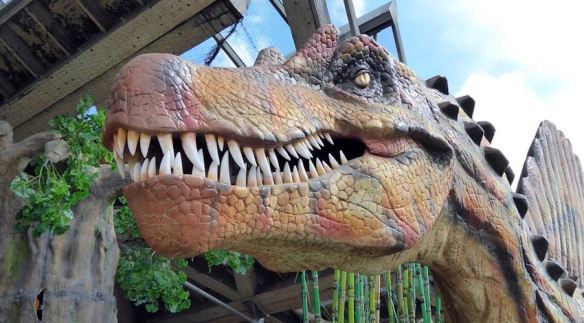
What a view, right? Thank goodness this is only an observation tower! Because if it was real… It would be the last thing you ever saw.
During the holidays, nothing frightens adults more than the words, “Some Assembly Required.” We’ve all been there. Why are there always screws left over? That is a topic for another day. Today, I want to talk about quick and easy ways to put together beautiful gifts and I can assure you no tools are required!
For the Chocolate Lover
Who doesn’t love chocolate? And yes, the zebra print stiletto shoe is chocolate too!
DIY Hot Chocolate or Cookies
All you need is a container, such as a basket, tray, bowl, jar, etc. Come up with a theme for the gift. Gather and arrange the contents in a pleasing way. That’s all there is to it. Let’s look at a few more options:
DIY Dinner for Two
A bottle of wine, pasta and sauce, fresh loaf of bread, etc. You could choose a food theme, such as “A Taste of Italy,” or “An Evening in Paris.”
Lavender Stress Relief/Aromatherapy
Everyone needs to relax and unwind. Lavender is the perfect choice to promote sleep, to reduce stress, and for calming body, mind and spirit. Choose from a wide selection of lavender products, including essential oil, microfiber pillow, body lotion, shower gel or bubble bath, chocolate and tea.
DIY Breakfast Basket
Many people enjoy eating breakfast foods at any time of the day or night. This gift may include, pancake mix, maple syrup, chocolate chips, sausage or bacon, fresh fruit, a bottle of juice, and whipped cream.
For Coffee or Tea Lovers
Start with a great mug or teacup/saucer, add a variety of teas or coffees, and you are well on your way to pleasing the coffee or tea drinkers in your life. Extras may include coffee creamer, biscotti, and chocolate covered coffee beans.
Can’t Get Enough Makeup
Do you know someone who loves playing with makeup? Cosmetic manufacturers have prepackaged gift baskets, cases and bundles filled with lipsticks, eyeshadows, nail polishes, and more.
DIY Spa Day
A spa day is all about pampering. This gift might include plump towels, massage oil, manicure & pedicure kit, candles, facial mask, bubble bath, exfoliating cream, moisturizer, etc.
Holiday Cookies
Everybody loves cookies, especially when they are homemade. Simply arrange your cookies on a decorative plate, seal with colorful plastic wrap, and tie with a pretty bow.
Homemade Muffins & Breads
Homemade muffins and bread are always appreciated, easily portable, and can be stored in the freezer for enjoyment any time of year.
Fruit Basket
Many fruit baskets are available through local stores and on the internet, or you can create your own, filled with all the gift recipient’s favorites.
Still not sure how to put it all together? Here are a few step-by-step gifts for inspiration:
Gift Tower #1 – Sweet Treats
Gathering the Gifts
Biscotti and butter poundcake are the stars of this gift, accompanied by assorted candies, cookies, yogurt-covered pretzels, and kitchen towels. A metal Christmas tray will serve as the base and the recipient can reuse it for years to come.
Assembling the Gift Tower
Stack the items in layers like a three-dimensional puzzle upon the tray.
Wrapping the Gift
You may need someone to help with the wrapping to hold everything in place. Center the tower on the paper, pull up the sides and tie it at the top with yarn or ribbon. You might want to use clear tape to seal any gaps. Tie a fancy bow to complete the gift.
Gift Tower #2 – Athletics
Gathering the Gifts
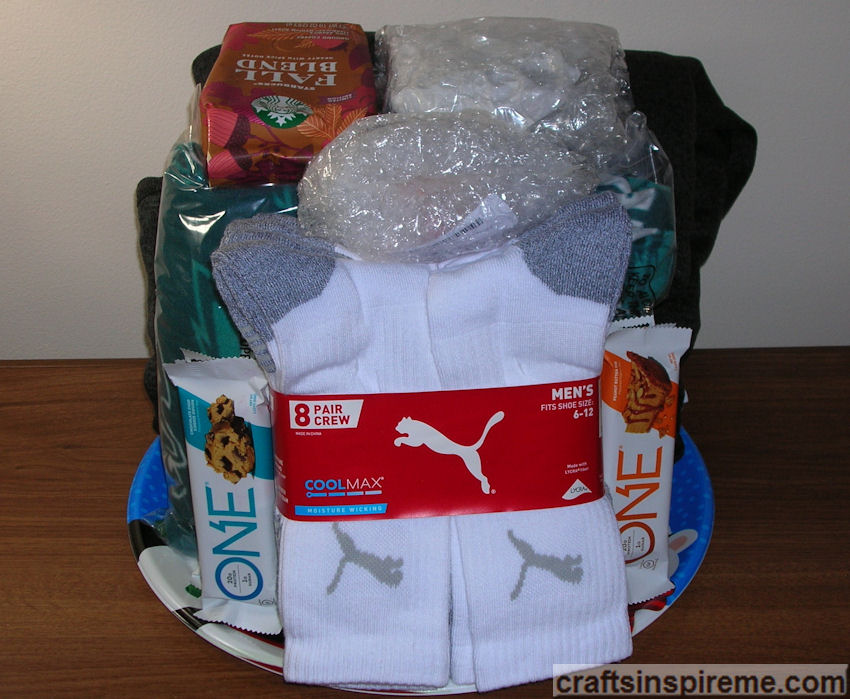
For the athlete in your family, a sweatshirt, socks, a hoodie, and protein bars will be appreciated. Add Starbuck’s coffee, a couple Christmas ornaments and a remote-control vehicle just for fun.
Assembling the Gift Tower
The gifts are stacked with the big items first and use the smaller ones to fill the gaps. If your items tend to shift easily, secure everything in place using yarn.
Wrapping the Gift
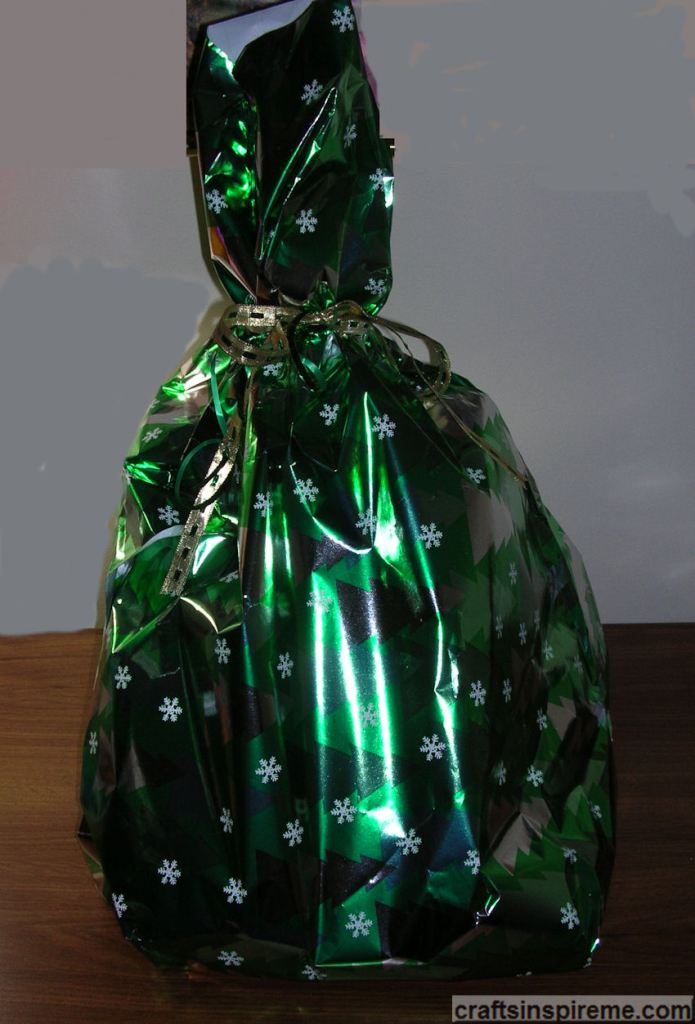
As with the previous gift, pull the wrapping paper upward, gather at the top and tie with an attractive ribbon.
Gift Tower #3 – Hearth & Home
Gathering the Gifts
For someone who loves home furnishings, start with potpourri, kitchen towels, a collectible glass ornament, and a large glass Christmas ball with a three-wick candle hidden inside. Add a few snacks for curling up by the fire and relaxing after a long day.
Assembling the Gift Tower
Fragile items will need to be secured in bubble wrap or boxed. Also, if you have scented gifts, such as potpourri, be sure to keep them separate from food items in the gift tower.
Wrapping the Gift
Festive wrapping paper and a coordinating bow are all you need to complete this gift.
I hope you have picked up a few gift giving ideas for this busy holiday season. Whatever you choose, let your creativity shine.
Thanks for Reading, Happy Holidays & Happy Crafting!
This Christmas tree is unlike most. It consists of individual flat pieces of wood, much like a signpost, ready for your painted decorations and inspiring words.
Words/Poetry
Most of my craft projects do not call for poetic or inspirational words. Grab a piece of paper and a pen and scribble down some possibilities. Take as much time as you need. Listen to song lyrics, read poems, or notice seasonal phrases from movies, books, or advertising.
Christmas Magic Sign
You will need to consider how many words/lines will fit.
Santa Christmas Sign
Use any fonts you like. You could use stencils for the lettering or freehand.
Merry Christmas Sign
Add decorative painted accents such as holly leaves and berries, or enhance your project with accessories like garland, and lights.
Decorated Christmas Tree
Even though this Christmas tree is made with flat pieces of wood, you still need to consider how to decorate it, starting with a color scheme.
Warm Colors
The warm color palette consists of reds, oranges, and yellows.
Cool Colors
The cool color palette includes greens, blues, and purples.
Monochromatic
With a monochromatic scheme, all decorations are the same color, and the variety comes from unique designs.
Multicolor
Create a festive atmosphere with all the colors of the rainbow.
Christmas Tree Lights
Instead of painting Christmas ornaments, you may want to paint lights with metallic acrylics. Another option is wrapping the tree with mini, battery-operated string lights.
How to Paint a Wooden Christmas Tree:
Raw Wood Tree
This freestanding, raw wood tree may need light sanding, especially the edges.
Supplies
Supplies:
Wooden Signpost Tree (28-1/2” high x 10-1/4” wide x 1/4” thick) (base 8”x4”x1/2” thick)
Acrylic Paints – green, yellow, brown
6) Bottles fabric paint: black, purple, blue, orange, pink, glow in the dark white
Paintbrushes
Paint the Tree & Star – Front
Using acrylics, paint the star, the “branches” and the trunk. You will need a thin brush to paint the trunk between the slats of green. Paint both sides of the tree, the base and all the edges.
Paint the Tree & Star – Back
Because this tree is meant to be seen from both sides, I came up with a finished design for the back. Paint the trunk brown from the base to the bottom “branch,” and green for the remainder.
Paint Details – Back
Apply fabric paints in thick dots to resemble ornaments upon the tree.
Repaint Star – Back
I didn’t like the look of the squared off piece of wood on the back of the star and thought it would better to see the full star on both sides. To accomplish this, I extended the star shape and filled it in with yellow as shown. A smiling face was added to the star, using black fabric paint, to give it personality.
Finished Tree – Back
The back of the tree is now complete. Only two more steps to complete this project.
Finishing the Tree – Front
Using black fabric paint, write the words you have chosen upon each board. Finish by giving the star a cute face. Allow it to dry overnight.
Finishing the Tree – Front
Using glow in the dark white fabric paint, trace the black letters to make them stand out better against the green tree. Every night, when you turn out the lights, the glowing words will make you smile. And what a nice way to fall asleep with inspirational thoughts floating in your dreams.
I hope you enjoy this project and are inspired to explore your creativity. Good luck in all your artistic endeavors and have fun decorating for the coming holidays!
In search of the perfect Christmas ornament? Found it!
If you haven’t found what you were hoping for, create it yourself! These clear Christmas balls don’t look like much in the box, but let your imagination soar and you’ll be amazed at what you can accomplish.
Metallic trim, fabric paint, glitter, and self-stick rhinestones are just a few of the possibilities to transform those plain plastic or glass balls into treasured ornaments for the tree.
At its most basic, color is usually the first decision. Plastic balls usually only come in clear but glass ones come in clear as well as assorted solid colors. To add color to a clear ball you have two options: 1) Apply paint to the exterior using a roller; 2) Pour paint inside the ball, drain the excess and allow it to dry upside down overnight. Applying paint on the inside preserves the reflective sheen on the exterior.
Ribbon and glitter provide sparkle and attractive patterns on these red ornaments.
Create a geometric pattern of your choice using glue and then roll the ball in glitter. After it dries, lightly brush off the excess and it’s ready to hang upon the tree.
This star got its sparkle by applying a layer of glue over the entire surface of the ornament and then rolling it in gold glitter.
You can fill clear ornaments with anything small enough to fit through the top, including beads, leaves. confetti, ribbon, seashells, sand, and flower buds.
Create texture using fabric paint. After the paint dries, spray the entire ball white and follow it with a spray of textured spray paint for a snow-covered effect.
This snowman was hand painted onto a red ball. If painting is not your strong suit, purchase self-adhesive decals from the paper crafting section to achieve the same look.
Maybe you prefer a little glitz and glam. If so, sequins are your best bet.
Silver & gold are a very popular color combination. Paint a metallic silver base layer. For the stars, apply glitter while the paint is still wet. Self-stick gold rhinestones were applied to the ball after the paint dried. As an alternative, you could use rhinestone studded trim to wrap the Christmas ball.
Ribbons and flowers make beautiful tree ornaments. If you like the look of snow, you can add crystals to the edges of flower petals as shown above. The Christmas ball is adorned with tiny bows.
If you love Tim Burton’s movie, Nightmare before Christmas, these two familiar characters will bring a sense of mischievous humor to your tree. Use metallic paint for the base coat applied with a roller to avoid brush marks. Use a black Sharpie pen for the details.
Glitter, patience, craft glue and a very steady hand are all required for this challenging delicate pattern. To simplify the process, use fabric glitter paint, which provides color, glitter and three-dimensional patterns in one easy step.
A few quick sprays of snow in a can will create this icy looking Christmas ball.
Overlap large no hole sequins, also known as paillettes, to create this flower-shaped ornament.
Spice up a plain gold ornament with silver glitter vertical stripes.
Use gold glitter fabric paint to create this forest of evergreen trees and stars in the sky. For extra texture, apply additional glitter to the trees while the paint is still wet.
This ornate pattern could be created a couple different ways. The simplified version could be achieved using a metallic gold sharpie pen. Another option is using gold ribbon for the thick horizontal lines, followed by thin glue and glitter. Green rhinestones are glued at the intersections as shown.
This rainbow ornament was made using a styrofoam ball, sequins and lots of pins.
Red beads in several sizes provide rich juicy looking color. The white ball has a combination of fabric paint, powdered “snow” and some scattered tiny silver sequins.
An ombré paint technique followed by the application of clear snow crystals gives this ornament the look of a frosted peach.
Silk flowers inserted inside the clear glass ball appear to bloom. To keep the flower in place, you may need to apply a small drop of clear glue using an extra long cotton swab or skinny craft stick.
Mosaic ornaments are quite beautiful. You could also use seashells or pompoms to create a similar look without the need for cutting any pieces to fit.
Rows of tiny sequins and braided white trim form the pattern on this striped ball.
These three-dimensional holly designs were created using fabric glitter paint, followed by loose glitter while the paint is still wet. It may require two coats to build up the thickness on the outer edges of the leaves. The inner sections of the leaves have green glitter. Glue red or green rhinestones on as berries.
The holidays are an excellent opportunity to exercise your creative muscles. By designing your own ornaments, you’re guaranteed to have a uniquely stylish Christmas tree featuring some of your best work. As your collection grows, they’ll become heirlooms with a lifetime of memories. Enjoy the creative process. You’ve got this!