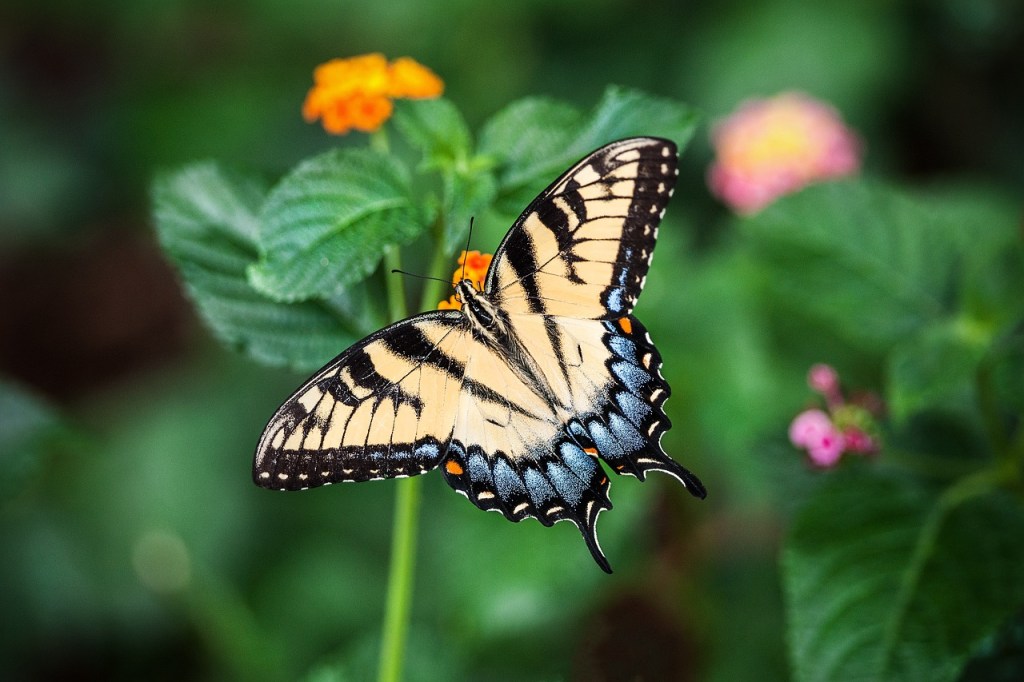
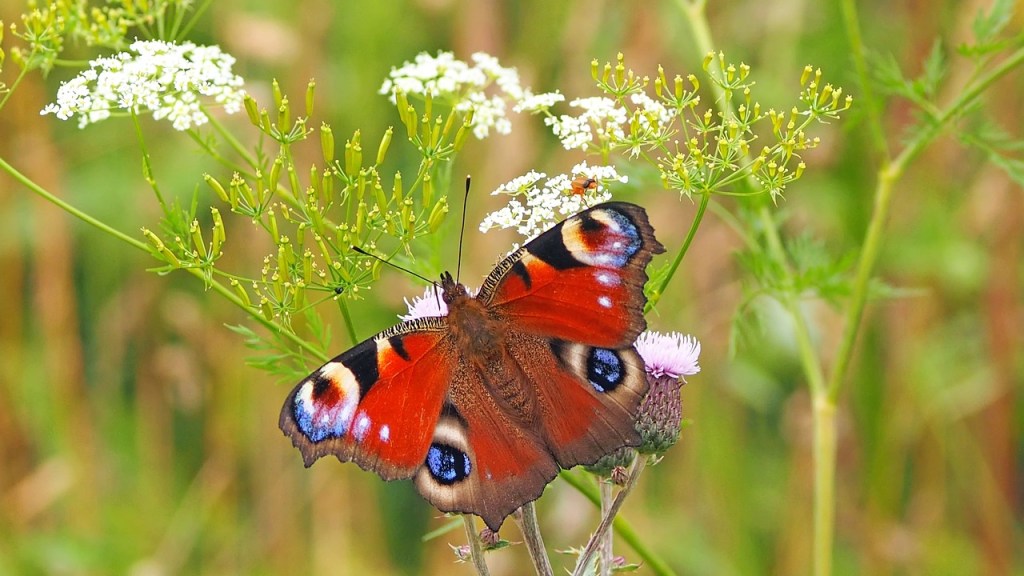
As new blooms of spring dazzle us with their beautiful pastel or jewel tone petals, equally attractive butterflies gather sweet nectar and flutter away like fairies in the wind.
Experiences like this make it easy to believe in magic.
For our project this week, we will create a beautiful butterfly garden, which will always be fresh and colorful as a spring morning, and it never needs to be watered. Let’s get started…
How to Paint a Wood Carved Butterfly Garden:
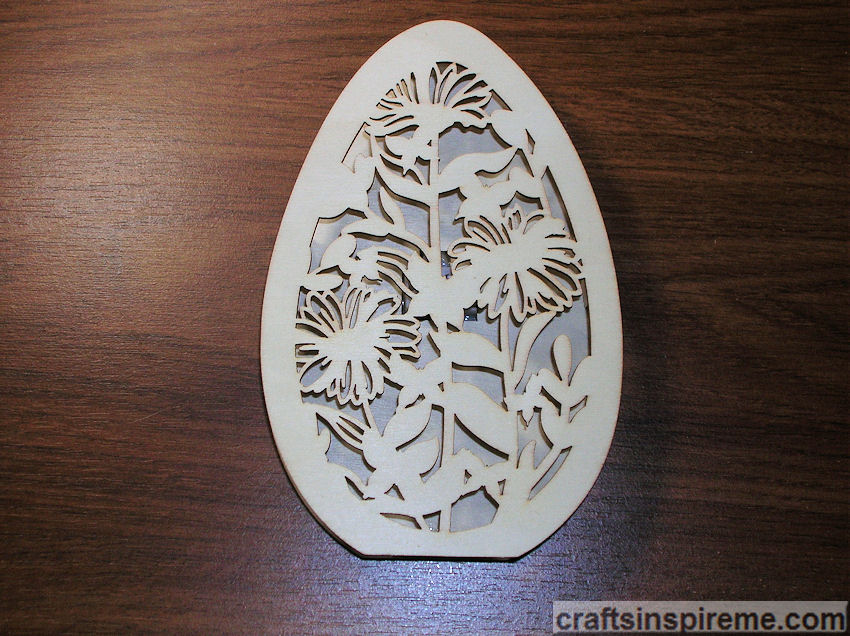
Raw Wood Flower Garden
When I first saw this wood carving, I didn’t notice the butterflies. As you begin to add colors, the butterflies appear almost like magic.
Markers
Acrylic Paints
Supplies:
LED Wooden Flower Garden (7” high x 4-1/2” wide x 1-1/8” thick)
Markers – blue, lavender, green, fuchsia, red, yellow & black
Acrylic Paints – white & blue, plus metallic paints: gold, rust, blue, & purple
Paintbrushes
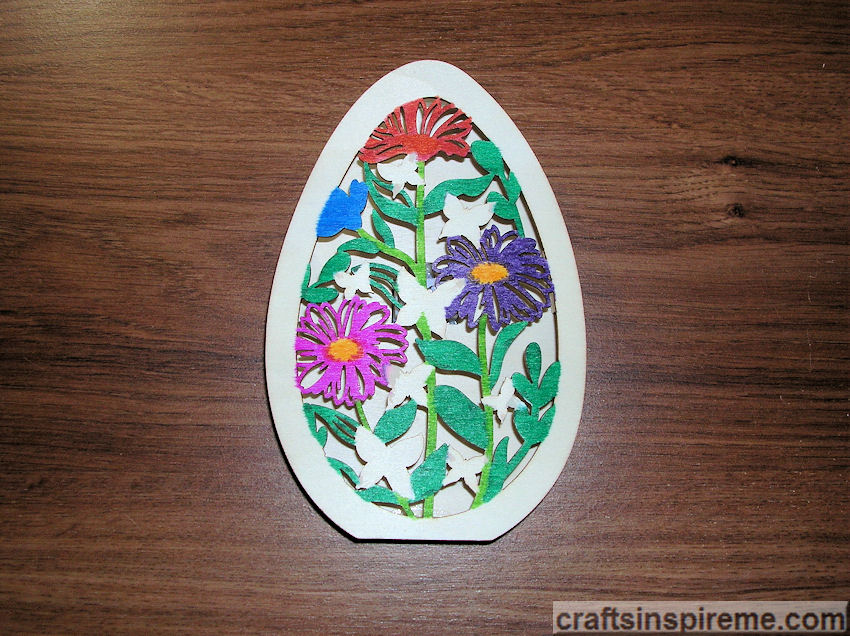
Color with Markers
Begin coloring the flowers and leaves. If you are undecided between two colors, try the lightest color first. You can always go darker, if desired. If you make a mistake, it can be covered with paint to match the wood and then try again with the markers.
Color Remaining Leaves with Markers
The butterflies really stand out now against the boldly colored leaves and flowers.
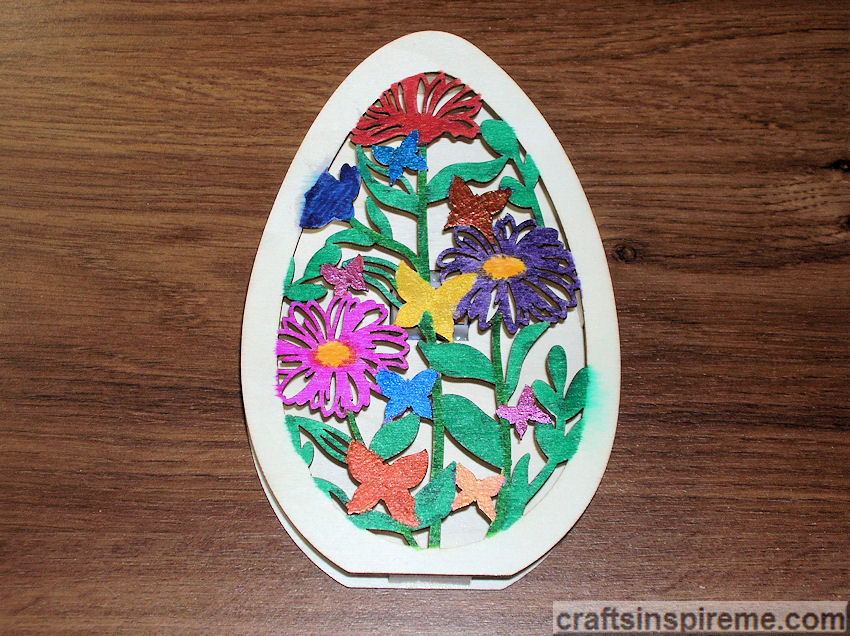
Paint the Butterflies with Acrylics
I experimented with different base colors for each butterfly, depending upon how well they contrasted with the surrounding vegetation. To complete this project, you could paint the butterfly wing details with acrylics too, but I had already decided to use three dimensional paints, as shown below.
Create wings patterns with dots, stripes, contrasting colors, etc.
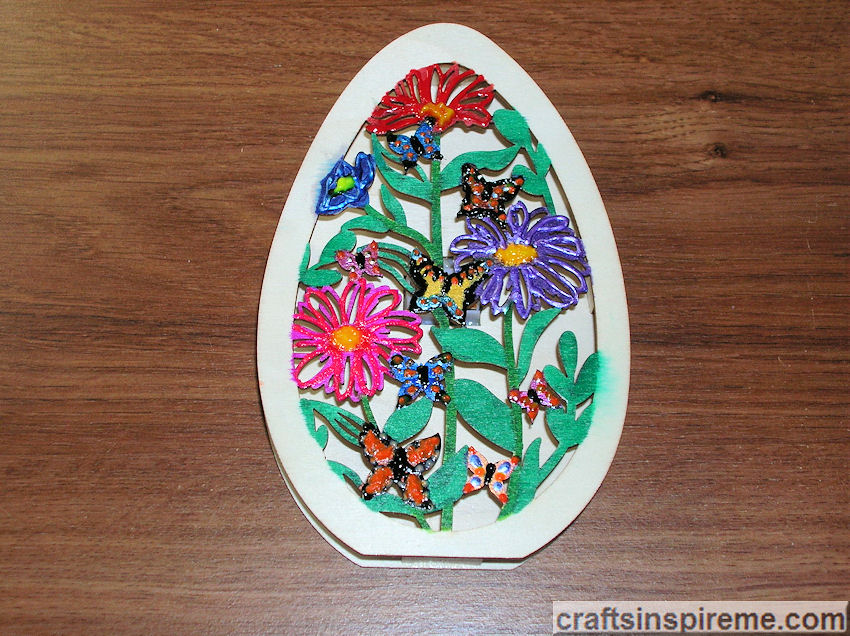
Paint the Flower Petals with 3D Paints
Define Details by Layering 3D Paints
Finished Project
Define leaf veins, stems, and flower centers with 3D paints. I added vines and leaves in a few spots along the perimeter. Paint the outer edge and backer board with light blue acrylic paint.
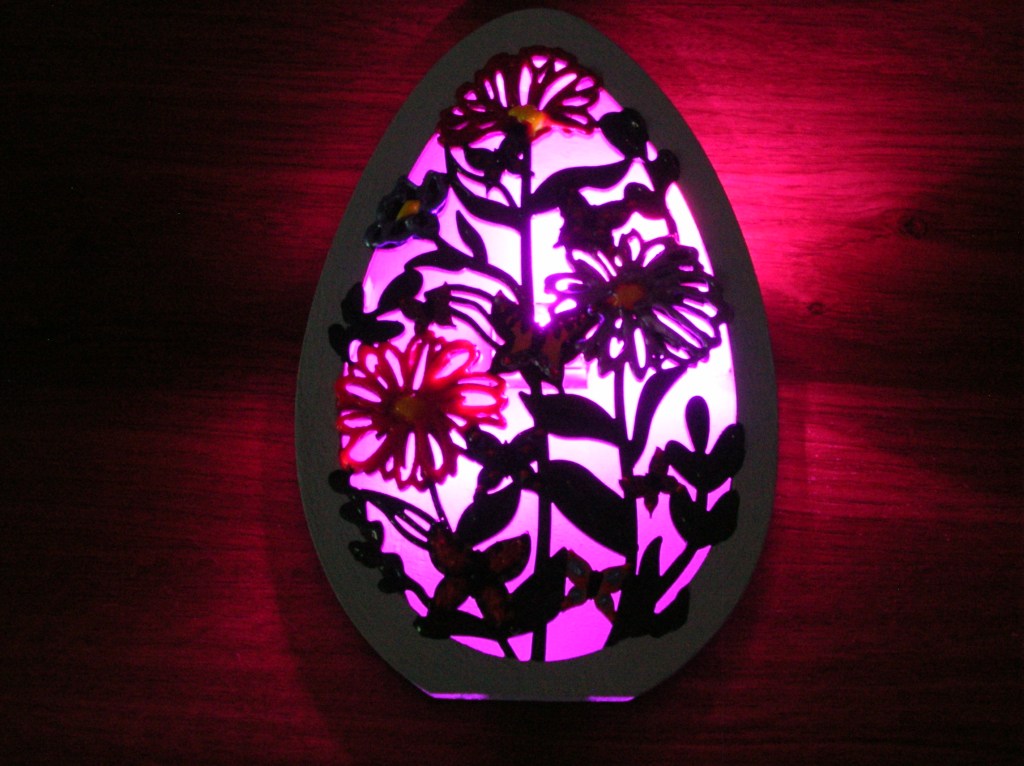
Finished Project Lit
The concealed LEDs give a soft purple glow in the dark, which serves perfectly as a nightlight.
I hope you enjoyed this transformative journey. Together, we have created a garden that will last for generations to come. What is your favorite flower or butterfly? Please let me know in the comments section.
Many people think the symbolic cross originated in Christianity, but the cross has been used for centuries by many ancient cultures, including the Egyptians and Babylonians.
Ancient Egyptian Ankh
In ancient Egypt, the ankh represented “Life.”
Compass on Ancient Maps
Crosses have been found in prehistoric cave paintings, most likely indicating astronomical events as well as the cardinal directions, much like the compass shown on the map above.
Crosses can be found in very diverse places, such as cemeteries, churches, clothing, and even jewelry. Before designing a cross, let’s take a look at a few more examples:
Greek Cross
The ancient Greek cross had equal length arms and resembled the letter “X,” while the more modern version has the typical upright design and the addition of three lobes at each end.
Celtic Cross
The cross tombstone in the photo above illustrates the intricately woven knots, which are an integral part of every Celtic design.
Ornate Sterling Silver & Turquoise Cross
Silver or gold, jewel encrusted crosses reflect light and dazzle the eye with ornate patterns and precious gemstones of all kinds.
Contemporary Stained Glass Cross
Brilliant stained glass in a kaleidoscope pattern twinkles in the sunlight in this very contemporary window.
Maltese Cross
The Maltese cross has four V-shaped arms. It has a more subtle cross design, which in this case could be easily mistaken for a flower.
How to Design Painted Wood Crosses:
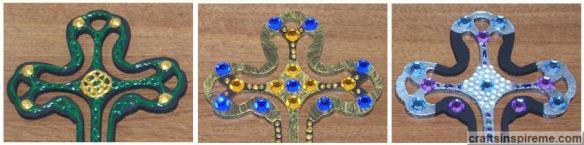
Instructions for 3) designs are presented below: Celtic, Jeweled Gold, and Jeweled Silver.
Raw Wood Cross
Each raw wood cross is sanded lightly, as needed. The supplies needed vary according to the design chosen. If you happen to have colored pencils or markers on hand, you might want to trace the cross onto sheets of paper and color a few samples to help narrow down your design choices.
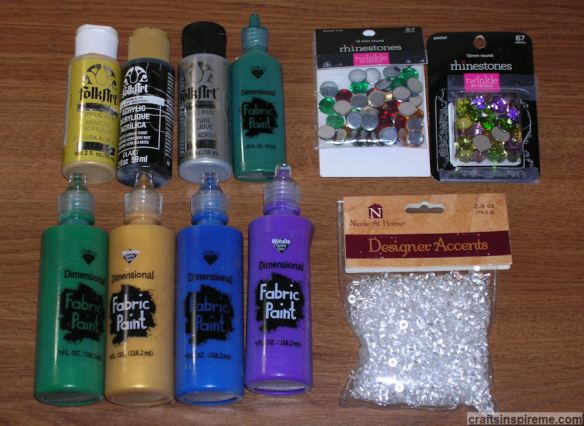
Supplies Supplies:
Wooden Cross (8-1/4” high x 5-3/4” wide x 1/4” thick)
Acrylic Paints – black, metallic gold, metallic silver
5) Bottles Fabric Paint – dark green, medium green, blue, purple, & metallic gold
1) Package – 12mm round Jewel Tone Rhinestones
1) Package – 12mm round Pastel Rhinestones
1) Package – Clear Diamond-shaped Rhinestones
Paintbrushes
Sandpaper
Cross Painted Black
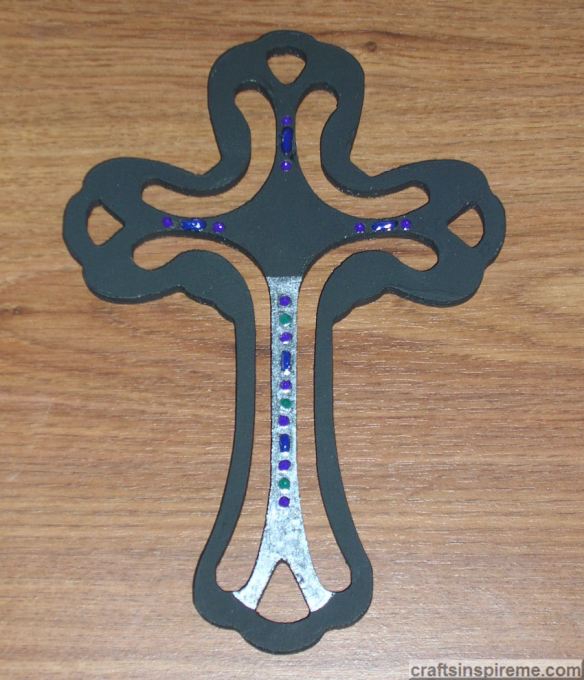
Each cross design in this project starts the same way, by applying 2 coats of acrylic black paint as a basecoat.
The Celtic Cross:
Paint the perimeter details using medium green fabric paint for a 3-dimensional effect. Single lines and infinity symbols make up this pattern.
Using the same fabric paint, paint the inner details including woven chains, and a large Celtic knot design in the center. Create pairs of large round “beads” of paint at each end (top, bottom, left and right).
For a more 3-dimensional effect, carefully apply a second coat of fabric paint. After it has dried, add the gold details using metallic gold fabric paint. This completes the Celtic Cross design.
Gold Jeweled Cross:
Your first decision is how much gold versus black you want to have in the design. Using metallic gold acrylic paint and a brush, I created a starburst at the center, which radiates outward to the ends. A studded detail was created using metallic gold fabric paint.
Experiment with different colors and placement of the rhinestones. Do not glue them down until a later step. After seeing this, I decided to increase the gold areas for a more opulent appearance and because the blue “sapphires” look better against the gold.
Here you can see how the gold has been enhanced, leaving only a few key areas black. All the inside and outside edges have also been painted gold.
In this version, three colors of rhinestones, blue, green, and yellow, have been used.
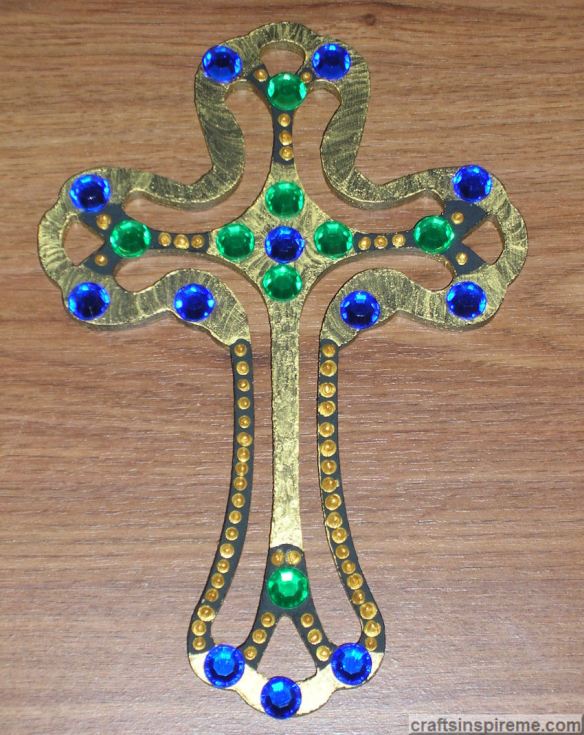
Here the rhinestone colors were limited to blue and green.
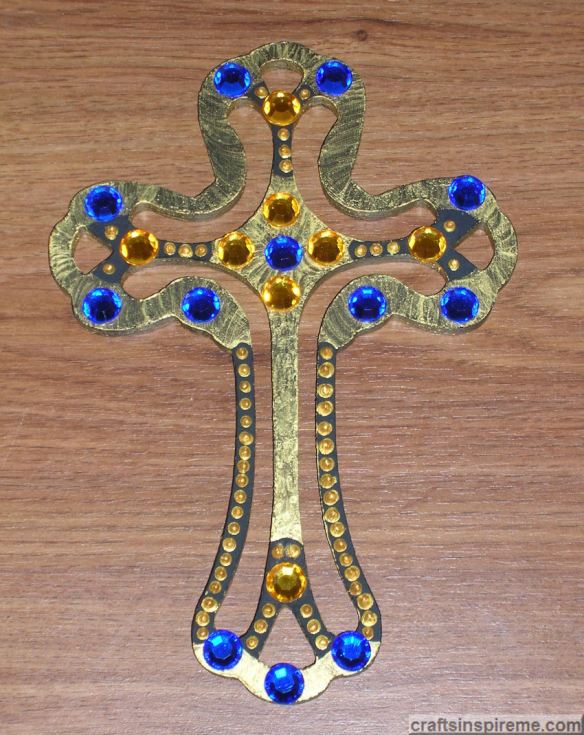
This is the finished version with blue and yellow rhinestones. The deep yellow coordinates well with the rich metallic gold. Use Elmer’s glue to affix the gems. This completes the Gold Jeweled Cross Design.
Silver Jeweled Cross:
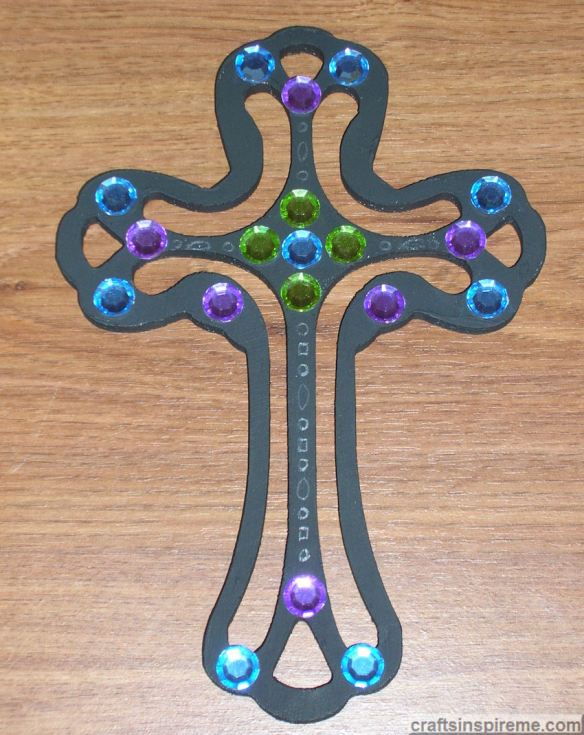
I had pastels in mind for this cross. I started out by testing different combinations of pastel colored rhinestones. I liked the light blue and purple with the green center.
Metallic silver and black make a powerful combination with maximum contrast and reflectance. The rhinestone colors were carried into an alternating painted “gem” pattern created using dark green, blue and purple fabric paint in gemstone shapes.
The remaining inner portions, including the edges, are painted with acrylic metallic silver paint. Layout the rhinestones, but do not glue them down until a later step. Clear “diamond” rhinestones are glued in the center along with one round blue stone.
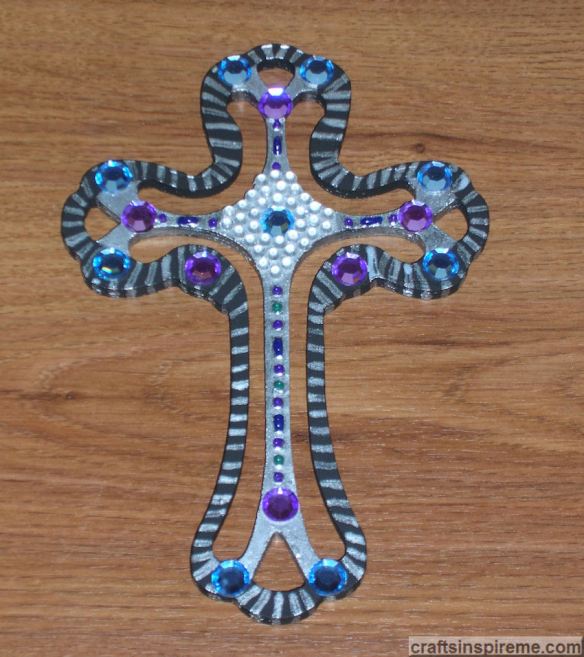
It felt like a little more silver was needed. I painted stripes at each end of the cross and then added more stripes along the outer edges.
Feeling good about the design, more stripes were added throughout the design. I have never been a big fan of stripes, so I’m not sure why I did this. The nice thing about paint is that you can easily change your mind and simply repaint.
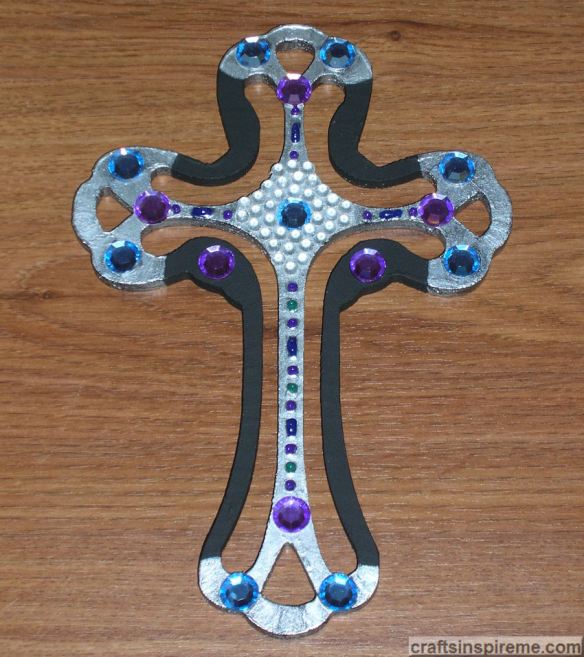
It took 2 coats of black to cover the stripes. Metallic silver was painted at the ends, and only those edges were painted silver, while the remainder was black. This completes the Silver Jeweled Cross design.
Finished Cross Designs:
Each of these crosses has its own unique style, but they barely touch the surface of design possibilities. Take a trip to the craft store to see what kinds of decorations appeal to you as well as the different styles of wood crosses available. In fact, you might have so much fun making the first one that you’ll have to go back to buy more.
Regardless of whether you call it a bar, pub or saloon, bartenders frequently say to customers, “Pick Your Poison.” If you are unfamiliar with this expression, it means what kind of alcohol do you want. I found a “Pick Your Poison” sign, which will make a great addition to my brother’s bar. Let’s get started.
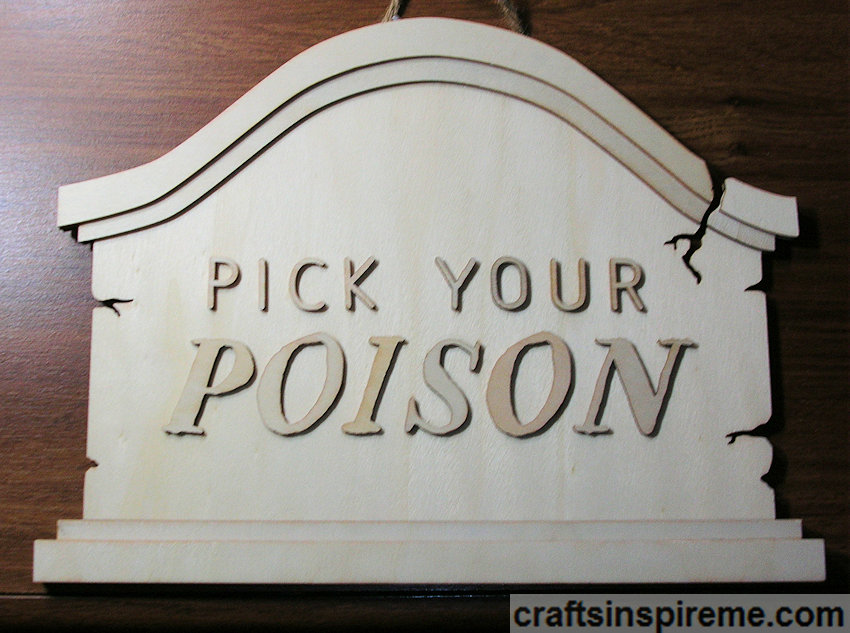
Unfinished Sign
I purchased this sign at Michaels Arts & Crafts from their Halloween collection. Experiment with color schemes on scrap paper and then choose your supplies. Later in this post, you will see further experimentation using photo editing software.
Supplies
Supplies:
“Pick Your Poison” Sign (14” wide x 1” deep x 8” high)
Acrylic Paints – black
Magic Markers – green, black
Paintbrushes
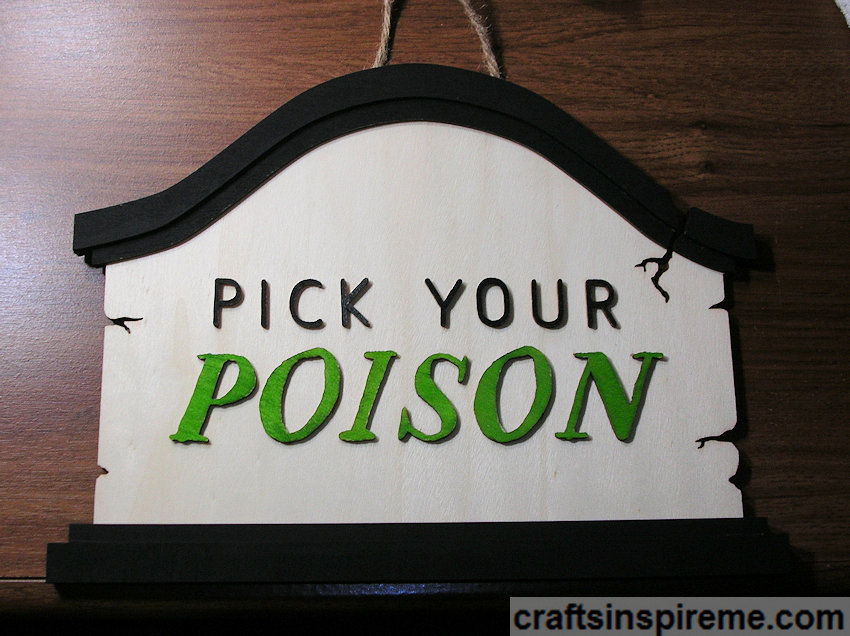
First Line Colored Black
Using a black marker, color the top line of text. It may require a few coats.
Second Line Colored Green
Color the next line of text green. It may require a few coats.
Top & Bottom Trim Painted Black
Paint the trim black. I wanted the word poison to really stand out but the marker just wasn’t enough. I switched to paints as you will see below.
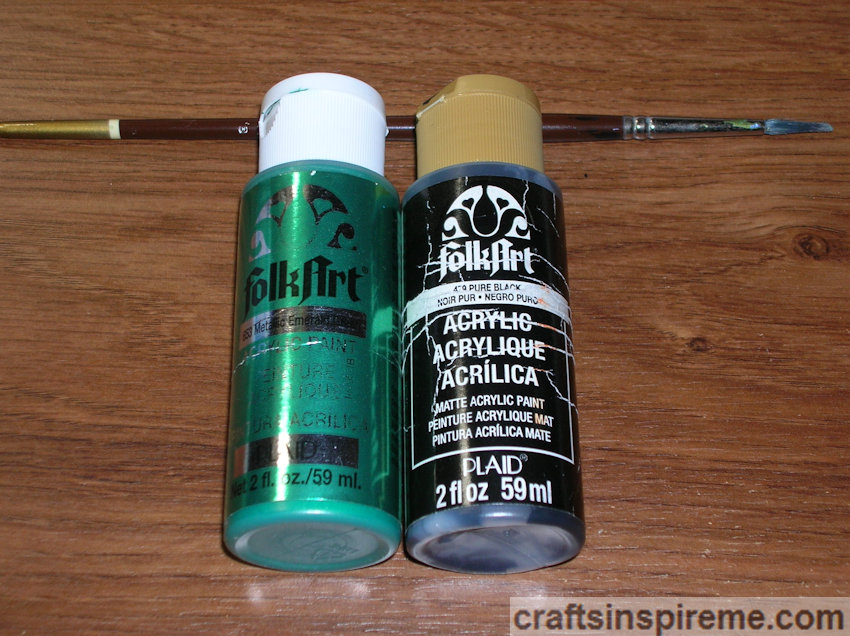
Revised Supplies
Revised Supplies: Acrylic Paints – black, metallic green Paintbrushes
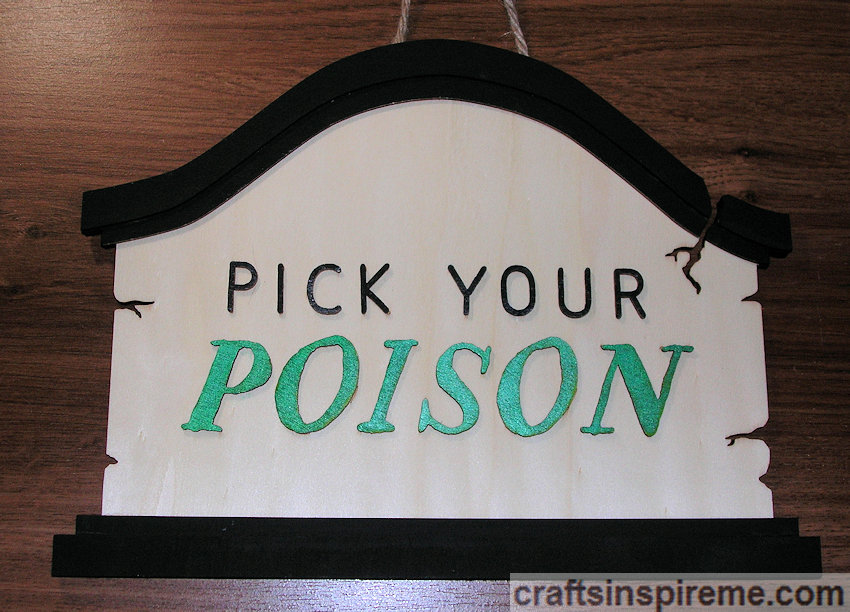
Painted Letters
Paint the word Poison with several coats of metallic green. I considered adding drips of 3D paint to make the green letters appear to be bubbling or oozing but decided against it. You could stop at this point if you like the wood grain background.
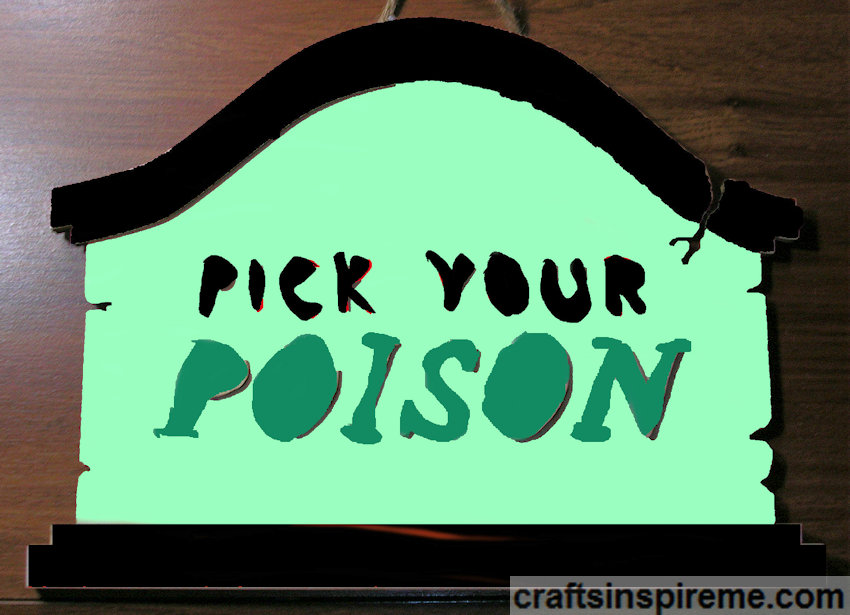
Photo Editing – Experiment 1
Using photo editing software, I experimented with different background colors. I was just dabbling so I apologize for the sloppy lettering. It was just what I needed to decide how to proceed.
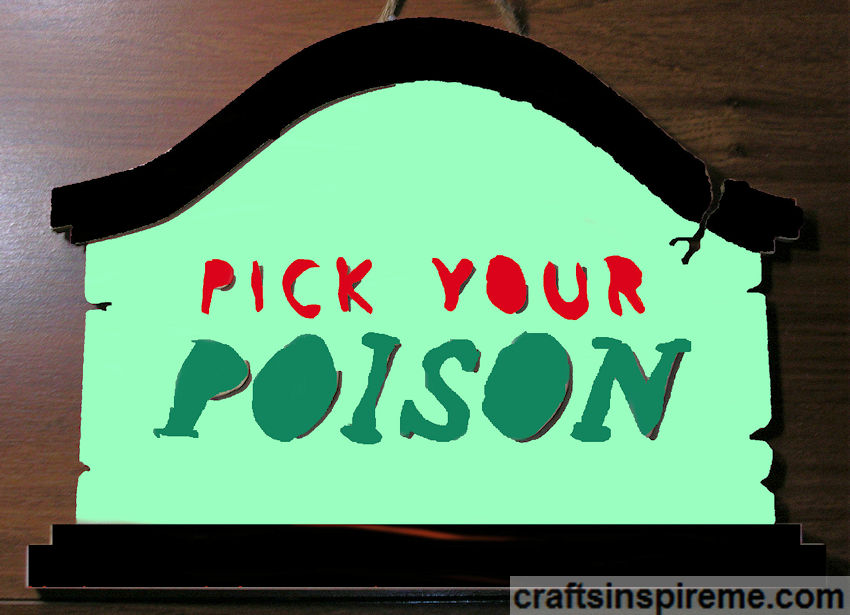
Photo Editing – Experiment 2
I also tested different color combos for the text against the new backgrounds.
Photo Editing – Experiment 3
Because I liked the high contrast and implied sense of danger, I chose red as the background color.
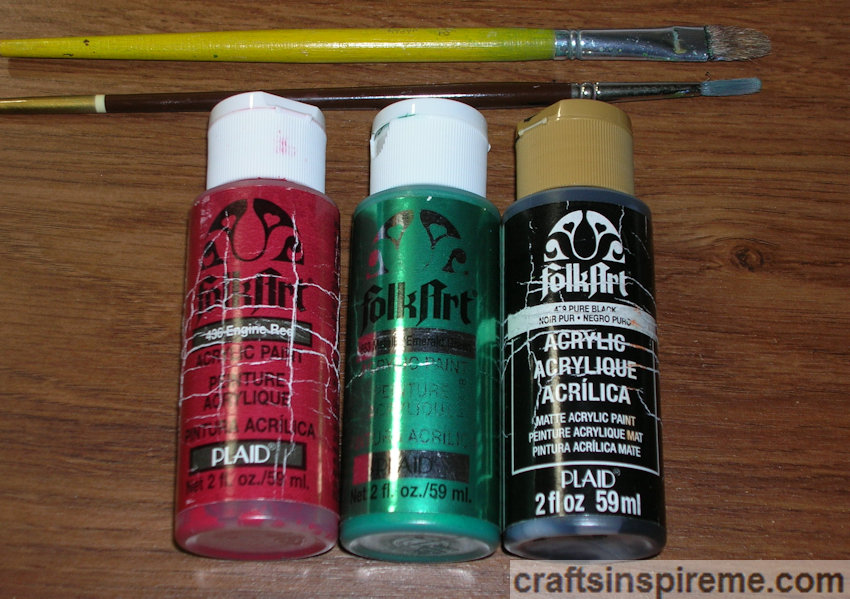
Finalized Supplies
Finalized Supplies: Acrylic Paints – black, metallic green, red Paintbrushes
Painted Background Red
Paint the background red. Due to streaking, which did not appear until after the paint had dried, it took several coats of paint.
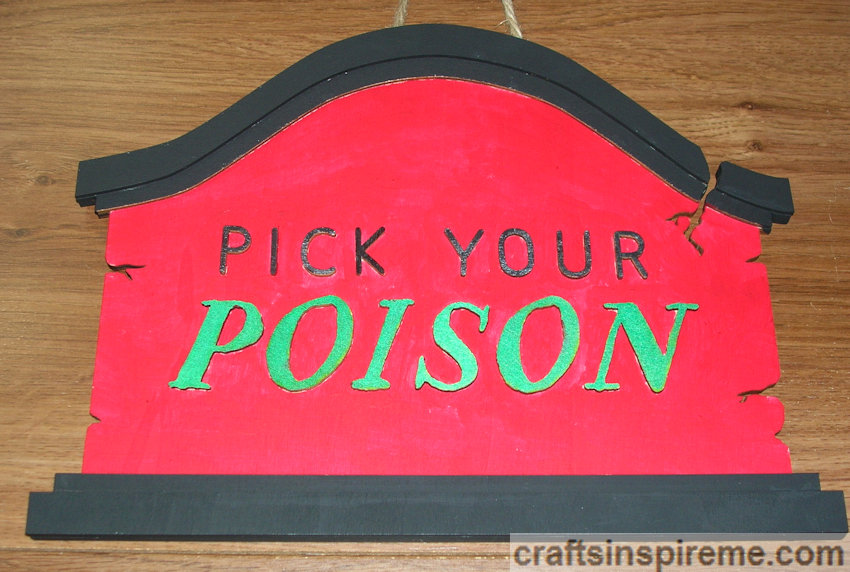
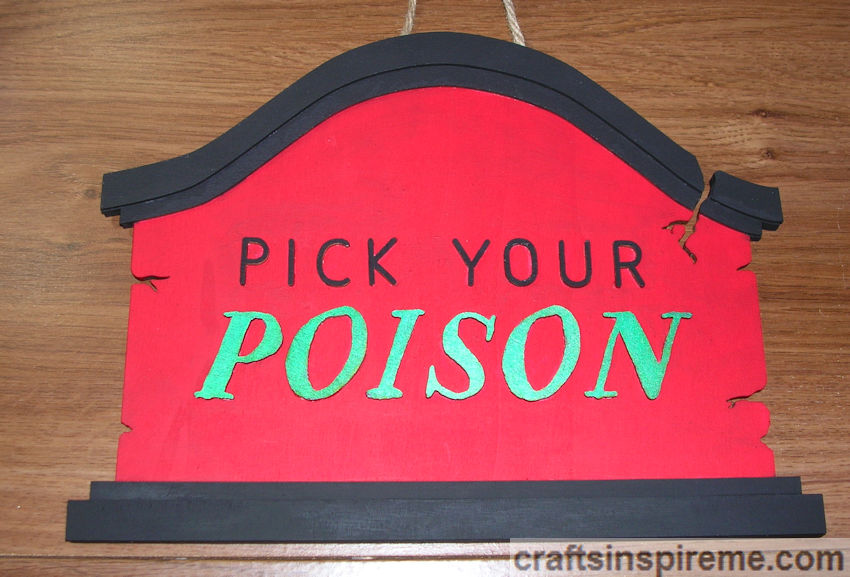
Finished Sign
Here is the finished sign, ready to be hung above the bar.
I hope you enjoyed this quick & easy project as much as I did. Sitting here at the bar, I drink a toast to my readers. I’ll save the seat next to me in case you decide to join me.
When you think of Halloween, what images come to mind? Most likely there’s a black cat and a few pumpkins in the mix, and rightly so since these mascots of Halloween have been honored for centuries.
In this vintage illustration, a cuddly kitten saunters through a pumpkin patch.
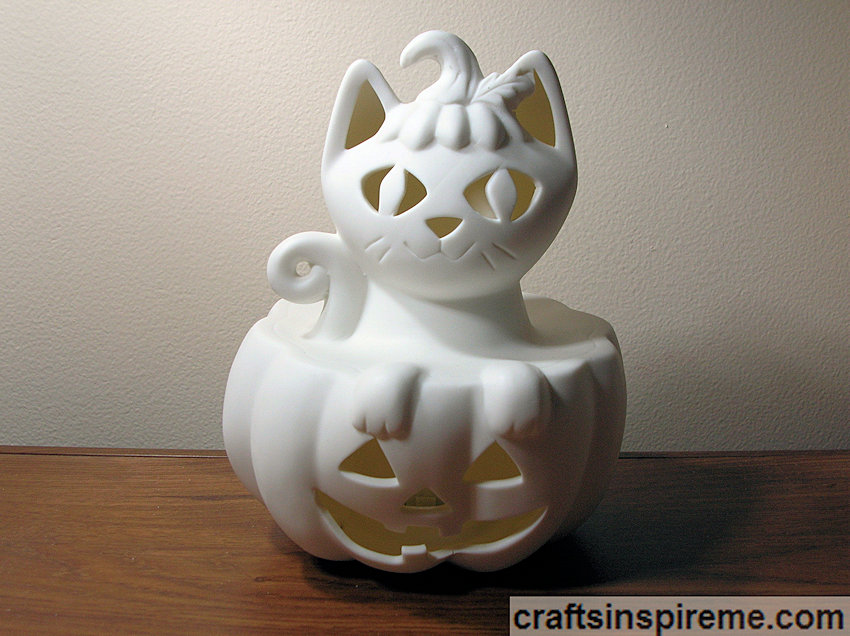
Ceramic Cat & Pumpkin – Front
Our project this week is an adorable kitten sitting inside a jack-o-lantern.
Ceramic Cat & Pumpkin – Back
This three-dimensional Halloween decoration is available at Michaels.
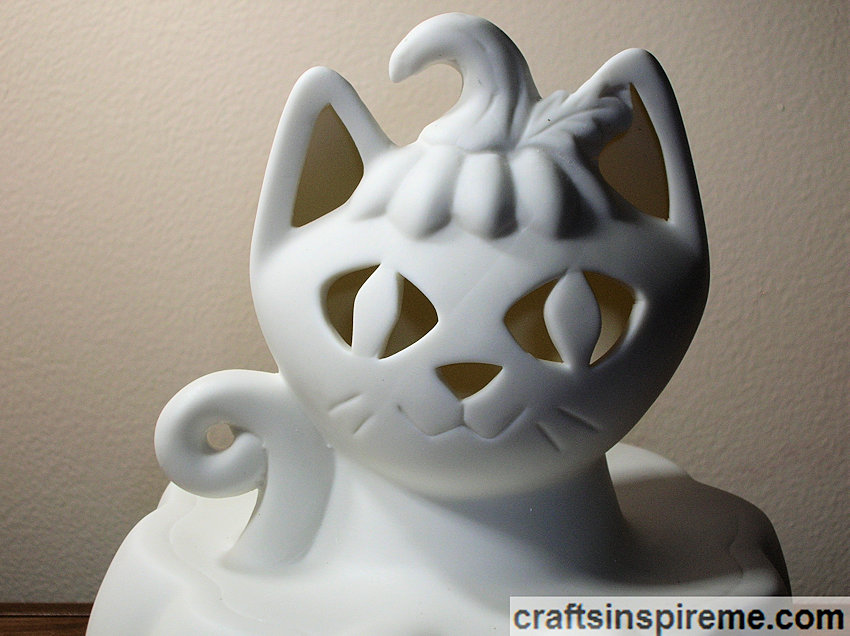
Ceramic Cat Closeup
The top of the pumpkin sits on the kitten’s head like a little hat. Aww, so cute!
Ceramic Pumpkin Closeup
The cut-outs in the faces of the cat and pumpkin hint at a surprise, which will be revealed at the end of this post in the last photo.
Supplies
Supplies:
Ceramic Cat in a Pumpkin (6” wide x 6” deep x 8” high)
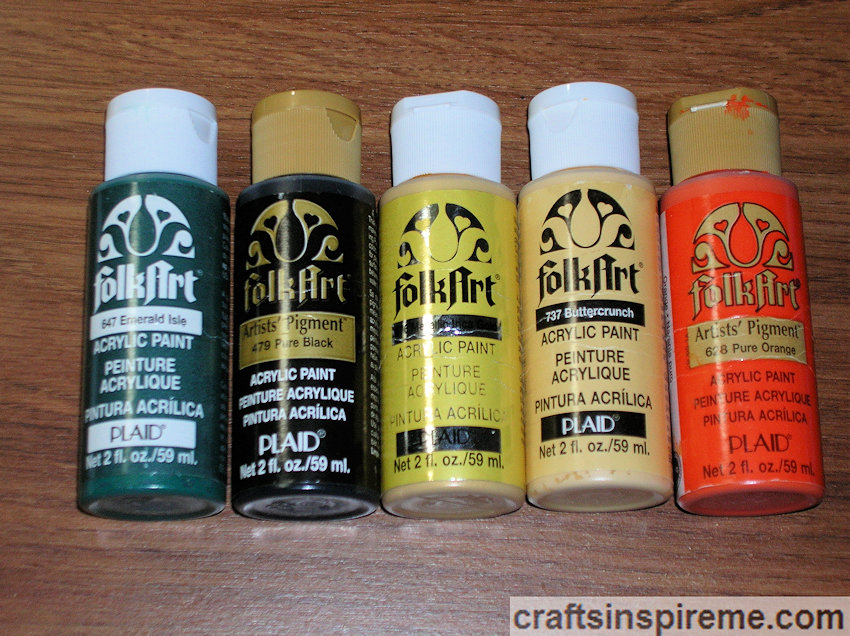
Acrylic Paints – dark green, black, metallic gold, buttercrunch yellow & orange
Paintbrushes
Painted Pumpkin – Front
Paint the pumpkin orange and the stem green. Be sure to paint all the edges of the cut-outs too.
Painted Pumpkin – Back
It will probably require two coats of paint for a nice even finish.
Painted Cat’s Eyes & Pumpkin Top Edge
Paint the cat’s eyes metallic gold, including the inner edges. Add black for the pupils and a dot of white in each. Paint the top edge of the pumpkin, around the cat’s body, with buttercrunch yellow.
Painted Pumpkin Top Edge – Back
Painted Cat Closeup
Painted Pumpkin Closeup
Painted Cat – Front
Paint the cat with two coats of black paint, including the front paws draped over the pumpkin. Add black lines on both sides of the pumpkin stem.
Painted Cat – Back
Working out the Details
At this point I noticed something funny. It looks like this kitten is sitting in a bowl of soup, and his disembodied paws appear to be floating on top! To fix these issues, draw lines in pencil to thicken the pumpkin’s rim and connect the paws, via legs, to the body.
Painted Details – Front
Paint the legs black, and the pumpkin rim orange. With a fine brush, paint the whiskers white and the mouth pink. Indicate toes with thin white lines on the front paws.
Painted Details – Back
Finished Cat Closeup
Finished Pumpkin Closeup
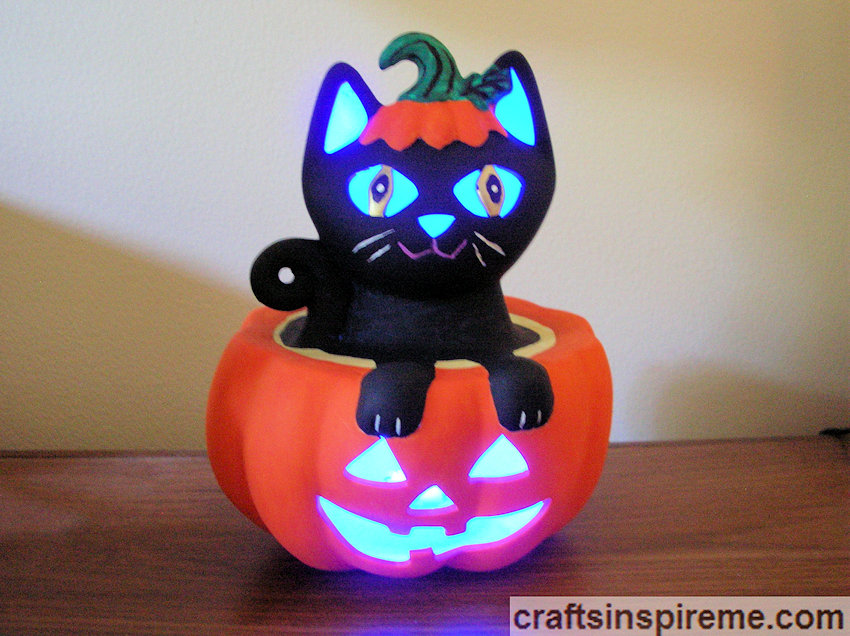
Glowing LED Lights
This is the finished project. Concealed LED lights illuminate the inside, just like a real jack-o-lantern. I hope you enjoyed this fun and easy Halloween project.
New ideas are always brewing at the arts and crafts studio. Here is a sneak peek at a few of the upcoming projects…
Cake Decorating
Cake decorating has been a popular topic on this blog, and I have lots of new cake designs to share.
Crafting with Feathers
Craft stores always have feathers, and there are many creative ways to include them in your artwork.
Full Color Makeover
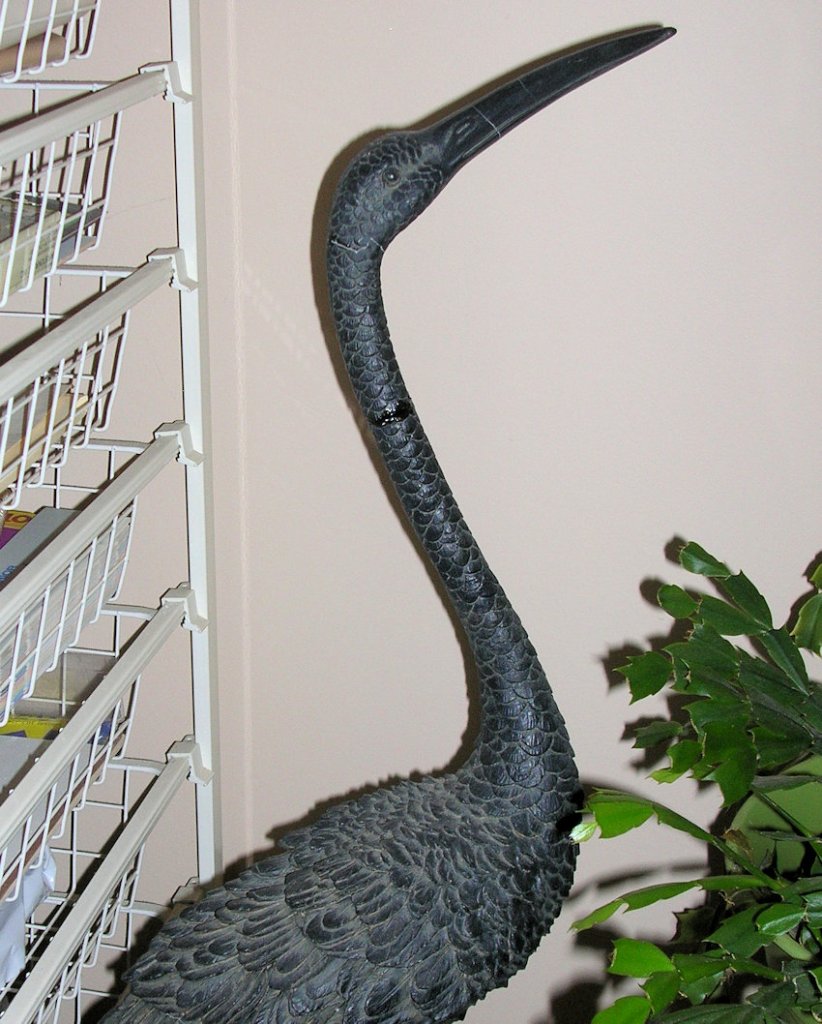
This monotone crane has been standing next to a potted plant for years. It is high time he gets some much-needed attention. Believe it or not this makeover will transform him into a crowned prince.
Cookie Decorating
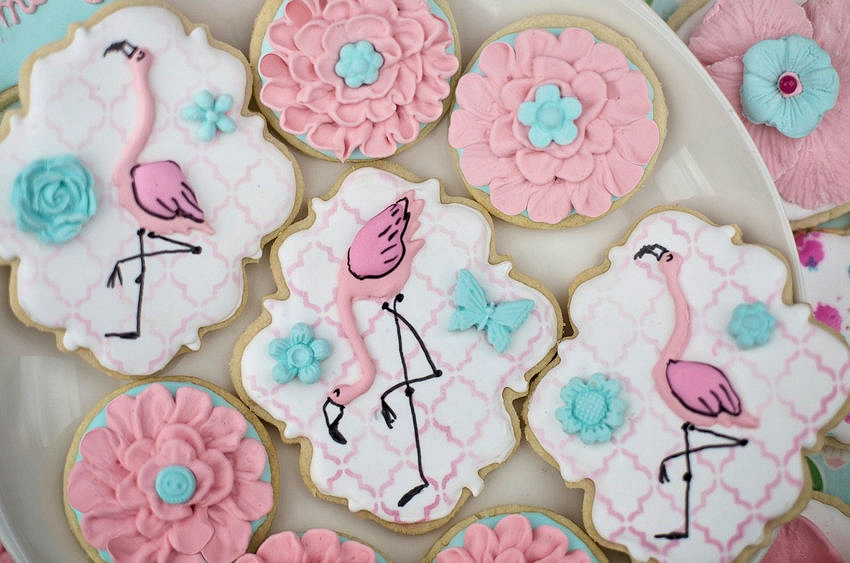
The only time of year my family decorates cookies is Christmas. This post will inspire you to create beautiful cookies any time of year.
Painted Wood Crafts
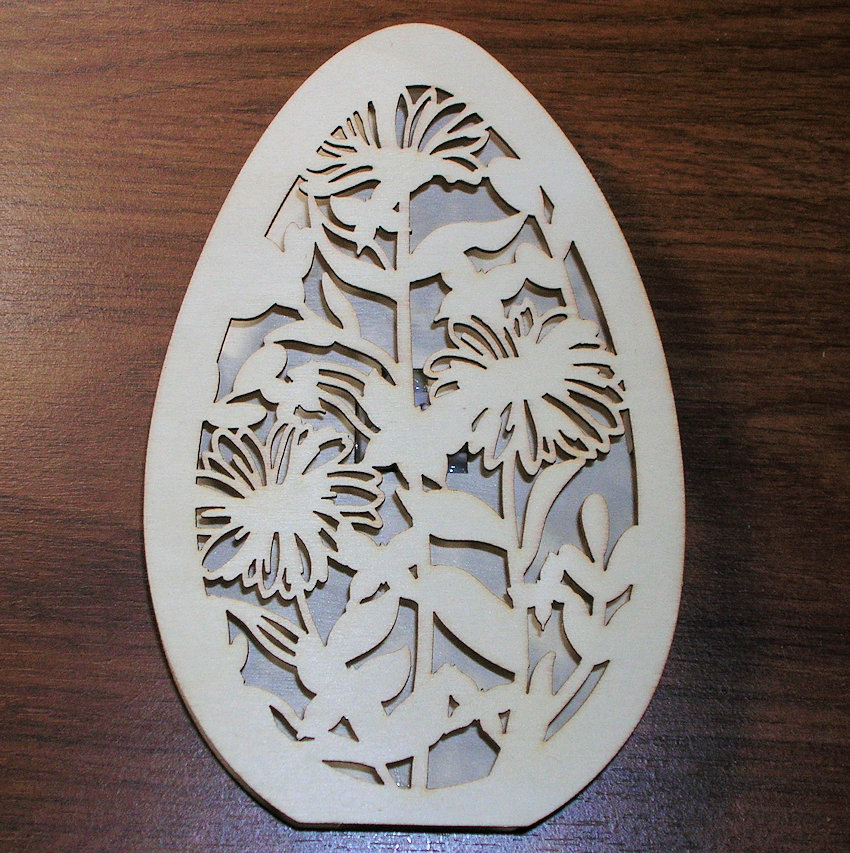
Wood crafts are inexpensive, easy to color or paint, and quickly produce attractive décor for your home.
Magical Creatures from Harry Potter
The world of Harry Potter is inhabited by some extraordinary creatures. With a little creative magic, you can conjure one to adopt into your family.
Art Studio Mascots
Speaking of adoption, our foster cats have become permanent members of the family, and they will be popping into the studio from time to time for a visit. Here are a few of their recent comments: “Being an inspiration is exhausting and we’re working for kibble. F.Y.I., the feather projects will be delayed indefinitely…you don’t have any. You’re welcome. Wake us when there’s a big juicy mouse project!”
I hope you enjoyed this brief look into future posts. Comments and suggestions are welcome, and I look forward to hearing from you.
A little piece of paradise – Isn’t that what we all want? That means different things to different people. For many, the idea of a cozy grass shack on a tropical island is a common fantasy. Of course it goes without saying that we’ll expect all the comforts of home in that “shack,” but that’s not important. Visualizing the dream is the focus here. This time of year so many people visit the seashore. An ocean-themed centerpiece, created one piece at a time, brings memories of vacations past to mind, and inspires dreams of vacations yet to come.
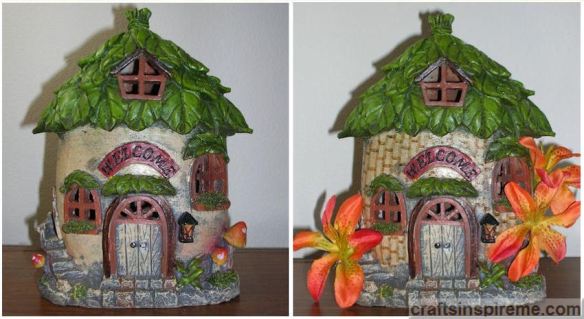
Before & After Photos: Tropical Home – Front Facade. What was once a home for tiny gnomes transforms into a tropical retreat with orange silk flowers, and a bamboo pattern drawn by hand on the exterior walls using a brown Sharpie marker.
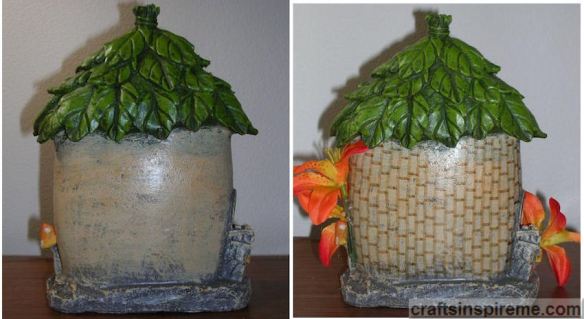
Before & After Photos: Tropical home – Back Facade. The bamboo pattern continues across the back, giving it that island vibe.
Before & After Photos: Lighthouse. Whoever heard of a lighthouse without a roof? To make the roof shown, fold the paper into a cone and staple it as needed to hold its shape. Glue a soup can lid to the bottom of the cone and paint it gray to match the lower portion of the building. Add twine along the edge and down the sides to resemble a standing seam metal roof. Tie several knots in a piece of twine and glue it to the peak of the roof. Tint the glass votive holder yellow using a highlighter, and line the inside with orange paper to suggest a brilliant light glowing from within the tower.
Before & After Photos: Sailboat. This sailboat only needed minor adjustments. The faded white stripes needed a fresh coat of paint, and the middle stripe was changed to orange. Because the opposite side of the sail was unfinished, the stripes and shells were duplicated on the back. A cute little blue bird was glued on top of the mast.
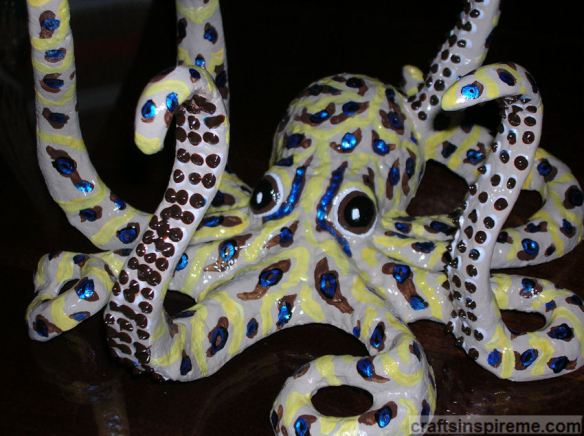
The Star of the Show: A Blue Ringed Octopus Before & After Photos: Octopus Closeup. It’s hard to believe the monochromatic octopus on the left is the same one on the right, but it is. It’s amazing what a difference a little paint can do.
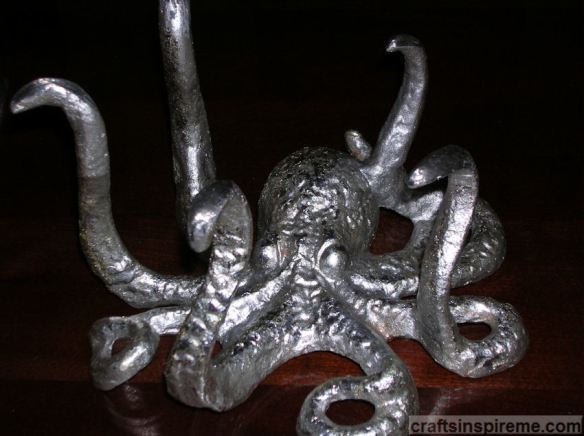
Original Octopus Candleholder: This whole project started with this silver metal octopus candleholder. As you can see, it looks top heavy with the large pillar candles, and the octopus is rather hidden underneath. Round candles were another option, but he looked like a juggler! (lol)
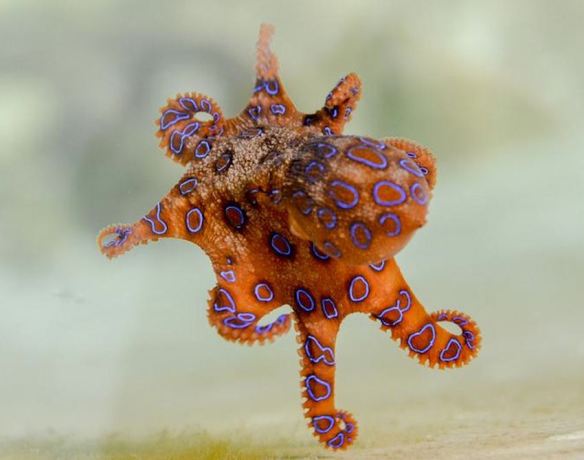
As with all creative projects, it’s helpful to gather a few photos for inspiration. The blue ringed octopus is a fascinating creature. Fans of James Bond 007 will remember the movie, Octopussy, in which Maude Adams had an aquarium with this beautifully patterned octopus, and she also wore a white silk robe emblazoned with its colorful, exotic image. Each octopus has a unique pattern, and the blue iridescent rings are impressive creations courtesy of Mother Nature.
Supplies:
Octopus (7-1/2” high x 4-1/2” wide x 1-3/8” thick)
Acrylic Paints – tan, brown, black, yellow, white, & metallic blue
1) Bottle fabric paint – white
1) Bottle fabric paint – brown
2) Paintbrushes – one for base coat, and a fine brush for details
Paint Palette
Clear Spray Paint
This is how it looks without the candles. The large metal plates are too big, overpowering the beauty of this piece.
The plates were removed using a Dremel cutting tool, and the tips of the tentacles were filed smooth. Now you start to notice the amazing sculptural details created by the artist.
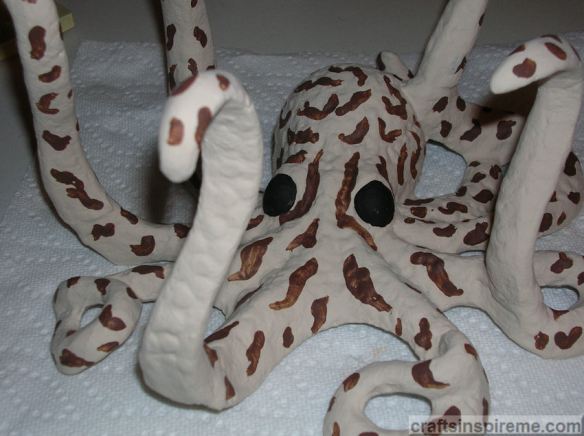
The color was the next issue to be addressed with two coats of tan paint. The artist painstakingly created a realistic looking octopus, but that thick coat of silver paint had obscured all those intricate details.
A brown pattern was applied to the entire body and the eyes were painted black.
Black spots were added, overlapping the brown.
Blue iridescent rings were applied over the black spots. Random yellow stripes wrap around the legs and head. A white dot was added to the pupil of each eye.
The eyes were made more realistic with the addition of brown irises and white outlines.
Two coats of clear spray paint were applied to protect the acrylic paints. White suction cups were added to the underside of the tentacles and allowed to dry. Next brown fabric paint was applied over each of the suction cups to provide shape and depth. This beautiful sculpture now has the rich, colorful appearance it deserves, and makes an interesting conversation piece.
Photo: Completed Centerpiece. Black pebbles form little volcanic islands amid a vast ocean. In front of a cozy tropical home, a mermaid sits quietly reading, as a sailboat glides along the water. Another mermaid leaps out of the sea with a treasured seashell in her hand. The lighthouse makes a welcome rest stop for wildlife and a sunbathing mermaid. A feisty octopus playfully thrashes about the water’s surface. Palm trees swaying in the breeze display a pair of small signs that says it all: “Beach Please!”
All babies are cute, but baby elephants are so expressive like the one above having the best day ever!
Baby Nuzzles Mom
Standing beside their watchful mothers, they look so small and somewhat fragile.
Baby’s First Steps
With those big floppy ears, it’s easy to imagine them taking flight, playfully floating upon the breeze and coming to a landing in our love-filled hearts. Let’s bring some of that joy into this week’s project.
How to Paint a Wooden Baby Elephant:
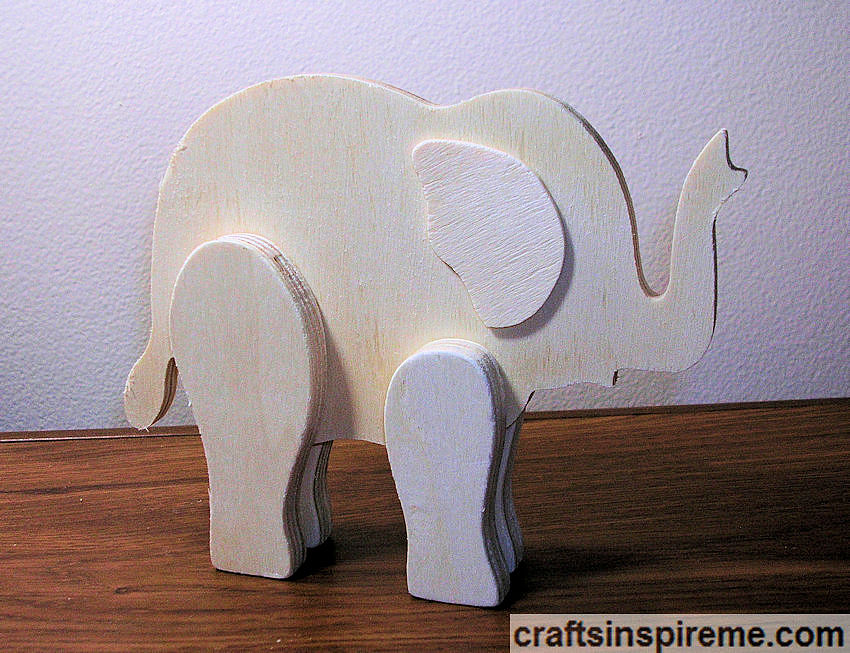
Raw Wood Elephant
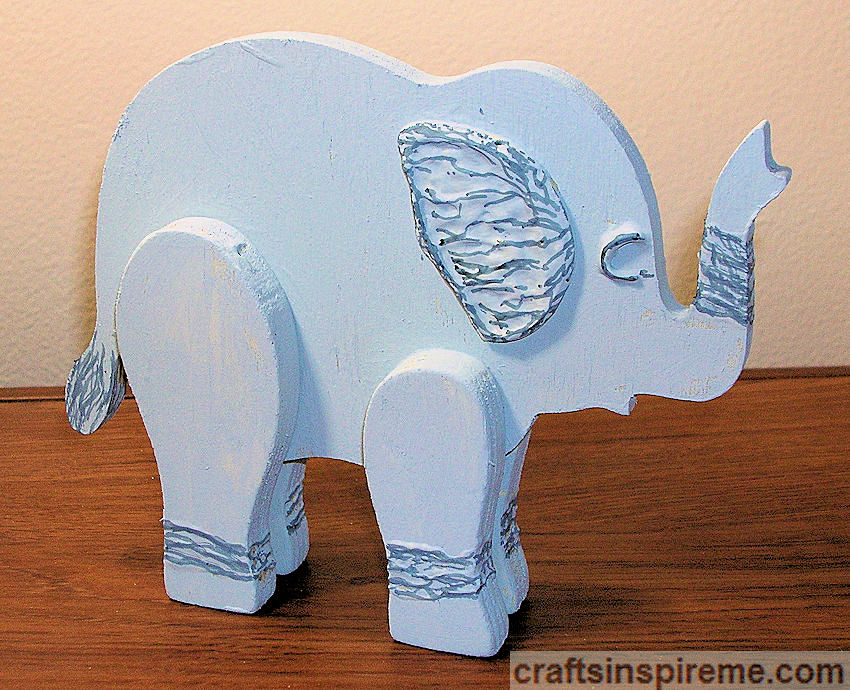
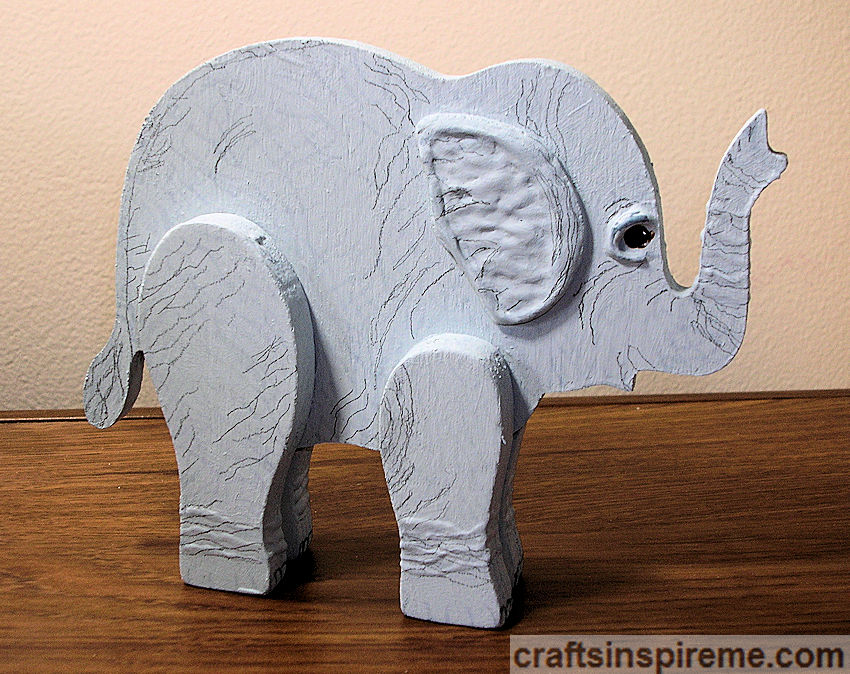
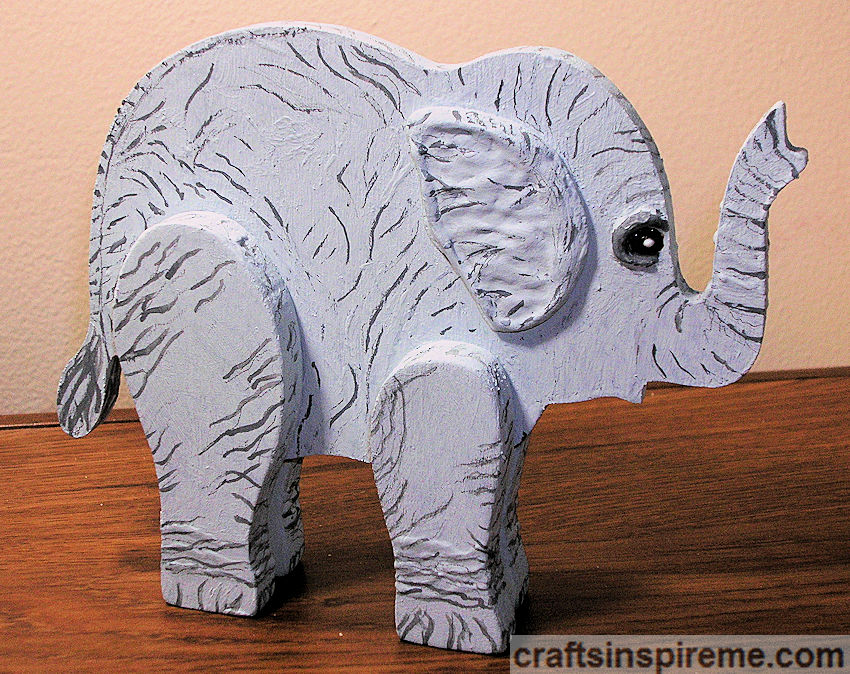
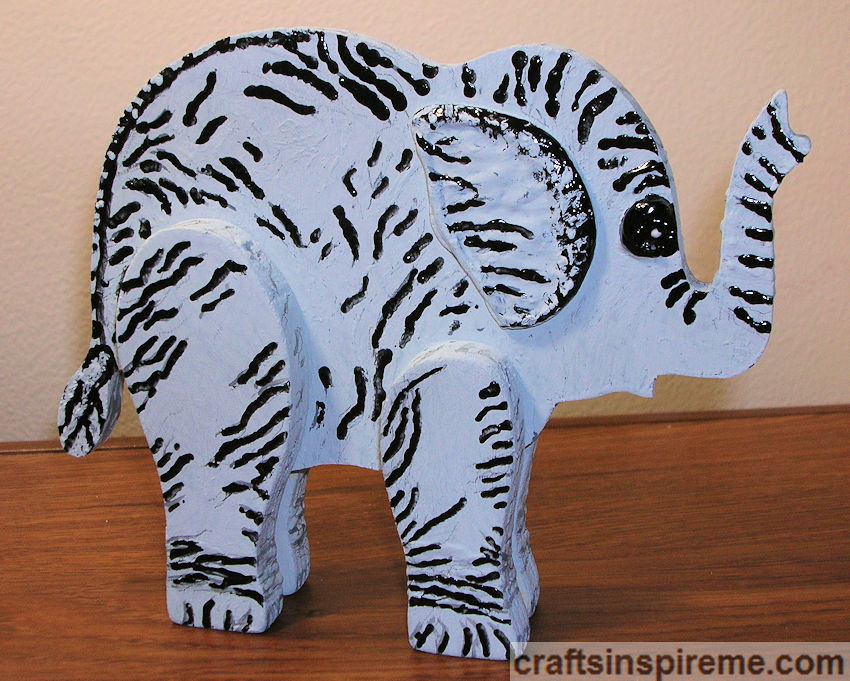
In previous painted wood projects, the animals had feathers, scales, or fur. Elephants present a unique challenge: wrinkles. I must admit this took much longer than expected as I progressed through a series of trial and error to achieve the desired appearance by layering. Let’s get started…
Supplies
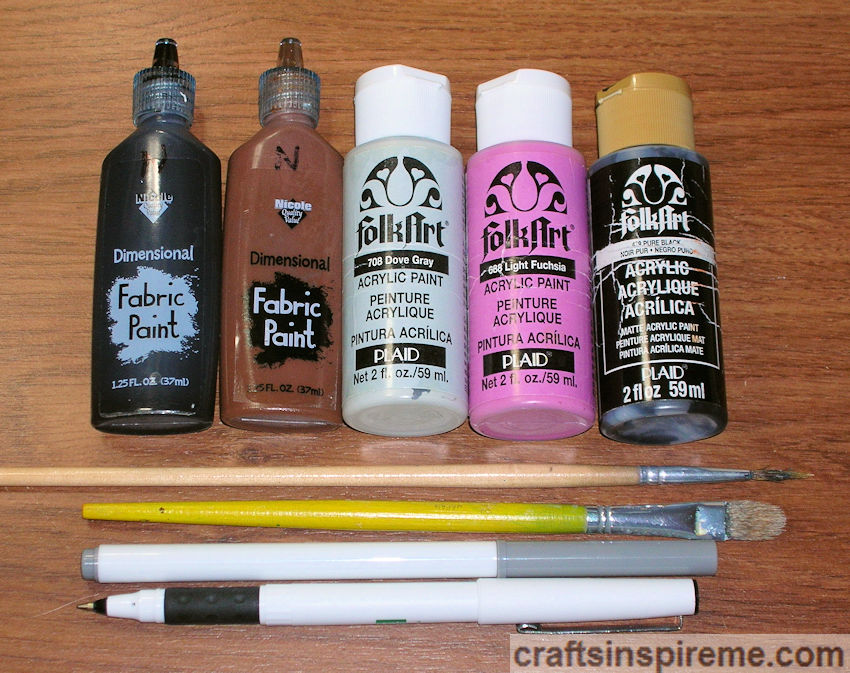
Supplies:
Wooden Elephant (5” high x 6-1/4” wide x 1-1/4” thick)
Acrylic Paints – Gray & Black, (Pink is optional)
Paintbrushes
Markers – Gray
Pens -Black Fine Point
1) Bottle fabric paint – Brown
1) Bottle fabric paint – Black
1) Bottle fabric paint – White (not shown)
Texture Building
Start building texture with three-dimensional fabric paint. I used white, but any color will do because we will paint over it in a later step. Draw both eyes with a pencil. Thicken and shape the ears and outline the eyes with fabric paint.
Paint the Body
Paint the body gray, including both sides and all the edges.
Draw Details with a Marker
Define the wrinkles using a gray marker.
Add More Wrinkles
After viewing numerous photos, I added wrinkles all over the body using a marker but immediately regretted it. I should have followed my own advice: Draw or paint what you feel, not what you know.
Repaint the Body
A fresh coat of paint gives us a clean slate to try again and allows the marker lines to lightly show through, which is great for the next step.
Cautiously Draw Wrinkles
Using a pencil, slowly add details in key areas to imply overall wrinkles. Build up the eyes with brown fabric paint.
Trace with a Marker
With a gray marker, trace the wrinkles and outline the eyes. Finish building the eyes up with brown fabric paint and allow it to dry. Add pupils and a white spot in each to bring them to life.
Trace with Fabric Paint
Retrace the wrinkles with black fabric paint. You are probably thinking, “Here she goes again. Jumping in with both feet,” and you are correct. The difference is this time … I like it! Don’t worry about too much contrast because we will tone it down in the next step. Develop the eyes with the same fabric paint.
Repaint & Create More Texture
By repainting the body with gray paint, the raised wrinkles recede, becoming part of the thick skin. Next, mix black and gray acrylic paint to create a darker gray. Dip a cotton ball in the new dark gray paint and dab it on a piece of scrap paper to remove the excess. Lightly dab the cotton ball all over the body to create new subtle layers of texture. Repeat as needed.
Trace with a Marker
Retrace the wrinkles, ears, and eyes with gray marker. Add lines around the mouth and tip of trunk. At this point you could stop, but I wanted to add a few little details to make this elephant look like a baby. For that we need a little inspiration.
Adorable Baby Elephant
Three things stand out: eyelashes, the pink inside of the mouth, and peach fuzz hair running along the spine from top of the head to the tail. Markers or paint will work nicely for the first two details, but the third requires a special ingredient…
A Longhair Cat
Yes, I am recommending the use of cat hair for an art project. I must say it is the oddest ingredient I have ever used. Longhair cats require daily brushing, so collecting soft hair is no problem. (lol)
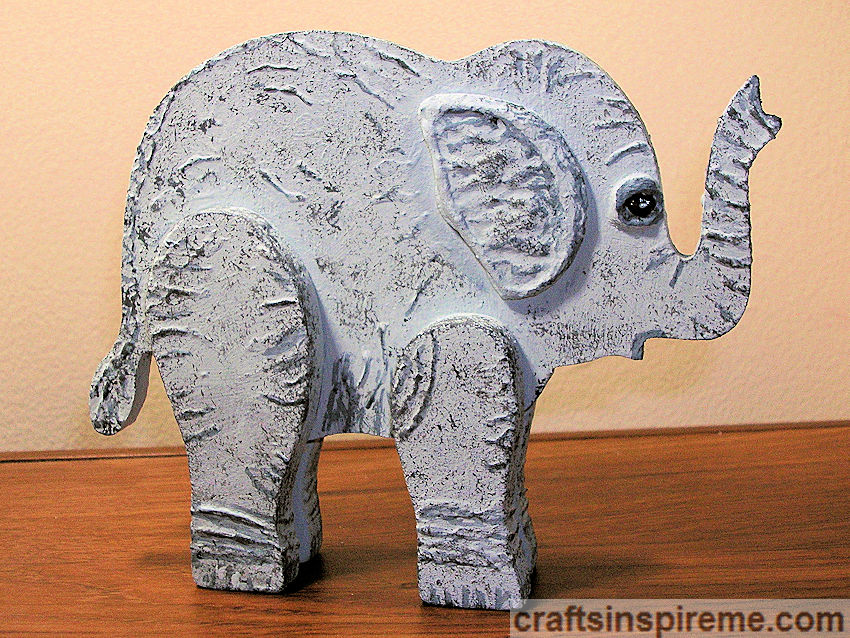
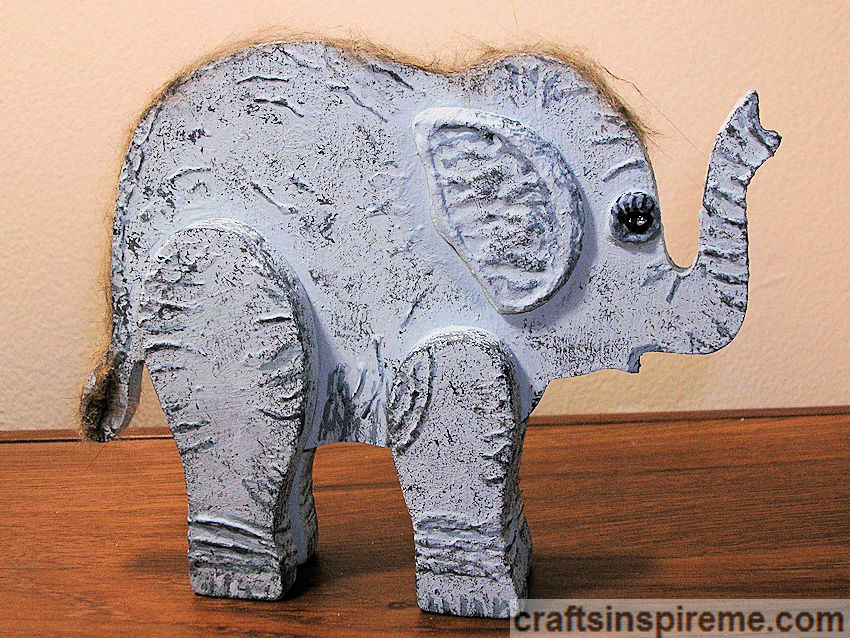
Completed Baby Elephant
Glue on the hair with Elmer’s glue. Adjust and trim the hair as needed. Add eyelashes with a fine point black pen and paint the inside of the mouth pink.
Closeup of Elephant’s Face
Although these details are minor, I think they provide softness and a “cuteness” factor to this baby elephant, just like his living counterparts.
Baby Elephant – Before & After
This completes our project. Persistence pays off. Experimentation is a tremendous help in solving artistic problems. If you are not happy with the results, let it sit for a day or two and the inspiration will come to you just when you need it most.
Have you faced any artistic challenges like wrinkles? Have you used an unusual item, such as cat hair, in an arts and crafts project? Please share your ideas in the comments section. Thanks for joining me. Good luck with your future works of art.
Sixty-five million years ago the Tyrannosaurus Rex, also known as T-Rex, spent his days hunting, eating, and making little dinosaurs. Archaeologists, writers, and world-renowned movie directors have been thrilling us ever since with all the gory details of this master predator.
Did they roar like lions? Were they solitary animals or did they mate for life? Having such short arms, I wonder, how did they get back up after a fall?
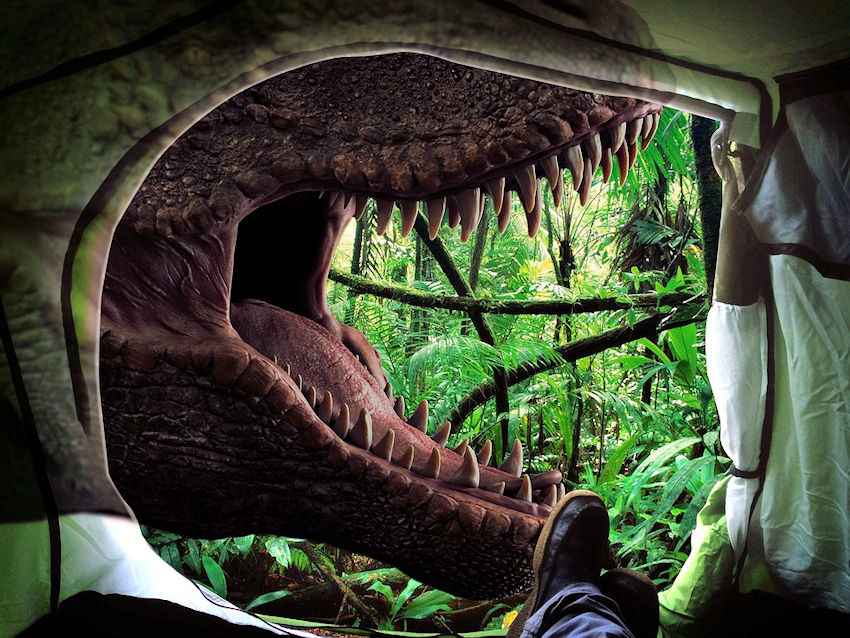
After viewing this photo, who wants to go camping? (lol) The mere thought of facing a creature, capable of eating its prey whole, leaves us with mixed feelings of fear and awe. And we love it. To bring a few of those Jurassic thrills into our lives, let’s jump into our next project:
Inspiration
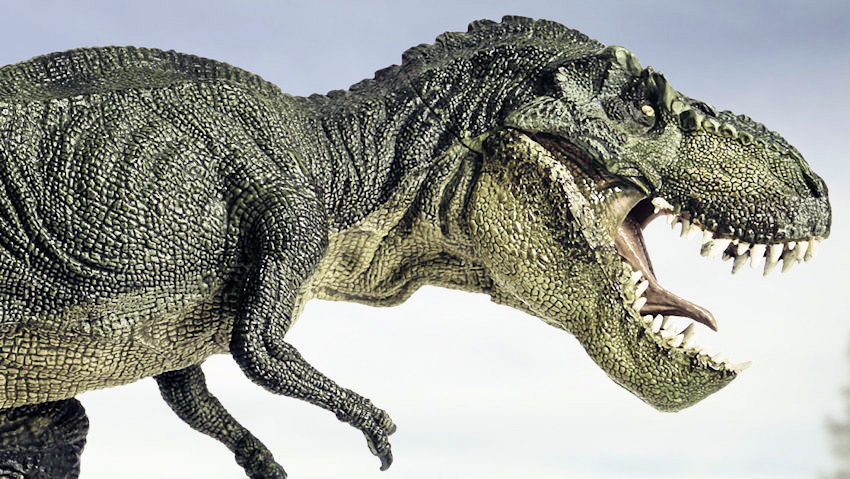
Huge jaws, piercing eyes, and razor-sharp teeth – what’s not to love?
Inspiration
When we look at large lizards alive today, we can visualize tyrannosaurs having thick, textured skin, consisting of scales and bony plates, with a ridge along the spine.
Inspiration
Predators typically have camouflaging patterns and colors to give them an advantage while hunting. With these ideas in mind, we can begin the creative process to bring the T-Rex back to life. Let’s go!
How to Paint an LED Tyrannosaurus Rex:
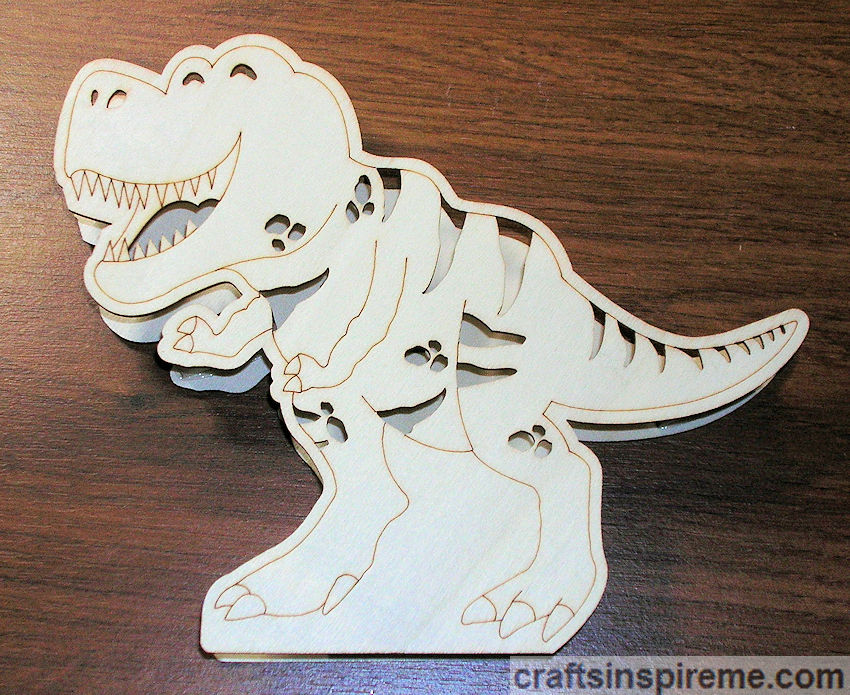
Raw Wood T- Rex, Front
This wooden T-Rex (available at Michaels) has preprinted details and cut outs to enable green light from a concealed LED bulb to penetrate the figure and cause an eerie glow in the surrounding area.
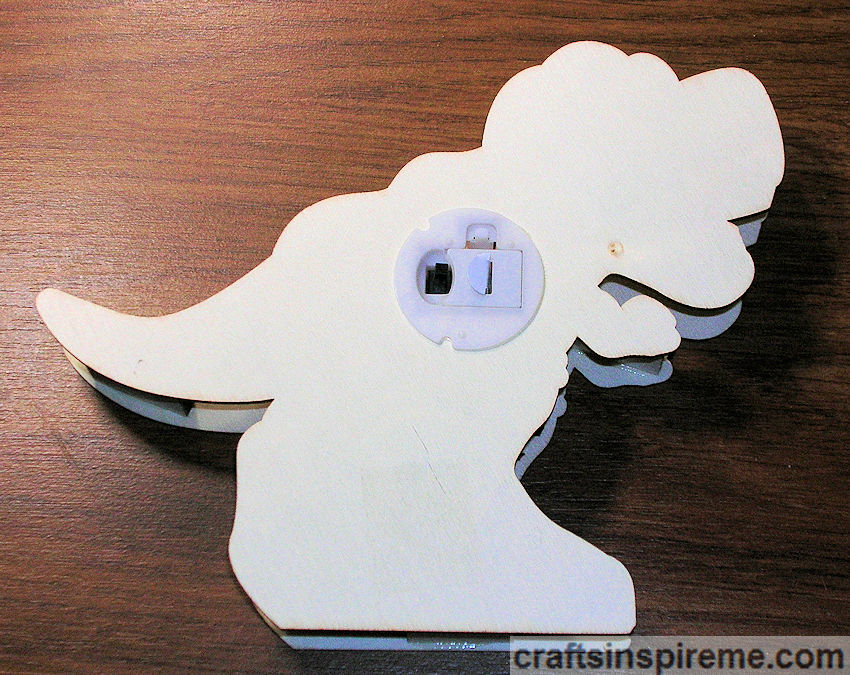
Raw Wood T- Rex, Back
The back is plain wood with the on/off switch and battery compartment. The wood on the front is smooth, however you might want to sand the back lightly, however that is entirely up to you.
Supplies
Supplies:
LED Wooden T-Rex (5-3/4” high x 7” wide x 1” thick)
Acrylic Paints – Cappuccino, Light Fuchsia, & Dove Gray
Paintbrushes
Markers – Brown & Black
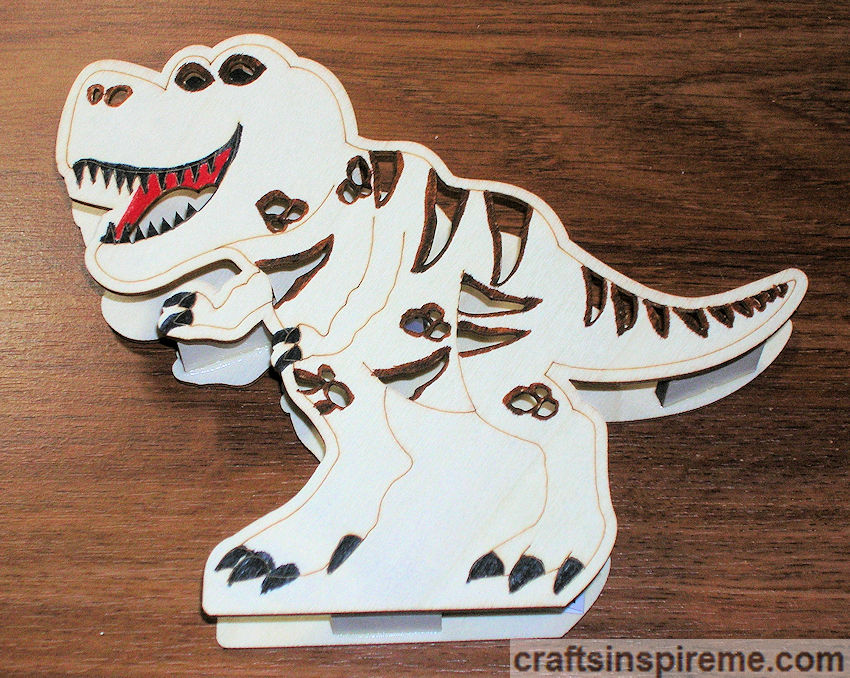
Marker Drawn Details
Use magic markers to figure out the color scheme.
Painted Basecoat, Front
Paint the entire body with the basecoat.
Painted Basecoat, Back
Paint the basecoat on the back. I did not add any details, but you can if you wish.
Marker Drawn Details
Go over the details with markers.
Painted Gray Background
Paint the background gray to contrast with the tan body. At this point you could stop.
If you have been following this blog for a while, you know there is a more advanced painted version. Please read on to discover how to give this dinosaur a more reptilian appearance.
Advanced 3D Painting:
Three-Dimensional Fabric Paints
Supplies:
1) Bottle fabric paint – Brown
1) Bottle fabric paint – Black
Painted 3D Details
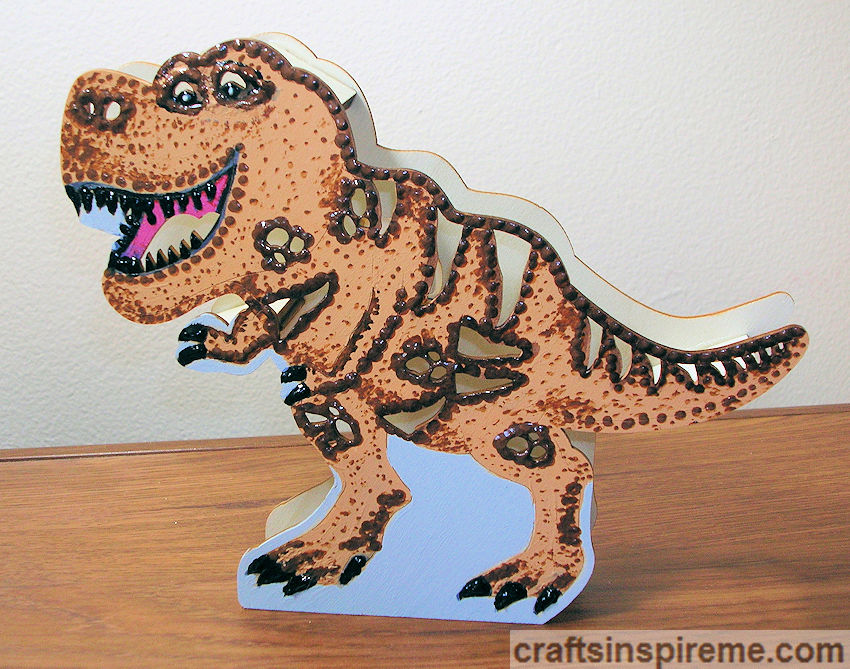
Using brown fabric paint, apply nubby texture to the body. The black paint is for the teeth, pupils, and claws. I outlined the eyes in black too but didn’t like it. To me, he appeared to be wearing a pair of sunglasses. (lol) You can see the revision below.
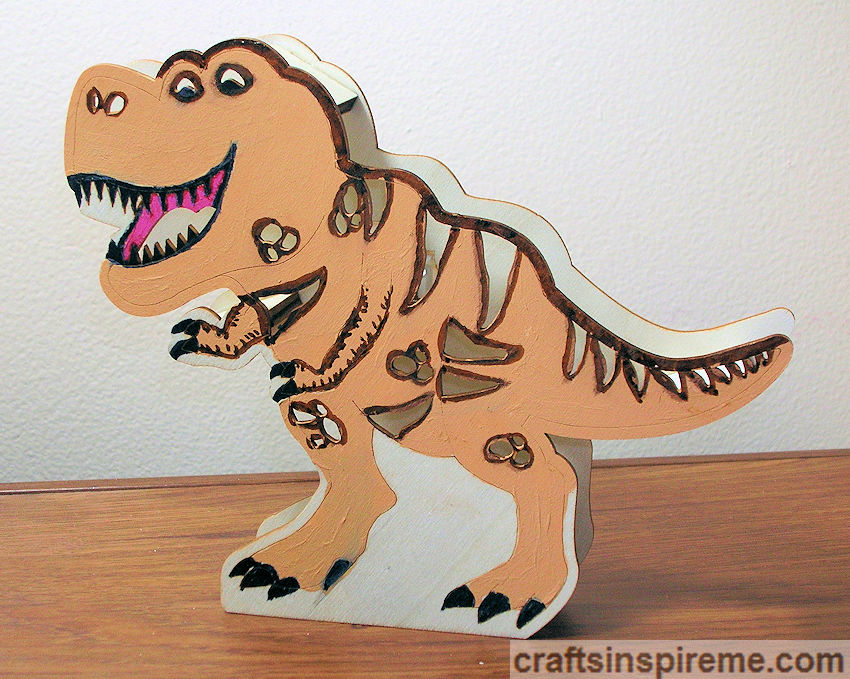
Completed T-Rex
This is the completed Tyrannosaurus Rex in all his glory.
T-Rex Before & After
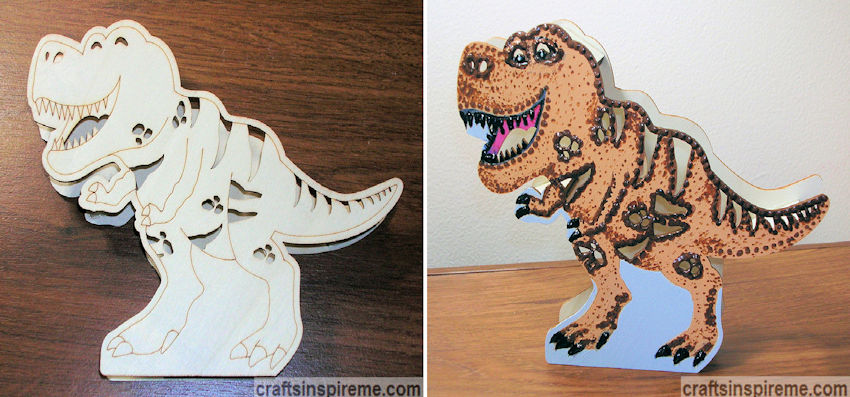
I am always surprised seeing the plain original wood side by side with the completed project. Caught up in the creative process, it’s easy to forget where we started.
Lit T-Rex with Flash
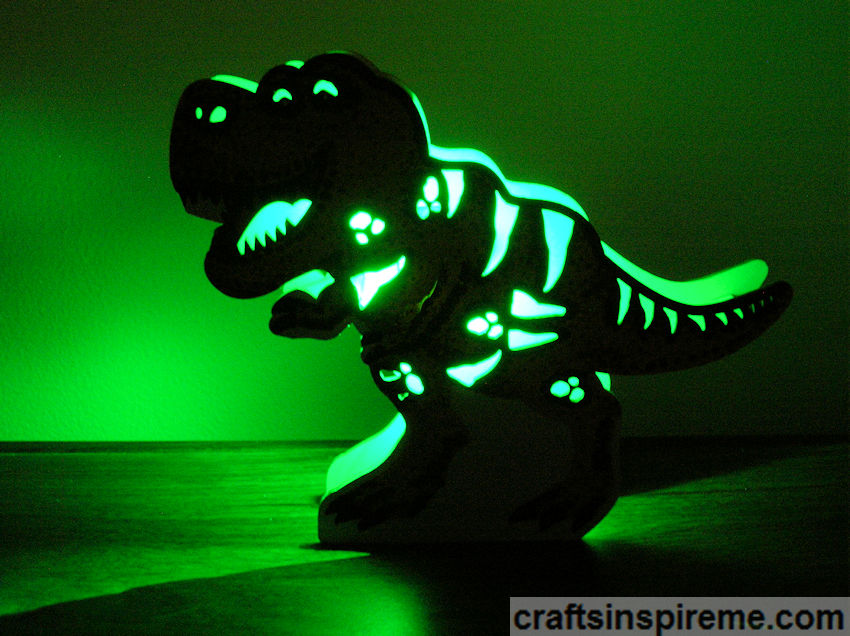
This photo, taken using flash photography, shows the soft glow of the LED light.
Lit T-Rex without Flash
In a dark room, this T-Rex makes a cool nightlight.
I hope you enjoyed this transformative journey. Thank you for coming along for the ride. What is your favorite dinosaur and why? Please let me know in the comments section.
Welcome to part two delving into the inspiring art of painting. As we go, we will examine different types of paints and techniques to pique your interest. By the end, I hope you will have better insight into the many artistic possibilities and take away a few ideas for future creative projects. Let’s go…
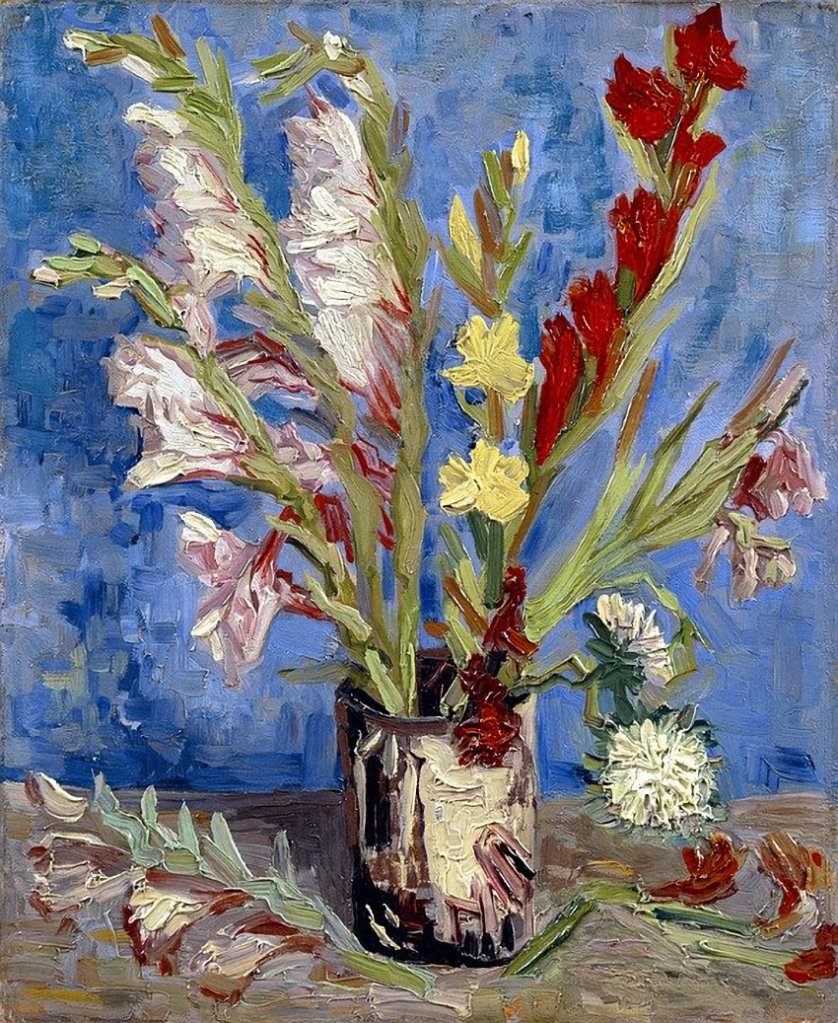
Oil Painting: Produces incredible effects ranging from translucency to rich sculpted textures.
Oil on Canvas
Compared to other options, oil painting requires more supplies, such as solvents, primer, and varnish, and as a result the chemical fumes necessitate working in well-ventilated rooms or outdoors.
Smooth Application
Applying oil paints with brushes produces intricate details and luminous colors.
Thick Textured Application
When oil paint is applied with a palette knife (a.k.a. painting knife), textures can be achieved with sculptural, three-dimensional accuracy found in nature such as leaves, flowers, and trees.
Fine Arts Collectibles
Prior to using oil paints, surfaces must be prepped with primer or gesso, and upon completion the finished work should be sealed with varnish to protect the paints.
Wall Art
The preferred choice of world-renowned artists, such as Van Gogh, and Michelangelo, and da Vinci, oil paints are excellent for a wide variety of subjects in styles ranging from classical to abstract and everything in between.
Paint Pens: Offer precise control for detailing and illustration.
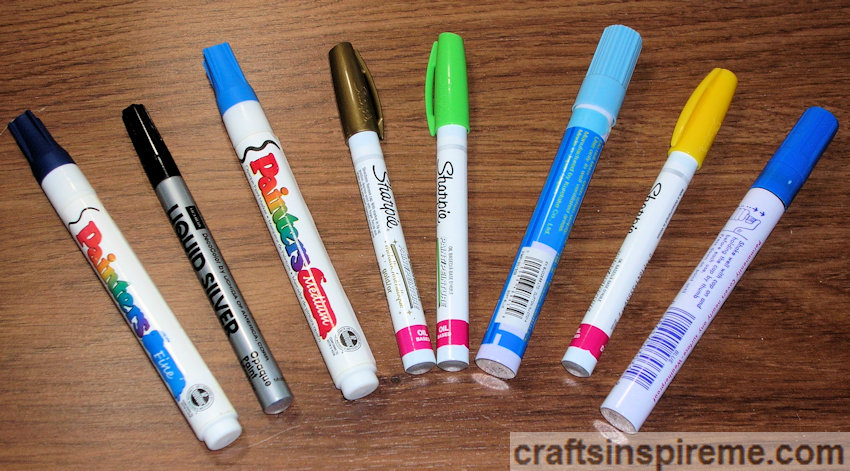
Assorted Paint Pens
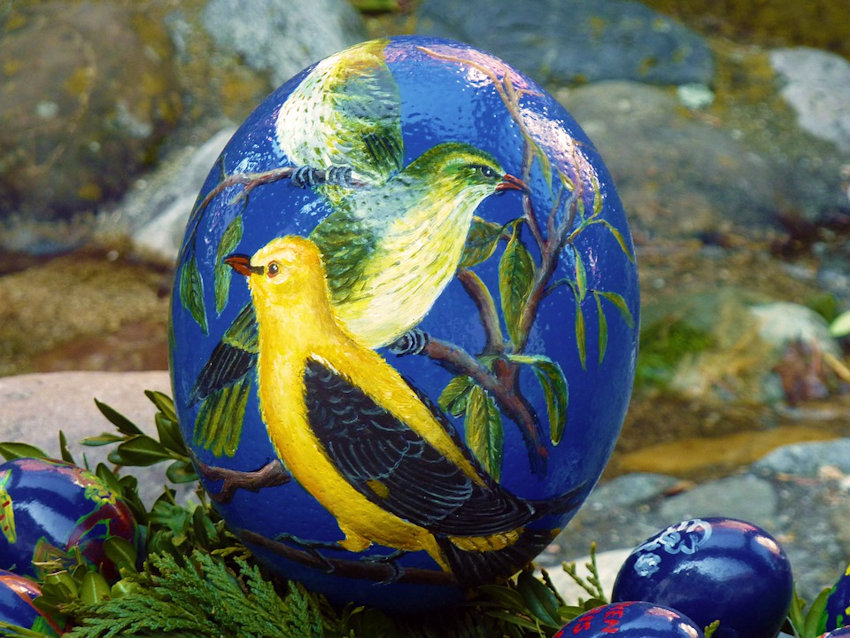
Paint pens are prefilled with water-based paints, oil-based paints, or fabric paints in a variety of colors. Since many have strong fumes, you may need to work in a well-ventilated room or paint outdoors.
Specialty Finishes
Tip sizes are available in fine, medium, and broad. You can create layers of colors and finishes, such as metallics and glitter.
Any Materials
Whether you plan to paint rocks, plastic, metal or just about anything else, there is a paint pen for it. The only limitation might be very thin materials, which may allow the paint to bleed through, so remember to have a protective cover underneath to protect your worksurface.
Exterior & Interior
Interior or exterior projects are no problem. Be sure to check pen labels for usage because sometimes store displays become mixed up. Find the right pen for the job and it will last for years to come.
Hand Drawn Designs
Let your imagination run wild on new DIY projects or existing items with a fresh coat of paint and custom hand-drawn designs.
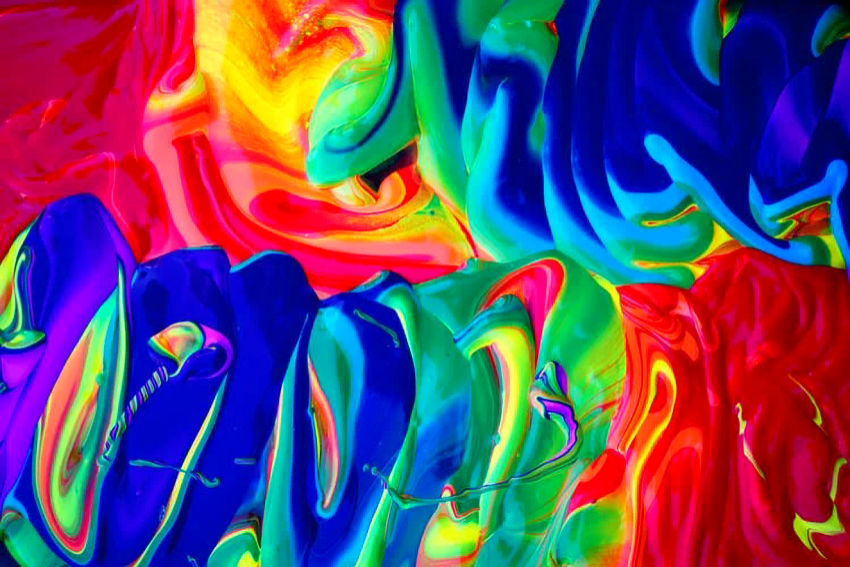
Paint Pouring: Represents playful self-expression, where each combination of colors results in freeform, one-of-a-kind designs.
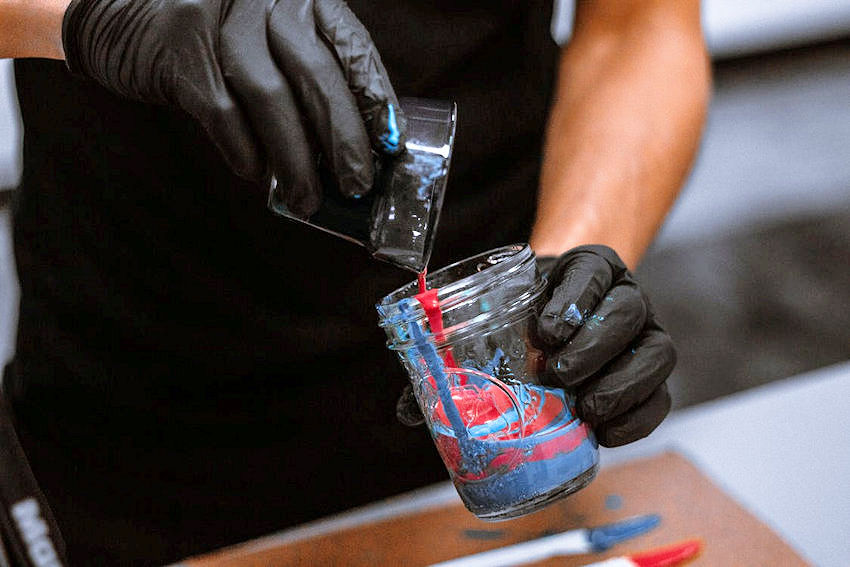
Mixing Paints
Although acrylic paint cleans up easily with soap and water, you will need gloves, an apron, a covered worksurface, and drop cloths to protect the floor.
Abstract Art
Cups of paint are simply poured onto a canvas or any object, and then tilted back and forth allowing gravity to handle the initial composition.
Decorative Items
Paint pouring utilizes unusual tools, including a hairdryer, wooden craft sticks, balloons, drops of silicone, and a kitchen torch.
Tabletop
Lively patterns resemble natural stone, undulating waves, or clouds drifting upon the sky. Turn ordinary tabletops, ceramics, coasters, picture frames and more into unique works of art.
Abstract Art
Set your inner child free by exploring the playful world of paint pouring.
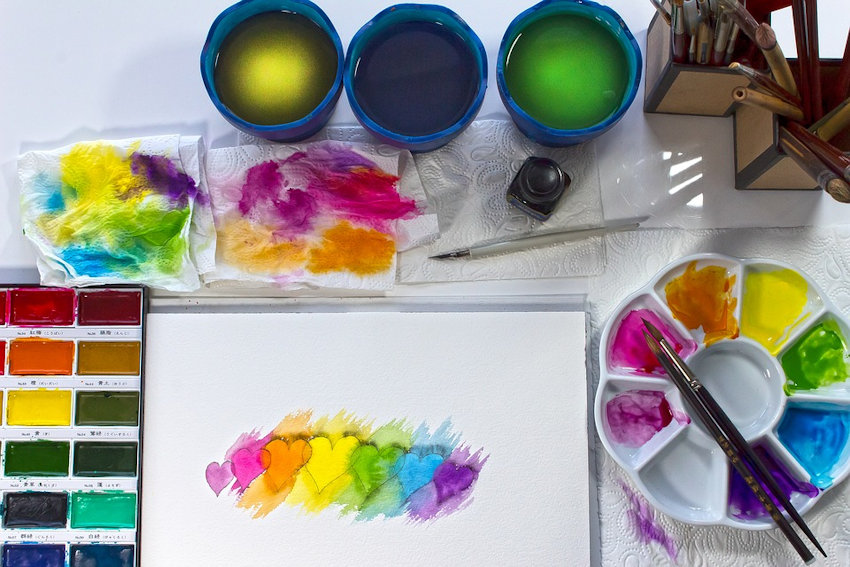
Watercolor Painting: soft and dreamy with vivid colors and subtle nuances.
Watercolor Basics
For many people, watercolors are the first introduction to painting with beginner’s trays prefilled with paint. Watercolors are nontoxic and cleanup is easy with water.
Dreamy Gardens
Be sure to paint on watercolor paper, which dries flat. Regular paper is too thin, resulting in bubbles when wet followed by warping when dry.
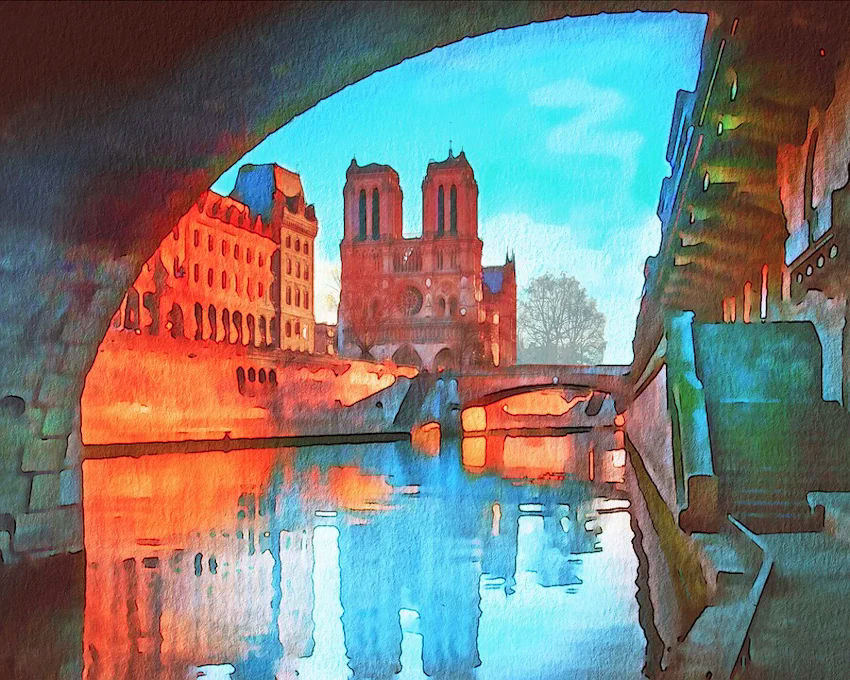
Water & Sky
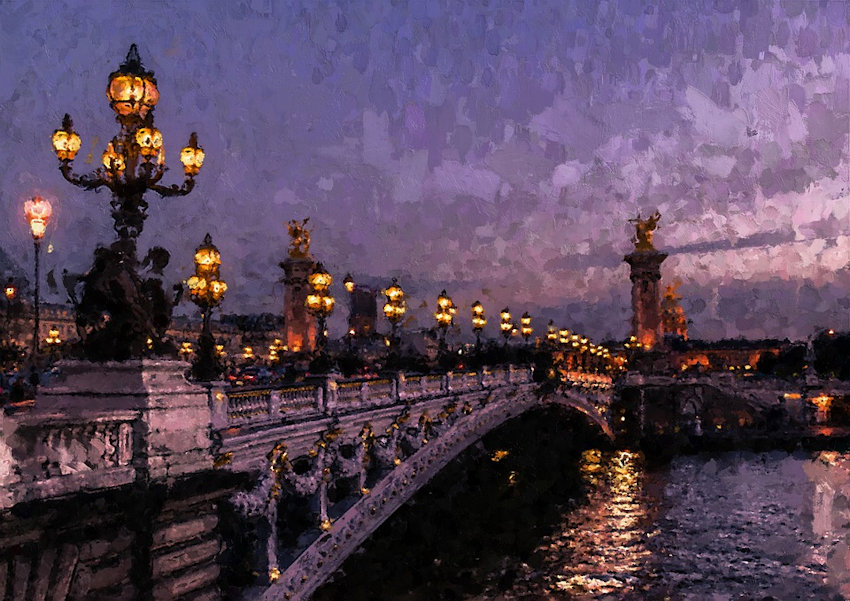
Watercolors are the perfect choice for painting water and sky, accompanied by reflections rivaling those in nature, but architecture presents a challenge. As you can see, the edges of Notre Dame Cathedral lack definition. Please refer to the photo below for the solution.
Watercolor Painting & Technical Pens
When you are painting a world-renowned landmark like the Taj Mahal, you really need to get it right because people will notice if something is out of place. Watercolors can be combined with technical pens, creating clean crisp edges for the structures and soft fluid movement in the reflecting pool and sky.
Aquatic Scenes
Ocean vistas and all the denizens of the sea benefit from the use of watercolors, which ebb and flow onto the page like the tide upon the sand.
Painting Gallery:
Oil Painting
Watercolor Painting
Paint Pens & Airbrushing
Paint Pouring
Painted Pottery & Ceramics
Oil Painting
Paint Pens & Acrylic Painting
Watercolor Painting & Mixed Media
Paint Pens & Airbrushing
Oil Painting
Mixed Media Sculpture Painting
Watercolor Painting
I hope you have found some inspiration to paint whatever appeals to you in a style all your own. To narrow down the options, review the painting photos above and search for more online. Notice the colors, patterns, textures, subjects, and special effects. Notice which ones really capture your attention. Do you have any favorites? Please let me know in the comments section. In case you missed part one of this series, please click here. Good luck with your painting endeavors!
Have you ever wanted to give painting a try? Anyone can paint. With a little patience and a lot of creativity, you will feel like an accomplished artist in no time. It’s fun, relaxing and reduces stress. What are you waiting for? Let’s get started!
Acrylic Painting: Bold colors, unlimited finishes and surfaces, ease of use
Paint by Number
One of the easiest ways for beginners is with an acrylic “Paint by Number” kit, which comes complete with paints, brushes, and a preprinted canvas. Simply match the numbered paints with their corresponding locations on the canvas. There is a wide range of themes for all ages and skill levels.
Decorative Painting & Wall Art
Acrylic paints can be used in almost any application. Brushes are cleaned with soap and water, and the paints have low or no odor, which is great for those sensitive to strong fumes.
Furniture Painting
Make a new piece of furniture look like an old friend with decorative designs and an antiquing finish.
Statues & Figurines
Upcycle a garage sale purchase with a fresh coat of paint and colorful accents.
Faux Finishes & Decorative Painting
Upgrade walls, or any surface with acrylic faux finishes and decorative painting, including Sponge Painting, Marbleized, Faux Wood Grain, Crackle, Metallic, Plaster, Textured, Stenciling, Stippling, Mural Painting, & Tromp l’oeil.
Airbrush Painting: Street art, murals, and no size limitations
Airbrushing
Airbrushing requires compressed air to disperse paint onto any surface. Cans of spray paint work in the same way and are often used on building-sized murals.
Large-Scale Painting
This handsome German shepherd painting disguises an otherwise unsightly telecommunications box.
Automobile Painting
Riding in style has a whole new meaning when your car becomes a mobile work of art.
Mural Painting
Let imagination run wild as any wall, inside or out, can be adorned with flights of fancy.
Tromp l’oeil Painting
Tromp l’oeil means “Fool the Eye” and in this photo three-dimensional painting turns this electrical transformer into a lovely stable, complete with bales of hay and a friendly face.
Fabric Painting: Art, fashion, and home furnishings
Hand Painting
Fabric markers can be used to layout your design, followed by fabric paint applied via brush or easy-squeeze bottles for three-dimensional paints.
Silk-Screening
Silk-screening is like stenciling for fabrics. A separate screen is used for each color, which is applied using a squeegee.
3-D Painting & Appliques
Fabric paints can be applied to any surface, bringing designs to life in three dimensions. They also function as glue, sealing the edges of appliques and adhering beads and other embellishments.
Tie Dyeing
Tie dyeing is easy for kids of all ages, and the end results are always a surprise.
Designing Home Furnishing & Apparel Fabrics
Large-scale patterns are perfect for upholstery, draperies, and pillows. Apparel styles are constantly changing. Launch the next fashion trend by creating and wearing your own designs.
Glass Painting: Illuminating color, and painting with light
Wall Hangings & Suncatchers
Luminous colors and intricate eye-catching details, hallmarks of stained glass, bring character and beautiful style to any décor.
Mosaic Glass Gems & Jewelry
Earrings, bracelets, necklaces sparkle with colorful glass beads. Mosaic glass gems are perfect accent on crafts as well as vases, flowerpots, etc.
Glassware
Drinking glasses and pitchers take center stage with hand-painted colorful accents.
Christmas Ornaments
With a box of clear glass ornaments, you can let your creativity sore. Paints can be applied inside and out, and the finishes range from metallic, pearlescent, iridescent, and glitter in every color of the rainbow.
Stained Glass Windows
Museums, churches, and many secular buildings are adorned with spectacular stained glass. Sunbeams are transformed into a dazzling kaleidoscope of heavenly light.
Painting Gallery:
Acrylic Painting, Airbrushing, & Paint Pens
Airbrushing
Acrylic Painting & Airbrushing
Fabric Painting
Glass Painting
Airbrushing
Acrylic Painting
Acrylic Painting & Airbrushing
Glass Painting
Acrylic Painting
Acrylic Painting & 3D Fabric Painting
Glass Painting
Painting is a wonderful pastime, which enriches your life and can be easily shared with family and friends. No matter what your style and interests may be, there’s a type of painting to challenge your skills and engage your mind for experiences that will last a lifetime. Enjoy the journey!










































































 Crafts Inspire Me